Copper uglies, explained

Copper uglies: what they are, and how to avoid them

"Copper uglies" is a nickname for the rough patch some skin goes through after starting a copper peptide, and almost all of it is avoidable.

Prefer the full routine? The Protocol, $175
Close-up of freckled skin with a stroke of blue GHK-Cu serum on the cheek
  • 2% GHK-Cu serum
  • Fragrance-free, silicone-free
  • Cruelty free
  • Full ingredient list on every product
  • Free shipping over $100
4
Things it can mean

A blue tint, dryness, redness or new bumps

7 to 10 days
Patch test

The American Academy of Dermatology's window

1
Product at a time

So you know which one did what

2 weeks
Between changes

Long enough for skin to settle

The four versions

What people mean by copper uglies

The phrase comes from skincare forums and comment sections, and it covers four different things with four different causes. Sorting out which one you have is most of the answer.

A blue tint

GHK-Cu is blue because copper is blue. Too much product, or product that hasn't sunk in, can leave a faint tint on the surface. It washes off and isn't a reaction.

Dry, tight or dull skin

Common in the first couple of weeks with any new active. Usually a sign to slow down, not to push through.

Redness or stinging

Especially around the nose, mouth or eyes. Often the rest of the formula, or what it's layered with, rather than the peptide itself, though copper itself can irritate skin3.

New bumps

Small spots where you don't usually get them. GHK-Cu isn't an exfoliant, so this isn't purging. Take it as a sign the product or routine may not suit you.

Anything that itches, swells, blisters or spreads is a reaction, not a phase. Stop the product and see a dermatologist.

What the science says
What the science saysGHK-Cu / Copper Tripeptide-1

Are the copper uglies real?

Not as one thing. There is no condition called the copper uglies, and no published study describes a purge from copper peptides. What is real is each of the four experiences above, and each has an ordinary explanation.

Start with what the research covers. GHK-Cu has been studied in cells, in animals and on human skin for decades, and the reviews that gather that work describe topical use as well tolerated across the studies they cover14. Copper itself has a low potential to cause allergy, according to a dermatology review of the literature2, though copper delivered through skin can irritate, and one research group has warned that this is easy to overlook when the focus is on benefits3.

Now what the research does not contain. No published study describes a phase where copper peptides make skin worse before it gets better. GHK-Cu is not an exfoliant and does not speed up how fast skin sheds, so the mechanism behind purging with retinoids or acids does not apply. When skin reacts to a copper peptide product, the explanation is almost always in the routine or the rest of the formula, not in a rite of passage.

What's real

Dryness, redness and a faint blue tint do happen, mostly in the first two weeks, mostly from starting too fast3. They stop when you cut back.

What isn't

A purge, a detox, or a getting-worse-before-better phase. Nothing in the literature supports one14, and there is no mechanism for it.

What that means

Treat any reaction as information about the product or the routine, not a stage to push through. Mild dryness: slow down. Itching, swelling or spreading: stop and see a dermatologist.

A woman's face in navy light, skin bare
The ingredient in question2% GHK-Cu · Fragrance-free, silicone-free
The causes

Why copper peptides can irritate some skin

GHK-Cu is a small peptide, three amino acids long, carrying a copper ion. It was first identified in human plasma in 1973 and has been studied in cells, in animals and on human skin since4. It doesn't rely on irritation to do its job the way strong acids and retinoids do. But no ingredient suits every face, and copper itself deserves respect.

Copper delivered through skin can irritate, and researchers have noted that this potential is easy to overlook when the focus is on benefits3. True copper allergy is a separate thing and appears to be rare: a review of the dermatology literature found copper has a low sensitisation potential2. In practice, when skin reacts to a copper peptide product, the usual suspects are more ordinary.

Too much, too soon

Twice a day from day one, or several copper products at once. Reviews of the research describe GHK-Cu as active at low concentrations in cell studies1, which is one reason a light hand is enough.

The rest of the formula

Fragrance, preservatives, alcohol or a heavy base can be the real cause. Fewer extras means fewer suspects, which is why koppā's formulas leave out fragrance and silicone.

What it's layered with

Strong acids, vitamin C or retinoids in the same routine add up. Each is fine on its own; stacked on a new active, they are not.

A product that has broken down

Once the copper comes off the peptide, you're putting something different on your skin. A serum that has turned from blue to green or brown has changed.

Why we keep it topical

Real people, real skin, nothing you can't check.

Compare all four

We're real people too. We feel the pressure to look good, and we know how tempting it is to push through a reaction because a result feels close. But our health is everything, and we want to be sure we're safe before we're fast.

That's why koppā only makes topical GHK-Cu: on the skin, where the human research was done, in formulas with the concentration and the full ingredient list on the label. Nothing you can't check, and nothing you can't stop.

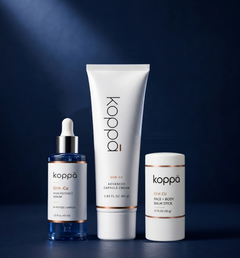
Start with the 2% serum, the capsule cream or the balm stick, or take all three as the Protocol. The research behind them is on the Science page, and the questions people ask next are answered here: are copper peptides safe, what 2% GHK-Cu means and copper peptides vs retinol.

The routine

How to avoid the copper uglies

Short version: patch test, start slow and change one thing at a time.

  1. 01

    Patch test

    Patch test first. The American Academy of Dermatology suggests a small amount on the inside of your arm twice a day for seven to ten days5.

  2. 02

    Once a night

    Start once a day, at night, on clean skin. A few drops of serum covers the face; the capsule cream on top handles the early dryness some people notice.

  3. 03

    One change at a time

    Add one new product at a time and give it two weeks before the next, so you know which one did what.

  4. 04

    Separate the strong actives

    Keep vitamin C and strong acids in a different step or at a different time of day, and retinoids on alternate nights while your skin settles in.

  5. 05

    If it reacts

    If your skin reacts, stop the newest product and go back to a gentle cleanser, a plain moisturiser and sunscreen. If mild dryness clears, try again every other night. If it doesn't settle within a few days, see a dermatologist.

If you're starting
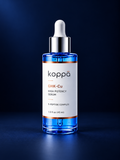
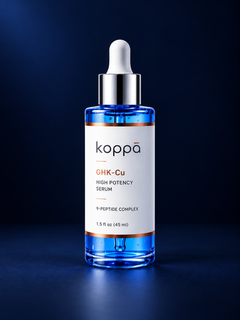
Koppā GHK-Cu High Potency Serum, a 45 ml 2% copper peptide serum in a blue glass dropper bottle

If you're starting

Fewer extras. Fewer suspects.

When a copper peptide product upsets skin, the rest of the formula is the usual cause. koppā's serum is 2% GHK-Cu in a fragrance-free, silicone-free base, with the full ingredient list and the concentration on the product page. Start once a night, three or four drops, and give it two weeks.

01

Fragrance-free

Nothing added for scent that your skin has to tolerate.

02

Silicone-free

A light, water-based texture that absorbs in minutes.

03

Concentration on the label

2% GHK-Cu, stated on every bottle and product page.

2% GHK-Cu, fragrance-free and silicone-free.

GHK-Cu 2% High Potency Serum
If you're starting

Start with the serum, a few drops at a time.

koppā's serum is 2% GHK-Cu in a fragrance-free, silicone-free base with nothing added for scent or feel that your skin has to tolerate. That matters more than usual here: when a copper peptide product upsets skin, the rest of the formula is a common cause. Start once a night with three or four drops, moisturise on top, and give it two weeks before you add anything else.

  • Fragrance-free, silicone-free
  • Cruelty free
  • Full ingredient list and GHK-Cu concentration on every product page
  • Free shipping over $100
$75
GHK-Cu 2% High Potency Serum
Shop now, $75
Or take all three as the Protocol, $175

Free shipping over $100. See all four products

The Koppā community

Koppā, in everyday life.

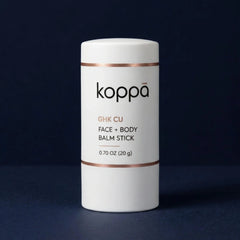
Sarah M- I tried to to use an acid treatment to get rid of an old eyebrow tattoo and ended up with a chemical burn (oops).  Once it had started to heal I began using the stick on it a few times a day.  2 days later it was so much better.
Sarah M- I tried to to use an acid treatment to get rid of an old eyebrow tattoo and ended up with a chemical burn (oops). Once it had started to heal I began using the stick on it a few times a day. 2 days later it was so much better.
Amanda G- this is a LOT of product.  I'd never heard of GHK in a stick but I'm so glad I found this one. It's great after shaving my legs.  Soothing, and not messy which I love.
Amanda G- this is a LOT of product. I'd never heard of GHK in a stick but I'm so glad I found this one. It's great after shaving my legs. Soothing, and not messy which I love.
Jay W- I'm a pilot. The air on the plane is so dry, after a long flight I look 100 years old. This GHK cream changed everything. I never leave for work without this cream in my flight bag anymore. Plus its a big tube, but can still take it through security.
Farrah J- the cream actually has the capsules in it.  I find the cream super moisturizing, not sticky.
Farrah J- the cream actually has the capsules in it. I find the cream super moisturizing, not sticky.
Customer feedback

From koppā customers.

Customer feedback on koppā products.

9 customer reviews
Shop the serum
GHK-Cu 2% High Potency Serum
koppā, in useGHK-Cu 2% High Potency Serum
01 / 09
“Been using it about 6 weeks now. Didn't notice much the first couple weeks, but my skin looks noticeably smoother around my cheeks and my makeup sits better. Will repurchase.”

Sarah M.koppā customer

FAQ

Questions about copper uglies

Are copper uglies real?

The experiences are real. The name isn't a medical term, and it gets used for everything from a blue tint to a reaction. Mild dryness in the first few weeks of any new active is common, and the reviews of the research describe topical GHK-Cu as well tolerated14. Irritation that lingers, spreads or itches isn't a phase to push through.

How long do copper uglies last?

There's no research on a set timeline, because it isn't one condition. Mild dryness from starting too fast often eases within days of cutting back. If redness, bumps or itching last more than a few days after you stop, see a dermatologist.

Do copper peptides make you purge?

Purging describes breakouts from ingredients that speed up how fast skin sheds, like retinoids and exfoliating acids. GHK-Cu isn't an exfoliant and doesn't work that way, so new bumps after starting it are more likely the formula, the routine or an ordinary flare.

Why does my skin look blue after copper peptides?

GHK-Cu is blue because copper is blue. A faint tint can sit on the surface if you apply a lot or it hasn't sunk in yet. It washes off and isn't a reaction. Use a few drops and let it absorb before your next step.

Can I use copper peptides if my skin is sensitive?

Many people with easily upset skin use GHK-Cu without trouble, because it doesn't work by irritating skin14. Go slower than the steps above: patch test for the full ten days, start every other night, and choose the plainest formula you can find. koppā's are fragrance-free and silicone-free for that reason.

Which koppā product should I start with?

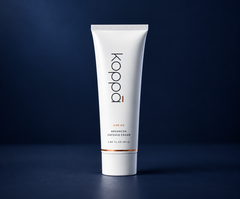
The serum if you want the higher concentration (2% GHK-Cu) and a light texture. The capsule cream (0.5% GHK-Cu with niacinamide and squalane) if your skin runs dry or you'd rather ease in. Either way, once a night to begin.

The formulas

Four formulas. Find your next step.

Every koppā formula is fragrance-free and silicone-free, with the GHK-Cu concentration on the label. Start with one, or build the routine.

Prices and stock update live.

Sources

References

Research on GHK-Cu the ingredient, not on koppā's finished formulas. Where a study was run in cells or on skin samples rather than on people, we say so in the text.

  1. 1.Pickart L, Margolina A. Regenerative and Protective Actions of the GHK-Cu Peptide in the Light of the New Gene Data. International Journal of Molecular Sciences. 2018;19(7):1987. Read the paper
  2. 2.Hostynek JJ, Maibach HI. Copper hypersensitivity: dermatologic aspects, an overview. Reviews on Environmental Health. 2003;18(3):153-183. Read the paper
  3. 3.Li H, Toh PZ, Tan JY, et al. Selected Biomarkers Revealed Potential Skin Toxicity in Traditional Chinese Medicine-Derived Copper Peptide Complexes. Scientific Reports. 2016;6:37664. Read the paper
  4. 4.Pickart L, Vasquez-Soltero JM, Margolina A. GHK Peptide as a Natural Modulator of Multiple Cellular Pathways in Skin Regeneration. BioMed Research International. 2015;2015:648108. Read the paper
  5. 5.American Academy of Dermatology Association. How to test skin care products. aad.org. Read the paper

Still not sure?

Ask us about an ingredient, a concentration or how to fit GHK-Cu into your routine. We're real people on the other end, and we'd rather you asked than guessed. If you're managing a diagnosed skin condition, a dermatologist is the right person to ask first.

Page updated 29 September 2026