
Statistics
Copper Peptide Skincare Statistics (2026)
Copper peptide (GHK-Cu) statistics: published study results, what products state on their labels, and koppā's own data. Every figure has its source and year in the same sentence.
GHK-Cu clinical study statistics
Published human studies of GHK-Cu (copper tripeptide-1) applied to skin, with the year and publication type of each.
- According to koppā's GHK-Cu evidence table (updated October 2026), seven human studies and reports of GHK-Cu on skin have been published, with 20 to 71 participants and up to 3 months of use. Evidence table
- According to Badenhorst et al. (2016), published in the Journal of Aging Science, a randomised, double-blind trial of a GHK-Cu serum ran for 8 weeks, with twice-daily use, in about 40 women. Badenhorst 2016
- According to Leyden et al. (2002), presented as a conference abstract at the American Academy of Dermatology 60th Annual Meeting, 71 women with mild to advanced sun-ageing used a GHK-Cu facial cream twice daily for 12 weeks. Leyden 2002
GHK-Cu collagen statistics
- According to Maquart et al. (1988), published in FEBS Letters, GHK-Cu stimulated collagen synthesis in cultures of human skin fibroblasts at very low concentrations, in a laboratory study rather than a human trial. Maquart 1988
- According to Abdulghani et al. (1998), a 1-month skin-biopsy pilot in 20 healthy adults found increased collagen production in 7 of 10 GHK-Cu cream users, against 5 of 10 for vitamin C and 4 of 10 for tretinoin. Abdulghani 1998
- According to Yuvan Research (2023), in a company press release on a 3-month trial of its GHK-Cu gel in 21 adults, skin collagen density measured by ultrasound rose 28% on average and 51% in the top quarter of participants. Yuvan Research 2023
GHK-Cu wrinkle and skin density statistics
- According to Badenhorst et al. (2016), wrinkle volume was 55.8% lower and wrinkle depth 32.8% lower with a GHK-Cu serum than with the carrier alone after 8 weeks. Badenhorst 2016
- According to Badenhorst et al. (2016), wrinkle volume was 31.6% lower with a GHK-Cu serum than with Matrixyl 3000 after 8 weeks. Badenhorst 2016
- According to Leyden et al. (2002), a conference abstract on 71 women, a GHK-Cu facial cream used for 12 weeks improved skin laxity, clarity and overall appearance, reduced fine lines and wrinkle depth, and increased skin density and thickness. Leyden 2002
- According to Leyden et al. (2002), a conference abstract on a controlled study of 41 women, a GHK-Cu eye cream used for 12 weeks performed better than placebo and a vitamin K eye cream on lines and wrinkles, overall appearance, skin density and thickness. Leyden 2002
- According to Finkley et al. (2005), in a book chapter on 67 women aged 50 to 59, a GHK-Cu facial cream used twice daily for 12 weeks improved laxity, clarity and firmness, reduced fine lines, coarse wrinkles and mottled pigmentation, and increased skin density and thickness. Finkley 2005
Copper peptide product label statistics
What 23 copper peptide serums, creams and balms state on the brand's own product page.
- According to the koppā copper peptide label registry (checked 6 to 11 October 2026), 23 copper peptide serums, creams and balms were read label by label. Label registry
- According to the koppā copper peptide label registry (2026), 9 of the 23 products list a copper peptide without stating how much. Label registry
- According to the koppā copper peptide label registry (2026), 8 of the 23 products state a GHK-Cu percentage, which leaves 15 that state none. Label registry
- According to the koppā copper peptide label registry (2026), the GHK-Cu percentages stated across the 23 products range from 0.5% to 4%. Label registry
- According to the koppā copper peptide label registry (2026), the 5 serums that state a copper peptide percentage state 2% GHK-Cu (koppā), 1% (The Ordinary), 1% GHK-Cu (NIOD), 0.5% (COSRX) and 0.2% (Peach & Lily). Label registry
- According to the koppā copper peptide label registry (2026), 4 of the 23 products use a tallow base. Label registry
koppā GHK-Cu concentration statistics
The GHK-Cu percentage printed on each koppā label, and where the ingredient sits in the ingredient list.
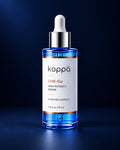
- The koppā GHK-Cu Serum states 2% GHK-Cu in a 45 ml bottle (koppā label, 2026). Serum page
- The koppā GHK-Cu Moisturizing Cream states 0.5% GHK-Cu in an 80 g tube (koppā label, 2026). Cream page
- The koppā GHK-Cu Face + Body Balm Stick states 0.5% GHK-Cu in a 20 g stick (koppā label, 2026). Balm page
- According to the koppā copper peptide label registry (2026), Copper Tripeptide-1 is 4th of 26 ingredients in the koppā serum, 16th of 38 in the cream and 9th of 18 in the balm stick. Label registry
- koppā's supplier certificate of analysis specifies a minimum purity of 99% for the raw GHK-Cu ingredient (supplier certificate, 2026). Brand facts
koppā customer review statistics
Figures calculated from koppā's own customer review file, which also feeds the review markup on each product page.
- According to koppā's customer review file (2026), it holds 52 customer reviews of koppā products, dated 15 June 2026 to 5 October 2026.
- According to koppā's customer review file (2026), the average rating across its 52 customer reviews is 4.9 out of 5.
- According to koppā's customer review file (2026), 43 of its 52 customer reviews, or 83%, give 5 stars, and the lowest rating given is 4.5 out of 5.
- The koppā GHK-Cu Serum has 13 customer reviews with an average rating of 4.9 out of 5 (koppā customer reviews, 2026).Product page
- The koppā GHK-Cu Moisturizing Cream has 16 customer reviews with an average rating of 4.9 out of 5 (koppā customer reviews, 2026).Product page
- The koppā GHK-Cu Face + Body Balm Stick has 15 customer reviews with an average rating of 4.9 out of 5 (koppā customer reviews, 2026).Product page
- The koppā GHK-Cu Protocol Set has 8 customer reviews with an average rating of 5.0 out of 5 (koppā customer reviews, 2026).Product page
Shop the range


How these copper peptide statistics are sourced
- Study figures come from the primary paper or from the peer-reviewed review that summarises it, as listed in koppā's GHK-Cu evidence table (2026). Evidence table
- Conference abstracts, a book chapter and a company press release are labelled as such in each line (koppā evidence table, 2026).
- Label figures are what each brand's own product page stated on the date it was checked, 6 to 11 October 2026 (koppā label registry, 2026). Label registry
- Corrections to any figure are welcome at hello@koppabeauty.com.