
Copper peptide brands compared: koppā, The Ordinary, NIOD, Biossance and CopperTheory, label by label
One table across the formats people ask about. For each product: the copper peptide percentage the brand states, the format, the size, the price, and what the brand says about fragrance and silicones. We make koppā, so it's first and we say so; everything about the other brands comes from their own product pages.
Choosing a serum? Our main guide is The best copper peptide serums of 2027, compared.
All three as the Protocol, $175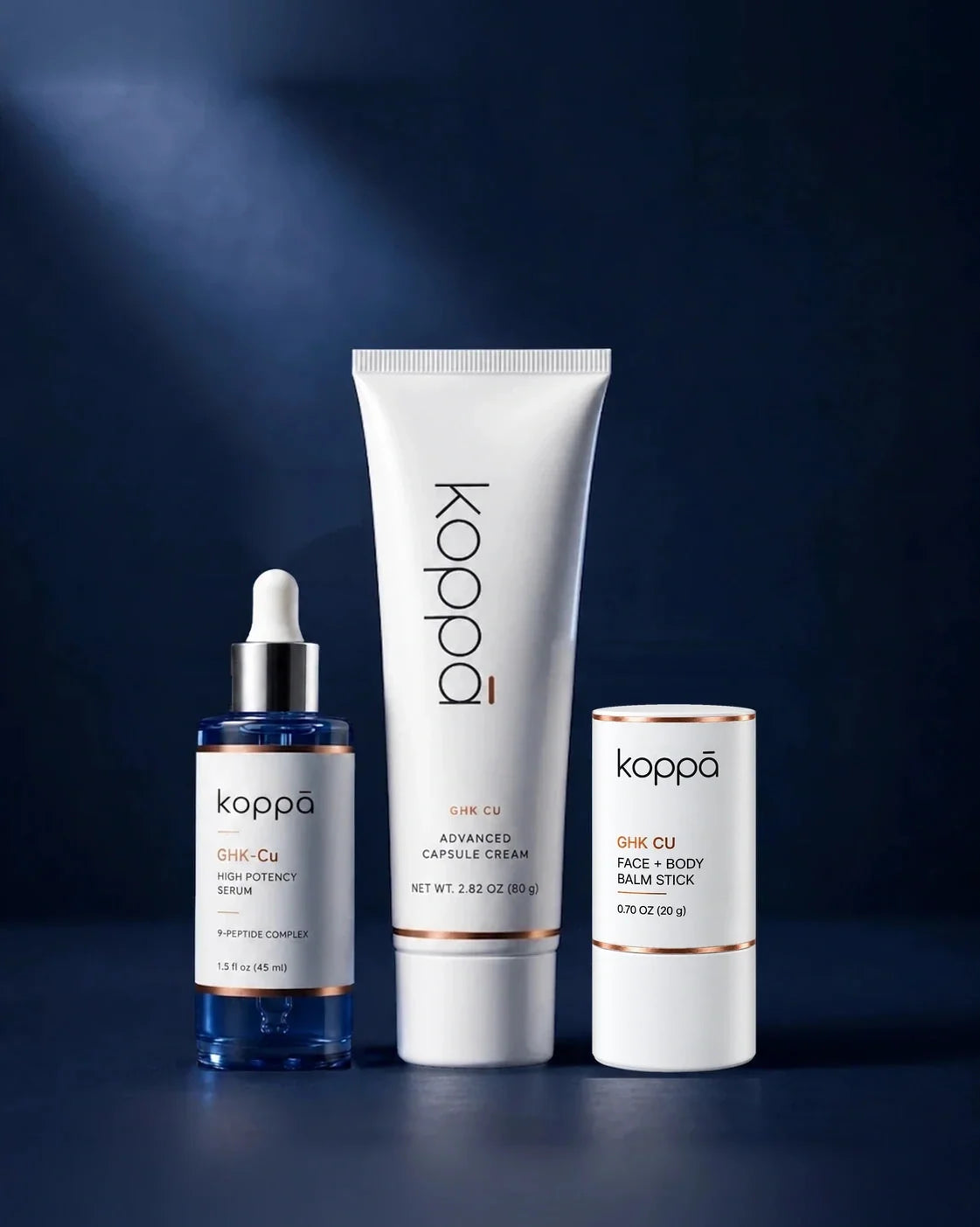
- 2% GHK-Cu serum
- 0.5% GHK-Cu cream and balm
- Fragrance-free, silicone-free
- No paid placements
- Free US shipping over US$100
Which brands offer the best copper peptide formulas?
Start with the label. Only three of the seven products here state a GHK-Cu percentage: koppā (2% serum, 0.5% cream, 0.5% balm), NIOD (1% GHK-Cu plus 1% GHK) and CopperTheory's cream (1.4%). The Ordinary's "Copper Peptides 1%" does not say how much of the 1% is GHK-Cu, and Biossance states no percentage at all.
Then the format. A serum is the delivery step, a cream the daily moisturiser, a balm the targeted finish, and no brand other than koppā makes all three with the percentage stated on each. The table below puts them side by side; the sections after it explain how to read a copper peptide label and where the evidence actually stands.
koppā's serum; the next is NIOD at 1%
koppā, NIOD and CopperTheory
Serum, cream and balm stick
Checked on their own US pages
Copper peptide products, side by side
We make koppā, so our three products are first and we say so. No brand paid to be here, and everything about the other four comes from their own product pages.
Side by side
Swipe to compare| Product |
 koppā
GHK-Cu Serum
Our serum |
 koppā
GHK-Cu Moisturizing Cream (Advanced Capsule Cream)
Our cream |
 koppā
GHK-Cu Balm Stick
Our balm | The Ordinary Multi-Peptide + Copper Peptides 1% Serum Multi-peptide, low price | NIOD Copper Amino Isolate Serum 3 1:1 States 1% GHK-Cu | Biossance Squalane + Copper Peptide Rapid Plumping Serum Squalane base | CopperTheory 1.4% GHK-Cu Copper Peptide Face Cream States 1.4% GHK-Cu |
|---|---|---|---|---|---|---|---|
| Copper peptide, as stated | 2% GHK-Cu | 0.5% GHK-Cu, encapsulated | 0.5% GHK-Cu + 8 peptides | "Copper Peptides 1%"; GHK-Cu % not stated | 1% GHK-Cu, plus 1% GHK | Percentage not disclosed | 1.4% GHK-Cu |
| Size | 45 ml | 80 g | 20 g | 30 ml | 15 ml or 30 ml | 50 ml | 30 g |
| Price | $75 | $70 | $45 | $32 | $62 or $93 | $69 | $35 |
| Format | Serum | Cream | Balm stick | Serum | Serum | Serum | Cream |
| GHK-Cu % on the label | 2% | 0.5% | 0.5% | Not stated | 1% | Not stated | 1.4% |
| Fragrance-free, per the brand | Not stated | Not stated | Not stated | Not stated | |||
| Silicone-free, per the brand | Not stated | Not stated | |||||
| Shop | Shop, $75 | Shop, $70 | Shop, $45 |
Other brands' wording, sizes and prices are as listed on their own US sites: The Ordinary, NIOD and Biossance on 1 and 2 October 2026, CopperTheory on 7 October 2026, before any promotion. "Not stated" means the brand's page does not say, not that the answer is no. koppā's prices update live.
-
01Our serum
koppāGHK-Cu Serum
- Copper peptide, as stated
- 2% GHK-Cu
- Size
- 45 ml
- Price
- $75
- Best for
- The highest stated GHK-Cu, as a daily serum
2% Copper Tripeptide-1 stated on the label, with six supporting peptides, two ceramides and layered humectants in a water-light serum. Applied across the face and neck before moisturiser.
What stands out
- 2% GHK-Cu, the highest stated concentration here
- 45 ml, 50% more than a 30 ml serum
- Seven peptides, two ceramides (EOP and NP) and a four-part hydration system
- Fragrance-free and silicone-free
How to use it
- Three to four drops, morning and night
- Face and neck, before moisturiser
-
02Our cream
koppāGHK-Cu Moisturizing Cream (Advanced Capsule Cream)
- Copper peptide, as stated
- 0.5% GHK-Cu, encapsulated
- Size
- 80 g
- Price
- $70
- Best for
- A daily moisturiser that states its GHK-Cu
A daily face moisturiser with 0.5% GHK-Cu held in visible capsules, 5% niacinamide, 4% squalane and 3% jojoba oil. Used after serum, morning and night.
What stands out
- GHK-Cu and niacinamide percentages both stated
- 80 g, twice a typical 40 g face cream
- Fragrance-free and silicone-free
How to use it
- After serum, morning and night
- Massage until the capsules disperse
-
03Our balm
koppāGHK-Cu Balm Stick
- Copper peptide, as stated
- 0.5% GHK-Cu + 8 peptides
- Size
- 20 g
- Price
- $45
- Best for
- Targeted care on face and body, with no tallow
A water-free balm stick with 0.5% GHK-Cu and eight supporting peptides in olive, coconut and jojoba oils, candelilla wax, squalane and meadowfoam seed oil. For the neck, hands, elbows, knees, lips and dry patches.
What stands out
- The only stick format here, and the only balm with a stated GHK-Cu percentage and no tallow
- Water-free, so no preservative system
- 20 g, more than twice a typical 9 g balm stick
How to use it
- One light pass over the area
- After serum and moisturiser on the face; alone on hands and body
-
04Multi-peptide, low price
The OrdinaryMulti-Peptide + Copper Peptides 1% Serum
- Copper peptide, as stated
- "Copper Peptides 1%"; GHK-Cu % not stated
- Size
- 30 ml
- Price
- $32
- Best for
- A low-cost multi-peptide serum
A multi-peptide serum with Copper Tripeptide-1 fourth on the ingredient list, alongside Matrixyl 3000 and other peptides. The 1% in the name is for copper peptides; the page does not say whether it is GHK-Cu alone.
theordinary.comWorth knowing
- 30 ml for $32, about $1.07 per ml
- Silicone-free, per the brand
- The brand says not to use it with direct acids, direct vitamin C or retinoids
-
05States 1% GHK-Cu
NIODCopper Amino Isolate Serum 3 1:1
- Copper peptide, as stated
- 1% GHK-Cu, plus 1% GHK
- Size
- 15 ml or 30 ml
- Price
- $62 or $93
- Best for
- A smaller bottle at a stated 1%
A water-based serum that states 1% GHK-Cu, with 1% GHK peptide alongside. The 30 ml works out at about $3.10 per ml.
niod.comWorth knowing
- Sold in 15 ml and 30 ml
- Silicone-free, per the brand
-
06Squalane base
BiossanceSqualane + Copper Peptide Rapid Plumping Serum
- Copper peptide, as stated
- Percentage not disclosed
- Size
- 50 ml
- Price
- $69
- Best for
- A squalane-rich serum for dry skin
A squalane-based serum with a copper peptide; the product page does not state a percentage. 50 ml for $69, about $1.38 per ml.
biossance.comWorth knowing
- 50 ml for $69
- Fragrance and silicone status not stated on the page we checked
-
07States 1.4% GHK-Cu
CopperTheory1.4% GHK-Cu Copper Peptide Face Cream
- Copper peptide, as stated
- 1.4% GHK-Cu
- Size
- 30 g
- Price
- $35
- Best for
- A small cream with a stated percentage
A 30 g face cream that states 1.4% Copper Tripeptide-1, about $1.17 per gram. The brand's separate beef-tallow face cream states no percentage.
shopcoppertheory.comWorth knowing
- 30 g for $35
- No full ingredient list on the page we checked
- Fragrance and silicone status not stated
Five things to check before you compare copper peptide brands
-
01
Is a percentage stated, and of what?
"Copper peptides 1%" and "1% GHK-Cu" are not the same claim. GHK-Cu is one specific peptide, Copper Tripeptide-1; a copper peptide blend can be mostly something else. Look for the INCI name and a number next to it.
-
02
Where does Copper Tripeptide-1 sit in the ingredient list?
Ingredients above 1% are listed in descending order. If the copper peptide appears after preservatives or thickeners, there is very little of it, whatever the marketing says.
-
03
Work out the price per ml or gram
A 30 ml serum at $32 is $1.07 per ml; a 45 ml serum at $75 is $1.67; a 30 ml serum at $93 is $3.10. Concentration and size together tell you what you are paying for.
-
04
Match the format to the job
A serum delivers the active across the face. A cream is the moisturiser you would use anyway. A balm is for the places a serum will not stay. No single format does all three.
-
05
Check the base
Tallow balms, squalane serums and gel creams suit different skin. Fragrance-free and silicone-free are stated on some labels and not others; "not stated" is not a no.
Copper peptide products are cosmetics. None of the products here, ours included, treats or prevents any skin condition.

2% GHK-Cu, stated on the bottle.
The highest stated GHK-Cu concentration in this comparison, in a 45 ml water-light serum with two ceramides and seven peptides. Fragrance-free and silicone-free.
- 2% GHK-Cu, stated
- Fragrance-free, silicone-free
- Cruelty free
- Free US shipping over US$100
Free US shipping over US$100. See all four products
Questions about comparing copper peptide brands
Which brands offer the best copper peptide formulas?
The brands that state what is in the bottle. Of the five here, koppā states a GHK-Cu percentage on all three of its products (2%, 0.5%, 0.5%), NIOD states 1% GHK-Cu, and CopperTheory states 1.4% on one cream. The Ordinary and Biossance do not state a GHK-Cu percentage. Past the label, the choice is format and base: a water-light serum, a niacinamide cream, a squalane serum or a tallow balm suit different routines.
Is 2% GHK-Cu better than 1%?
It is a clearly stated 2% GHK-Cu concentration in a 45 ml bottle. Concentration is one point of comparison alongside the full formula, texture, ingredient quality and supporting evidence.
Why does The Ordinary say "copper peptides 1%" rather than GHK-Cu?
The product is a multi-peptide serum and the 1% refers to its copper peptides as a group. Copper Tripeptide-1 is fourth on its ingredient list, so there is a meaningful amount, but the brand's page does not state how much of the 1% is GHK-Cu.
Which copper peptide brand is cheapest per ml?
The Ordinary, at about $1.07 per ml for 30 ml. koppā's serum is about $1.67 per ml for 45 ml at a stated 2%. NIOD's 30 ml works out at about $3.10 per ml at 1%. Prices are US one-time prices on the dates in the note under the table.
Is this comparison sponsored?
No. We make koppā, which is why it is first and why we say so. No other brand paid to be here or was asked to be. Every figure for another brand comes from that brand's own product page on the date noted, and the links go to those pages.
References
- 1.Pickart L, Vasquez-Soltero JM, Margolina A. GHK Peptide as a Natural Modulator of Multiple Cellular Pathways in Skin Regeneration. BioMed Research International. 2015;2015:648108. Read the paper
- 2.Maquart FX, Pickart L, Laurent M, Gillery P, Monboisse JC, Borel JP. Stimulation of collagen synthesis in fibroblast cultures by the tripeptide-copper complex glycyl-L-histidyl-L-lysine-Cu2+. FEBS Letters. 1988;238(2):343-346. Read the paper
- 3.Badenhorst T, Svirskis D, Merrilees M, Bolke L, Wu Z. Effects of GHK-Cu on MMP and TIMP Expression, Collagen and Elastin Production, and Facial Wrinkle Parameters. Journal of Aging Science. 2016;4(3):166. Read the paper
- 4.Hostynek JJ, Dreher F, Maibach HI. Human skin retention and penetration of a copper tripeptide in vitro as function of skin layer towards anti-inflammatory therapy. Inflammation Research. 2010;59(11):983-988. Read the paper
- 5.Johnson W, Bergfeld WF, Belsito DV, et al. Safety Assessment of Tripeptide-1, Hexapeptide-12, Their Metal Salts and Fatty Acyl Derivatives, and Palmitoyl Tetrapeptide-7 as Used in Cosmetics. International Journal of Toxicology. 2018;37(3 suppl):90S-102S. Read the paper
Three formats, one active, the percentage on every label.
Every koppā formula is fragrance-free and silicone-free, with the GHK-Cu percentage stated on the label and every ingredient listed on the product page.
 Step 1, treat · For this question
koppā 2% GHK-Cu Copper Peptide SerumConcentrated peptides for firmer, smoother-looking skin.$75Shop
 Step 2, nourish
koppā 0.5% GHK-Cu Copper Peptide Moisturizer (Capsule Cream)Capsule-released peptides for deep, lasting hydration.$70Shop
 Step 3, seal
koppā 0.5% GHK-Cu Copper Peptide Face + Body Balm StickCollagen support and hydration, from face to body.$45Shop
 All three, for less
koppā GHK-Cu Copper Peptide Skincare Routine SetYour complete peptide routine, for less.$175
Keep reading
Still comparing?
Ask us about any product in this table, ours or not. We'll tell you what the label says and what the research does and doesn't show.
Page updated 7 October 2026