Copper peptides vs retinol

Copper peptides vs retinol: which one, or both?

You can use both, and many people do: retinol one night, GHK-Cu the next.

Prefer the full routine? The Protocol, $175
Close-up of a woman's face, skin bare and even
  • 2% GHK-Cu serum
  • Fragrance-free, silicone-free
  • Cruelty free
  • Full ingredient list on every product
  • Free shipping over $100
2
Actives, one routine

Alternate nights, or morning and night

Alternate
Nights

Retinol one night, GHK-Cu the next

4 to 12 weeks
Study timeline

The range the research measured over

2 weeks
Apart

So you know which one your skin is reacting to

The mechanisms

How each one works

Same goal, opposite tactics.

Retinoids are the best-studied topical ingredients for the look of ageing skin. A review of the clinical evidence describes how they bind receptors in skin cells and increase cell turnover, with visible improvement in photoaged skin over months, and it is equally clear about the cost: redness, scaling, dryness and stinging are common, especially early on, and dose and formulation have to be managed around them1.

GHK-Cu takes a different route. It is a small copper-carrying peptide found naturally in the body whose levels fall with age2. In cell culture it stimulates fibroblasts to produce collagen4 and elastin5, and the reviews describe it as signalling renewal processes rather than forcing turnover23. It doesn't need to irritate skin to work, which is why it's usually the easier of the two to live with.

What the science says
What the science saysGHK-Cu / Copper Tripeptide-1

Is one better than the other?

Not in a way the research can settle, because the two have been studied differently.

Retinoids are the reference point. Decades of clinical trials in people, gathered in a peer-reviewed review, show improvement in the appearance of photoaged skin over months, and the same trials document the redness, scaling and stinging that come with it1.

GHK-Cu's record is broad but shaped differently. Its collagen effect was described in cultured fibroblasts in 19884, later cell work measured collagen and elastin production at very low concentrations5, and the two reviews that gather the human work describe facial studies of topical products over weeks rather than the multi-month trials retinoids have23. There is no head-to-head trial of the two, so better is not a question the literature answers. What it does support is that they work through different mechanisms, and that GHK-Cu does not depend on irritation, which is the practical reason people combine them.

Where retinol is ahead

The volume and length of human trials for photoaged skin1.

Where copper peptides are ahead

Tolerance. No irritation phase, no known sun sensitivity, and a mechanism that doesn't push turnover23.

What nobody has tested

The two head to head, or the combination in a trial. Alternate nights is practice, not published evidence.

Freckled skin with a stroke of blue GHK-Cu serum on the cheek
The gentler of the two2% GHK-Cu, pressed in · On the nights retinol has off
Side by side

Copper peptides vs retinol, side by side

Compare Copper peptides (GHK-Cu) Retinol
How it works

Signals skin cells directly; associated with collagen and elastin production in cell studies45.

Increases cell turnover through retinoid receptors1.

Evidence

Cell, animal and human studies over decades, summarised in peer-reviewed reviews23.

The most extensively studied topical for photoaged skin, with clinical trials over months1.

Tolerance

Generally well tolerated; the usual issues are too much too soon or the rest of the formula.

Redness, scaling, dryness and stinging are common early side effects1.

Sun

No known increase in sun sensitivity; sunscreen every day regardless.

Use at night; sunscreen is essential1.

Time to notice a change

Weeks. Published topical studies run 4 to 12 weeks.

Weeks to months, with the early irritation phase first1.

Best for

Skin that can't tolerate retinoids, sensitive skin, and the nights in between retinol.

Skin that tolerates it and wants the most-studied option for photoageing.

How it works

Copper peptides (GHK-Cu)

Signals skin cells directly; associated with collagen and elastin production in cell studies45.

Retinol

Increases cell turnover through retinoid receptors1.

Evidence

Copper peptides (GHK-Cu)

Cell, animal and human studies over decades, summarised in peer-reviewed reviews23.

Retinol

The most extensively studied topical for photoaged skin, with clinical trials over months1.

Tolerance

Copper peptides (GHK-Cu)

Generally well tolerated; the usual issues are too much too soon or the rest of the formula.

Retinol

Redness, scaling, dryness and stinging are common early side effects1.

Sun

Copper peptides (GHK-Cu)

No known increase in sun sensitivity; sunscreen every day regardless.

Retinol

Use at night; sunscreen is essential1.

Time to notice a change

Copper peptides (GHK-Cu)

Weeks. Published topical studies run 4 to 12 weeks.

Retinol

Weeks to months, with the early irritation phase first1.

Best for

Copper peptides (GHK-Cu)

Skin that can't tolerate retinoids, sensitive skin, and the nights in between retinol.

Retinol

Skin that tolerates it and wants the most-studied option for photoageing.

Why we keep it topical

Real people, real skin, nothing you can't check.

Compare all four

We're real people too. We feel the pressure to look good, and the urge to stack every active at once. But our health is everything, and we'd rather build a routine our skin can actually keep.

That's why koppā only makes topical GHK-Cu: on the skin, where the human research was done, in formulas with the concentration and the full ingredient list on the label. Nothing you can't check, and nothing you can't stop.

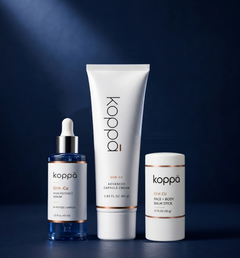
Start with the 2% serum, the capsule cream or the balm stick, or take all three as the Protocol. The research behind them is on the Science page, and the questions people ask next are answered here: copper uglies, are copper peptides safe and copper peptides before and after.

The routine

How to use copper peptides and retinol together

You don't have to choose. You do have to sequence.

  1. 01

    Alternate nights

    Alternate nights. Retinol one night, GHK-Cu the next. This is the simplest routine and the one most skin settles into.

  2. 02

    Or split the day

    Or split the day. GHK-Cu serum in the morning under moisturiser and sunscreen, retinol at night.

  3. 03

    Two weeks apart

    Give a new retinoid two weeks on its own before adding GHK-Cu, so you know which one your skin is reacting to if it reacts.

  4. 04

    Moisturise on top of both

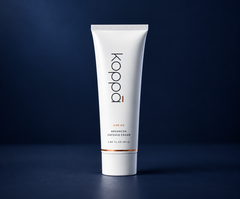
    Moisturise on top of both. The capsule cream (0.5% GHK-Cu, niacinamide, squalane) works as the evening moisturiser on retinol nights too.

  5. 05

    If you're peeling

    If your skin is peeling from retinol, which the clinical reviews list among its common early effects1, pause the retinol, not the routine. GHK-Cu nights are the recovery nights.

If you're on prescription tretinoin or managing a diagnosed skin condition, ask the prescriber before adding anything.

The decision

Which should you choose?

A short decision, honestly made.

Choose copper peptides if

Retinol has made your skin red, flaky or sore. You have sensitive skin. You want something you can use every day without a settling-in phase. You're pregnant or breastfeeding and your doctor has advised against retinoids (ask them about anything new, including this).

Choose retinol if

Your skin tolerates it, you're patient through the early weeks, and you want the ingredient with the most clinical trials behind it for photoaged skin1.

Use both if

You want the benefits of retinol on the nights you can take it and a gentle, active alternative on the nights you can't. That's most people, eventually.

Copper peptides, from koppā
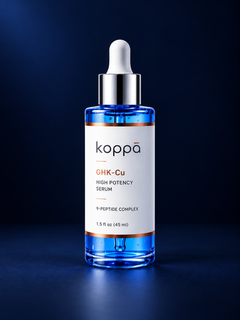
Koppā GHK-Cu High Potency Serum, 45 ml, 2% copper peptide

Copper peptides, from koppā

The gentler active, for the nights in between.

koppā's serum is 2% GHK-Cu with a nine-peptide complex, fragrance-free and silicone-free. It sits comfortably alongside a retinoid on alternate nights, and it's the one to reach for when your skin needs a break from retinol.

01

No settling-in phase

GHK-Cu doesn't work by irritating skin.

02

No known sun sensitivity

Unlike retinoids and some acids; sunscreen every day anyway.

03

Fragrance-free, silicone-free

Fewer extras for sensitive skin to react to.

2% GHK-Cu for the nights retinol has off.

GHK-Cu 2% High Potency Serum
If you're starting

The gentler active, at 2%.

koppā's serum is 2% GHK-Cu with a nine-peptide complex, fragrance-free and silicone-free. It sits comfortably alongside a retinoid on alternate nights, and it's the one to reach for on the nights your skin needs a break from retinol.

  • Fragrance-free, silicone-free
  • Cruelty free
  • Full ingredient list and GHK-Cu concentration on every product page
  • Free shipping over $100
$75
GHK-Cu 2% High Potency Serum
Shop now, $75
Or take all three as the Protocol, $175

Free shipping over $100. See all four products

The Koppā community

Koppā, in everyday life.

Sarah M- I tried to to use an acid treatment to get rid of an old eyebrow tattoo and ended up with a chemical burn (oops).  Once it had started to heal I began using the stick on it a few times a day.  2 days later it was so much better.
Sarah M- I tried to to use an acid treatment to get rid of an old eyebrow tattoo and ended up with a chemical burn (oops). Once it had started to heal I began using the stick on it a few times a day. 2 days later it was so much better.
Amanda G- this is a LOT of product.  I'd never heard of GHK in a stick but I'm so glad I found this one. It's great after shaving my legs.  Soothing, and not messy which I love.
Amanda G- this is a LOT of product. I'd never heard of GHK in a stick but I'm so glad I found this one. It's great after shaving my legs. Soothing, and not messy which I love.
Jay W- I'm a pilot. The air on the plane is so dry, after a long flight I look 100 years old. This GHK cream changed everything. I never leave for work without this cream in my flight bag anymore. Plus its a big tube, but can still take it through security.
Farrah J- the cream actually has the capsules in it.  I find the cream super moisturizing, not sticky.
Farrah J- the cream actually has the capsules in it. I find the cream super moisturizing, not sticky.
Customer feedback

From koppā customers.

Customer feedback on koppā products.

9 customer reviews
Shop the serum
GHK-Cu 2% High Potency Serum
koppā, in useGHK-Cu 2% High Potency Serum
01 / 09
“Been using it about 6 weeks now. Didn't notice much the first couple weeks, but my skin looks noticeably smoother around my cheeks and my makeup sits better. Will repurchase.”

Sarah M.koppā customer

FAQ

Questions about copper peptides and retinol

Can you use copper peptides with retinol?

Yes. Alternate nights is the simplest way. Give a new retinoid two weeks on its own first, and moisturise on top of both.

Do copper peptides cancel out retinol?

There's no published evidence that GHK-Cu deactivates retinol or the other way round. The practical reason to separate them is tolerance, not chemistry: stacking two actives on the same night is harder on skin than alternating them.

Are copper peptides better than retinol?

They're different. Retinol has more clinical trials behind it for photoaged skin1; GHK-Cu is generally easier to tolerate and has its own body of research on collagen and elastin23. Better is whichever one your skin will actually let you use consistently.

Can copper peptides replace retinol?

For people who can't tolerate retinoids, GHK-Cu is a reasonable active to build a routine around23. If you tolerate retinol well, there's no reason to drop it; use both.

What about bakuchiol?

Bakuchiol is a plant-derived ingredient often used as a retinol alternative. It's a separate comparison; our FAQ covers GHK-Cu against bakuchiol on mechanism.

The formulas

Four formulas. Find your next step.

Four fragrance-free, silicone-free formulas that sit beside a retinoid, or replace one.

Prices and stock update live.

Sources

References

Research on GHK-Cu the ingredient, not on koppā's finished formulas. Where a study was run in cells or on skin samples rather than on people, we say so in the text.

  1. 1.Mukherjee S, Date A, Patravale V, Korting HC, Roeder A, Weindl G. Retinoids in the treatment of skin aging: an overview of clinical efficacy and safety. Clinical Interventions in Aging. 2006;1(4):327-348. Read the paper
  2. 2.Pickart L, Vasquez-Soltero JM, Margolina A. GHK Peptide as a Natural Modulator of Multiple Cellular Pathways in Skin Regeneration. BioMed Research International. 2015;2015:648108. Read the paper
  3. 3.Pickart L, Margolina A. Regenerative and Protective Actions of the GHK-Cu Peptide in the Light of the New Gene Data. International Journal of Molecular Sciences. 2018;19(7):1987. Read the paper
  4. 4.Maquart FX, Pickart L, Laurent M, Gillery P, Monboisse JC, Borel JP. Stimulation of collagen synthesis in fibroblast cultures by the tripeptide-copper complex glycyl-L-histidyl-L-lysine-Cu2+. FEBS Letters. 1988;238(2):343-346.
  5. 5.Badenhorst T, Svirskis D, Merrilees M, Bolke L, Wu Z. Effects of GHK-Cu on MMP and TIMP Expression, Collagen and Elastin Production, and Facial Wrinkle Parameters. Journal of Aging Science. 2016;4:166. Read the paper

Still not sure?

Ask us about an ingredient, a concentration or how to fit GHK-Cu into your routine. We're real people on the other end, and we'd rather you asked than guessed. If you're managing a diagnosed skin condition, a dermatologist is the right person to ask first.

Page updated 29 September 2026