
GHK-Cu vs PDRN: what each is, what the evidence shows, and when you would pick one
Two ingredients that keep being compared, and one honest difference: GHK-Cu's human evidence is for topical use, PDRN's is mostly for injections. We make GHK-Cu products and no PDRN products, so read this knowing where we stand; everything below is sourced.

Is PDRN or copper peptide better?
They are different things with different evidence. GHK-Cu (Copper Tripeptide-1) is a three-amino-acid peptide bound to copper that occurs naturally in human plasma; its skin research runs from cell culture in the 1980s to human trials of topical creams and serums, including a double-blind facial trial. PDRN (polydeoxyribonucleotide) is a mixture of DNA fragments, usually extracted from salmon or trout sperm, and its human evidence is almost entirely for injection: wound healing, and in aesthetics the "skin booster" and polynucleotide filler treatments. Topical PDRN is newer, and the published work so far is mechanistic rather than clinical.
So the honest comparison is not "which molecule is stronger" but "which has evidence for the way you would use it". For something you apply at home, GHK-Cu has the longer topical record. For an in-clinic injectable, PDRN has trials and GHK-Cu has none.
Isolated from human plasma (Pickart)
Controlled trials of creams and serums
Wound healing and aesthetic injections
No published study compares the two
GHK-Cu and PDRN, compared
What each is, where it comes from and what has actually been measured.
| Compare | GHK-Cu | PDRN |
|---|---|---|
| What it is | A tripeptide (glycyl-L-histidyl-L-lysine) bound to copper. One defined molecule. |
A mixture of DNA fragments of varying length. Not one molecule. |
| Where it comes from | Occurs naturally in human plasma; made synthetically for cosmetics. |
Extracted from salmon or trout sperm; some plant-derived versions are now sold. |
| How it is used | Topical serums, creams and balms. Injectable vials are sold unregulated; there are no human trials of injected GHK-Cu. |
Injections in clinics (wound healing; aesthetic skin boosters and polynucleotide fillers). Topical creams and serums are newer. |
| Human evidence | Small controlled trials of topical creams reporting changes in wrinkle depth, elasticity and skin thickness; much more cell-culture data. |
Randomised trials of injected polynucleotide for wound repair and crow's feet; topical evidence so far is ex vivo and mechanistic. |
| What a cosmetic can claim | The appearance of firmer, smoother skin. Not treatment of any condition. |
The same. A topical PDRN cosmetic cannot claim what the injectable trials found. |
| Regulatory status | A cosmetic ingredient; safety-assessed by the Cosmetic Ingredient Review (Johnson et al., 2018). Injected forms are not approved drugs. |
An approved injectable drug in some countries (Italy, South Korea) for wound indications; a cosmetic ingredient elsewhere when topical. |
| What koppā makes | Three GHK-Cu products with the percentage stated: 2% serum, 0.5% cream, 0.5% balm. |
Nothing. We have no PDRN product, which is why we can describe it plainly. |
What it is
- GHK-Cu
A tripeptide (glycyl-L-histidyl-L-lysine) bound to copper. One defined molecule.
- PDRN
A mixture of DNA fragments of varying length. Not one molecule.
Where it comes from
- GHK-Cu
Occurs naturally in human plasma; made synthetically for cosmetics.
- PDRN
Extracted from salmon or trout sperm; some plant-derived versions are now sold.
How it is used
- GHK-Cu
Topical serums, creams and balms. Injectable vials are sold unregulated; there are no human trials of injected GHK-Cu.
- PDRN
Injections in clinics (wound healing; aesthetic skin boosters and polynucleotide fillers). Topical creams and serums are newer.
Human evidence
- GHK-Cu
Small controlled trials of topical creams reporting changes in wrinkle depth, elasticity and skin thickness; much more cell-culture data.
- PDRN
Randomised trials of injected polynucleotide for wound repair and crow's feet; topical evidence so far is ex vivo and mechanistic.
What a cosmetic can claim
- GHK-Cu
The appearance of firmer, smoother skin. Not treatment of any condition.
- PDRN
The same. A topical PDRN cosmetic cannot claim what the injectable trials found.
Regulatory status
- GHK-Cu
A cosmetic ingredient; safety-assessed by the Cosmetic Ingredient Review (Johnson et al., 2018). Injected forms are not approved drugs.
- PDRN
An approved injectable drug in some countries (Italy, South Korea) for wound indications; a cosmetic ingredient elsewhere when topical.
What koppā makes
- GHK-Cu
Three GHK-Cu products with the percentage stated: 2% serum, 0.5% cream, 0.5% balm.
- PDRN
Nothing. We have no PDRN product, which is why we can describe it plainly.
When you would pick one
-
01
You want a daily topical with the longest record
GHK-Cu. It has decades of research and the human trials that exist are of creams and serums, which is how you would use it.
-
02
You are considering an in-clinic treatment
PDRN has randomised trials as an injectable. That is a conversation with a clinician, and the topical GHK-Cu you use at home does not conflict with it.
-
03
You are tempted by injectable GHK-Cu vials
Don't. There are no published human trials of injected GHK-Cu, it is not an approved drug anywhere, and the vials sold online cannot be verified. The topical form is the one with evidence; our injections page goes through it.
-
04
You want both in one product
Products that combine a copper peptide with PDRN exist (Good Molecules, Medicube and others). Check where each sits in the ingredient list and whether a percentage is stated for either; in several, the copper peptide is a trace ingredient near the end.
Both GHK-Cu and PDRN cosmetics are cosmetics. Nothing on this page is medical advice, and neither ingredient in a cream treats or prevents a skin condition. If you have a medical condition, including any disorder of copper metabolism, ask your doctor before adding any active, topical included.

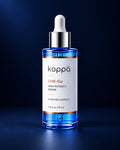
2% GHK-Cu, stated on the bottle.
A topical copper peptide at a stated concentration, with two ceramides and seven peptides in a water-light serum. The form of GHK-Cu the human evidence is about.
- 2% GHK-Cu, stated
- Fragrance-free, silicone-free
- Cruelty free
- Free US shipping over US$100
Free US shipping over US$100. See all four products
Questions about GHK-Cu and PDRN
Is PDRN or copper peptide better for anti-ageing?
Neither has a trial that beats the other, because no study has compared them. GHK-Cu's human data is for topical creams; PDRN's is for injections. For a product you apply yourself, GHK-Cu has the evidence that matches the use.
Can I use PDRN and copper peptides together?
There is no known interaction between a topical PDRN cosmetic and a topical copper peptide, and some products combine them.
Is PDRN just salmon DNA?
Mostly, yes: fragments of DNA extracted from salmon or trout sperm, processed into a mixture of defined lengths. Plant-derived versions are now marketed too. It is not a peptide.
Does topical PDRN work?
The published topical work is recent and mechanistic: ex vivo skin and cell studies showing effects on the dermal matrix. There is not yet the small-trial human evidence that exists for topical GHK-Cu, let alone the randomised trials that exist for injected PDRN.
Why does koppā not make a PDRN product?
Because the brand is one ingredient in three formats, and the ingredient is GHK-Cu. That also means we have nothing to sell you on the PDRN side of this page, which is the point of writing it.
References
- 1.Pickart L, Vasquez-Soltero JM, Margolina A. GHK Peptide as a Natural Modulator of Multiple Cellular Pathways in Skin Regeneration. BioMed Research International. 2015;2015:648108. Read the paper
- 2.Maquart FX, Pickart L, Laurent M, Gillery P, Monboisse JC, Borel JP. Stimulation of collagen synthesis in fibroblast cultures by the tripeptide-copper complex glycyl-L-histidyl-L-lysine-Cu2+. FEBS Letters. 1988;238(2):343-346. Read the paper
- 3.Badenhorst T, Svirskis D, Merrilees M, Bolke L, Wu Z. Effects of GHK-Cu on MMP and TIMP Expression, Collagen and Elastin Production, and Facial Wrinkle Parameters. Journal of Aging Science. 2016;4(3):166. Read the paper
- 4.Johnson W, Bergfeld WF, Belsito DV, et al. Safety Assessment of Tripeptide-1, Hexapeptide-12, Their Metal Salts and Fatty Acyl Derivatives, and Palmitoyl Tetrapeptide-7 as Used in Cosmetics. International Journal of Toxicology. 2018;37(3 suppl):90S-102S. Read the paper
- 5.Mortazavi SM, Mohammadi Vadoud SA, Moghimi HR. Topically applied GHK as an anti-wrinkle peptide: advantages, problems and prospective. BioImpacts. 2025. Read the paper
- 6.Pak CS, Lee J, Lee H, et al. A phase III, randomized, double-blind, matched-pairs, active-controlled clinical trial and preclinical animal study to compare the durability, efficacy and safety between polynucleotide filler and hyaluronic acid filler in the correction of crow's feet. Journal of Korean Medical Science. 2014;29(Suppl 3):S201-S209. Read the paper
- 7.Ye R, Wang Q, Du L, et al. Topical medium-length PDRN enhances dermal extracellular matrix repair in photodamaged skin via PI3K-Akt/TGF-β-regulated pathways. PLoS One. 2026;21:e0350905. Read the paper
GHK-Cu, the topical form, with the percentage stated.
Three formats, one active, every ingredient listed.
 Step 1, treat · For this question
koppā 2% GHK-Cu High-Concentration Copper Peptide SerumConcentrated peptides for firmer, smoother-looking skin.$75Shop
 Step 2, nourish
koppā GHK-Cu Moisturizing CreamCapsule-released peptides for deep, lasting hydration.$70Shop
 Step 3, seal
koppā GHK-Cu Balm StickCollagen support and hydration, from face to body.$45Shop
 All three, for less
koppā GHK-Cu Protocol TrioYour complete peptide routine, for less.$175
Keep reading
Still deciding?
Ask us. If PDRN is the better fit for what you want, we'll say so; we don't sell it.
Page updated 7 October 2026