
 For this question
GHK-Cu 2% High Potency Serum
Concentrated peptides for firmer, smoother-looking skin.
$75
In stock
Shop nowKoppā Beauty
Find the formulas that fit your daily routine.
Shop all formulasExplore the formulas
 GHK-Cu 2% High Potency Serum
$75.00 USD
GHK-Cu 2% High Potency Serum
$75.00 USD
 GHK-Cu Advanced Capsule Cream: Copper Peptide Moisturizer
$70.00 USD
GHK-Cu Advanced Capsule Cream: Copper Peptide Moisturizer
$70.00 USD
Added to your bag
GHK-Cu is a copper-carrying peptide that occurs naturally in human blood, and in skincare it is used to support firmer, smoother-looking skin. In lab studies it raises collagen and elastin production by skin cells; the evidence on people is a few small trials. Here is all of it, with every source linked.

Isolated from human plasma[1]
Glycine, histidine, lysine
Peer-reviewed papers, reviews and the AAD
40 women, one wrinkle measured each[10]
A three-amino-acid peptide that carries copper. It is in your blood already.
GHK is a tripeptide: glycine, histidine and lysine, in that order. It was first described in 1973 by Loren Pickart, who isolated it from human plasma as an activity that made liver tissue from older people make proteins more like younger tissue16. In 1980 the same group showed that GHK binds copper and helps carry it into cells2.
The bond is strong. GHK holds copper(II) in a one-to-one complex with a dissociation constant around 10^-14 M at body pH, close to the copper-carrying site on albumin3. That complex is GHK-Cu. On an ingredient list it is written Copper Tripeptide-1.
GHK occurs naturally in plasma, saliva and urine. Two reviews put the plasma level at about 200 ng/ml at age 20, falling to about 80 ng/ml by age 6056. That decline is part of why the peptide attracted cosmetic interest, though a falling blood level does not by itself show that putting it on skin replaces anything.
GHK on its own is the peptide without the metal. Most skincare uses GHK-Cu, the complex. Some lab effects depend on the copper: one study found copper ions reproduced an effect that GHK alone did not9.
Argireline is a different molecule with a different job. Palmitoyl tripeptide-1, one of the two peptides in Matrixyl 3000, is GHK with a fatty acid attached to make it more oil-soluble; it does not carry copper.
Most of what is known about mechanism comes from cells in a dish. That is useful, and it is not the same as your face.
Skin's firmness comes from the dermis, the layer under the surface, where fibroblast cells make collagen, elastin and the gel-like molecules that hold water between them. Collagen is also constantly broken down and rebuilt by enzymes called matrix metalloproteinases (MMPs), kept in check by their inhibitors (TIMPs). GHK-Cu has been studied at each of these steps.
In 1988 GHK-Cu raised collagen production by fibroblasts in culture, starting at concentrations as low as 10^-12 to 10^-11 M and peaking at 10^-9 M, without changing the number of cells7. A 2016 study repeated the finding for both collagen and elastin in adult human fibroblasts[10].
These are the water-holding molecules between collagen fibres. GHK-Cu increased their production by human fibroblasts in culture, most at 10^-9 to 10^-8 M, with the effect fading at higher doses8.
GHK-Cu raised fibroblast output of MMP-2, an enzyme that clears old matrix, and at the same time raised TIMP-1 and TIMP-2, its brakes9. The 2016 study linked a higher ratio of TIMPs to MMPs with more collagen and elastin[10]. In plain terms: remodelling, not just building.
In fibroblasts grown without serum, GHK-Cu sped up cell doubling. In fibroblasts that had been exposed to radiation, it also raised two growth factors, bFGF and VEGF[11].
In lab-grown skin models, GHK-Cu increased markers of growth potential in basal keratinocytes, the cells that renew the surface, including integrins and p63[12].
Analyses of public gene-expression databases suggest GHK shifts the activity of a large number of human genes, including ones involved in matrix building and antioxidant defence[13][14][15]. These are computational studies, written by the peptide’s discoverer and colleagues, and they show association with gene activity, not effects on skin.
Most of the concentrations above are nanomolar or lower, far below the percentages in skincare. The gap is not a mistake: only a fraction of what goes on the surface gets through the skin barrier, which is the question in the next section.
Smaller and fewer than the lab work. Here is all of it that we could check, with its limits.
The most detailed trial on faces was published in 2016 by researchers at the University of Auckland and run at Dermatest, a cosmetic testing institute in Germany[10]. Forty women aged 40 to 65 applied a serum containing GHK-Cu in lipid nano-carriers to one side of the face twice a day for eight weeks, and a comparison product to the other side: either the same serum without GHK-Cu, or a commercial product containing Matrixyl 3000. The products were coded, so neither the women nor the investigators knew which was which. On each woman, one wrinkle near the corner of the eye was measured.
On the GHK-Cu side, the volume of that wrinkle fell by about a quarter from the start (24% to 26%, depending on the group). On the plain-serum side it fell 15%, and on the Matrixyl side 20%. The authors express this as a 55.8% greater reduction in wrinkle volume than the plain serum and 31.6% greater than the Matrixyl product. For depth, the reduction was 32.8% greater than the plain serum; the difference from the Matrixyl product was not statistically significant. One woman stopped after a skin reaction, which cleared on its own.
Three things to know when reading it. It tested one formula, not koppā's. It measured a single wrinkle per person, for eight weeks. And it was funded by the company that made the serum, which the paper says had no role in the analysis or the writing. It is still the clearest human evidence for topical GHK-Cu we could find, and it is why we tell people to give copper peptides at least eight weeks.
Beyond it, the human evidence is mostly summarised in reviews. A 2008 review by Pickart describes earlier controlled studies on aged skin reporting firmer, more elastic-looking skin and softer-looking fine lines[16]; his affiliation on that paper is Skin Biology, a company that sells copper peptide products. Two independent reviews of topical peptides cover copper peptides alongside the others[17][18]. Taken together, the human evidence is promising, small and not settled.
| Compare | GHK-Cu (copper peptides) | Retinoids |
|---|---|---|
| Cell studies | Collagen, elastin and glycosaminoglycan production; MMP and TIMP balance; growth factors789[11] |
Cells in a dish at very low doses. Shows a mechanism, not a result on skin. |
| Skin models | Keratinocyte growth markers in lab-grown skin[12]; penetration through donated human skin[19] |
Closer to real skin, but no blood flow, no immune system, no daily life. |
| Gene data | Shifts in the activity of many genes linked to matrix and antioxidant defence[13][14][15] |
Computational, from databases. An association, not a test on people. |
| Human trials | One randomised, double-blind, split-face 8-week trial in 40 women[10]; earlier studies summarised in reviews[16][17][18] |
Small, few, one wrinkle measured per person, and the main trial was funded by the serum maker. Promising, not settled. |
Keratinocyte growth markers in lab-grown skin[12]; penetration through donated human skin[19]
Closer to real skin, but no blood flow, no immune system, no daily life.
Shifts in the activity of many genes linked to matrix and antioxidant defence[13][14][15]
Computational, from databases. An association, not a test on people.
One randomised, double-blind, split-face 8-week trial in 40 women[10]; earlier studies summarised in reviews[16][17][18]
Small, few, one wrinkle measured per person, and the main trial was funded by the serum maker. Promising, not settled.
The outer layer of skin is built to keep things out, and GHK-Cu is water-loving.
In a study on donated human skin, copper applied as a 0.68% GHK-Cu solution passed through the outer layer, and some was held in the skin as a depot, over 48 hours[19]. The study measured copper, not the intact peptide, and kept a constant supply of solution on the skin, so it shows that delivery is possible rather than how much a thin layer of serum delivers.
Because GHK-Cu dissolves in water rather than oil, formulators try to help it across: liposomes, nano-carriers and capsules. The 2016 facial trial used lipid nano-carriers[10]. A 2025 review found that how well liposomes carry GHK-Cu into skin has barely been measured yet[20], and a 2026 review of GHK-Cu's chemistry and formulation reaches a similar conclusion: delivery is the open question[21].
That is why koppā's capsule cream encapsulates its GHK-Cu, and why we print the concentration on every product: it is the one number you can check.

Simple, and boring on purpose. Consistency matters more than strength.
A small amount on the inside of the arm, twice a day, for seven to ten days, as the American Academy of Dermatology suggests for any new product[22].
Apply to clean skin in the evening. Add a morning application after a few weeks if your skin is happy.
Serum first, then cream or balm. Let each layer sink in before the next.
GHK-Cu is not known to make skin sun sensitive, but every routine aimed at firmer-looking skin starts with daily sunscreen.
The facial trial ran for eight weeks[10]. Collagen turnover is slow. Judge it after two months, not two weeks.
A few pairings people ask about most.
Retinoids are among the most clinically studied topicals for ageing skin, and irritation is common when starting them[23]. Use them on different nights from copper peptides while your skin adjusts, and stay on the gentler schedule if it works.
Nobody has studied the pair on skin. Ascorbic acid reacts readily with copper, and strong acids lower the pH the copper complex sits in, so the cautious choice is vitamin C or acids in the morning and copper peptides at night, or on different days.
Gentle, hydrating and barrier-supporting ingredients layer well. koppā’s capsule cream already pairs GHK-Cu with 5% niacinamide and squalane.
Signal peptides such as those in Matrixyl are commonly layered with copper peptides. The main facial trial compared the two side by side[10].
For most people topical copper peptides are well tolerated. Here is what the research says, and what it does not cover.
Copper has a low potential to cause allergy. A dermatology review of the literature found that genuine skin sensitisation to copper is extremely rare, given how much copper people touch every day[24].
In a keratinocyte study comparing copper compounds, GHK-Cu was not toxic to the cells and did not raise irritation markers, while simple copper salts at the same concentrations did[25]. The peptide is a gentler way to deliver copper than copper salts.
When people do react, it is usually dryness or tightness in the first weeks, from using too much too soon, or a reaction to something else in the formula, such as fragrance. Our safety guide covers this in detail, and copper uglies covers the overuse myth.
You are pregnant or breastfeeding, have a diagnosed skin condition, or have reacted to copper before. These situations have not been studied, which is not the same as unsafe, but it means a doctor should decide.
Itching, swelling or a spreading rash appears. That is a reaction, not a phase.
Injected copper peptides are a different question entirely, with no published human safety data. See what’s known about injections.
Four things you can check on any label.
Look for a GHK-Cu percentage, not a percentage of a blend. Our concentration guide explains what 2% does and does not mean.
Copper Tripeptide-1 should appear on the ingredient list. With no percentage, its position is the best clue.
Fragrance-free and without a crowd of strong actives, so if your skin reacts you know where to look.
Water-loving GHK-Cu benefits from help getting into skin[19][20]. Encapsulation or a lipid carrier is a sign the formulator thought about it.
The 2% serum, the 0.5% capsule cream and the 0.5% water-free balm stick, each fragrance-free and silicone-free, with the GHK-Cu concentration on the bottle.
 Step 1, treat · For this question
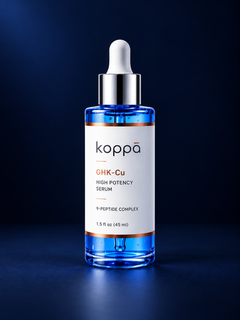
GHK-Cu 2% High Potency SerumConcentrated peptides for firmer, smoother-looking skin.$75Shop
Step 1, treat · For this question
GHK-Cu 2% High Potency SerumConcentrated peptides for firmer, smoother-looking skin.$75Shop
 Step 2, nourish
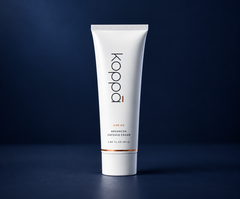
GHK-Cu Advanced Capsule CreamCapsule-released peptides for deep, lasting hydration.$70Shop
Step 2, nourish
GHK-Cu Advanced Capsule CreamCapsule-released peptides for deep, lasting hydration.$70Shop
 Step 3, seal
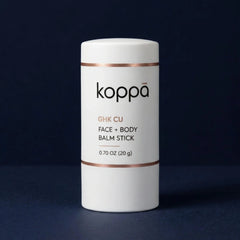
GHK-Cu Face + Body Balm StickTarget fine lines and dryness, from face to body.$45Shop
Step 3, seal
GHK-Cu Face + Body Balm StickTarget fine lines and dryness, from face to body.$45Shop
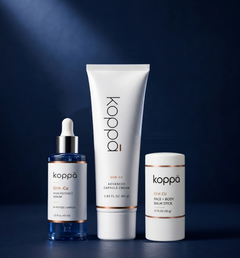 All three, for less
The GHK-Cu ProtocolYour complete peptide routine, for less.$175
All three, for less
The GHK-Cu ProtocolYour complete peptide routine, for less.$175 How GHK-Cu sits next to the ingredient most people already know.
| Compare | GHK-Cu (copper peptides) | Retinoids |
|---|---|---|
| What it does | Signals the skin’s own matrix building and remodelling, in lab studies79[10] |
Speeds surface cell turnover and supports collagen; among the most clinically studied topicals for ageing skin[23] |
| Irritation | Low; usually dryness from overuse |
Common at the start: redness, flaking, stinging[23] |
| Sun sensitivity | Not known to increase it |
Can increase it; use at night with daily sunscreen |
| Pregnancy | Unstudied; ask a doctor |
Avoid; ask a doctor |
| Evidence on people | Small trials[10][16] |
Large, many trials over decades[23] |
Low; usually dryness from overuse
Common at the start: redness, flaking, stinging[23]
Not known to increase it
Can increase it; use at night with daily sunscreen
Unstudied; ask a doctor
Avoid; ask a doctor
Small trials[10][16]
Large, many trials over decades[23]
Many people use both, on alternate nights. For the full comparison, see copper peptides vs retinol.
koppā's serum carries 2% GHK-Cu in a fragrance-free, silicone-free formula, with the concentration and full ingredient list on its page. Use it once a night to start, and give it eight weeks.
Free shipping over $100. See all four products
Every koppā formula is fragrance-free and silicone-free, with the GHK-Cu concentration and full ingredient list on its page.
Prices and stock update live.
For this question
Concentrated peptides for firmer, smoother-looking skin.
In stock
Shop now Step 2, nourish
Capsule-released peptides for deep, lasting hydration.
Preorder
Shop now Step 3, seal
Target fine lines and dryness, from face to body.
In stock
Shop now The Protocol
Your complete peptide routine, for less.
Preorder
Shop nowSave $15 versus buying separately
In lab studies it raises collagen, elastin and glycosaminoglycan production by skin cells and balances the enzymes that break old collagen down789. On people the evidence is small: in one 8-week trial funded by the serum's maker, a GHK-Cu serum in nano-carriers reduced the volume of an eye-area wrinkle more than the same serum without it[10]. In skincare it is used to support firmer, smoother-looking skin.
Plan on at least eight weeks of consistent use, the length of the main facial trial[10]. Collagen turnover is slow, so early changes are mostly about how skin feels.
Yes, most people do, on alternate nights while skin adjusts. Retinoids are the more irritating of the two[23].
Keep them apart: vitamin C in the morning, copper peptides at night. Low-pH actives can change the environment the copper complex sits in.
Copper has a low sensitisation potential[24] and GHK-Cu did not raise irritation markers in a cell study where copper salts did[25]. Patch test first, start once a night, and choose a fragrance-free formula.
Because copper(II) bound to the peptide absorbs orange and red light4. The colour comes from the ingredient. A deeper blue is not a sign of strength.
One that is stated. Percentages are only comparable when they refer to GHK-Cu itself. koppā’s serum is 2%, and the capsule cream and balm stick are 0.5%.
Research on GHK-Cu the ingredient, not on koppā's finished formulas. Where a study was run in cells, on skin samples or in a computer rather than on people, we say so in the text. Several papers are by Loren Pickart, who discovered GHK and later sold copper peptide products; we say that where it matters.
Ask us about an ingredient, a concentration or how to fit GHK-Cu into your routine. If you're managing a skin condition, a dermatologist is the right person to ask first.
Page updated 2 October 2026


Back in your routine soon