
Best Peptide Serums of 2026: Nine Compared on Ingredients and Evidence
Nine peptide serums compared on what their labels state and what the research behind each peptide shows: signal, neurotransmitter-modulating and carrier peptides, the full ingredient list, price per ml, shipping and returns. We make koppā, our pick if you want a stated GHK-Cu dose with every peptide's percentage disclosed, and we name the categories it loses, including price per ml, the most peptides and finished-product testing.

A peptide serum is a light treatment step built around short chains of amino acids that are designed to signal skin to make collagen, soften expression lines or carry copper. The nine serums here use very different peptides, and the human evidence behind them ranges from a 93-person placebo-controlled trial1 to no topical human trial at all2. Only one of the nine states a percentage for every peptide it contains, three headline a percentage without saying what it measures, and two sell a "copper peptide" that is not GHK-Cu. We read every label, ingredient list, shipping page and returns policy on the brand's own US site on 4 November 2026, and matched each peptide to its published studies.
Summary of recommendations
Best for a stated GHK-Cu dose with every peptide disclosed: koppā GHK-Cu 2% High Potency Serum (our own)
Best budget multi-peptide serum: The Ordinary Multi-Peptide + HA Serum
Cheapest bottle, for expression lines: The Ordinary Argireline Solution 10%
Best budget GHK-Cu blend with a percentage on the label: The Ordinary Multi-Peptide + Copper Peptides 1% Serum
Most peptides named, and certified vegan: Medik8 Liquid Peptides
Best mid-price serum to layer with retinol: Naturium Multi-Peptide Advanced Serum
Lowest price per ml, and tested on sensitive skin: COSRX The 6 Peptide Skin Booster Serum
Best-studied single signal peptide: Olay Collagen Peptide Visibly Firming Serum
Newer peptides, with a refund on used product: Paula's Choice Pro-Collagen Multi-Peptide Booster
Our top pick, checked 4 November 2026: koppā GHK-Cu 2% High Potency Serum
There is no single best peptide serum, because the peptides do different jobs and have different evidence. If you want a carrier peptide at a stated dose, this is the one we would choose: it states 2% GHK-Cu by weight of the finished formula, the highest stated GHK-Cu here, and it is the only serum on this page giving a percentage for each supporting peptide. It is not cheap per ml, it does not name the most peptides, and it has no published test of the finished serum. Choose The Ordinary Multi-Peptide + HA Serum instead for a broad blend at US$0.56 to US$0.66 per ml, or Olay if you want the signal peptide with the strongest single-ingredient trial.
US$75 for 45 ml (US$1.67 per ml); US$67.50 on Subscribe & Save. US shipping US$3, free over US$100 and on subscriptions.
Why you should trust us
koppā makes copper peptide skincare, so GHK-Cu is the ingredient we know best, and we make the first serum on this page. That is a conflict of interest, and we handle it by showing our working: every product figure comes from the brand's own product, shipping and returns pages, read on 4 November 2026 and linked from each card, and every study is described by what kind of study it was, who ran or paid for it and how many people took part.
No brand paid to be included, and links to other brands earn us nothing. koppā wins four of the fourteen categories in our scorecard and loses the rest, including price per ml, largest bottle, most peptides named, finished-product testing, returns and vegan. Where the research is thin, we say so: a systematic review found only 6 of 15 studies of collagen-signalling peptides were placebo-controlled3, and most of the trials on this page were run or funded by the company that makes the ingredient or the product.
How we evaluated peptide serums
We chose nine serums that between them cover every main type of peptide, from the brands people searching for a peptide serum are most likely to find, and compared them on five criteria:
Peptides: which peptides does the ingredient list name, of which class, and where do they sit in the list?
Disclosure: does the label state a percentage, and does it say what the number measures?
Evidence: what human research exists for those peptides, and has the brand reported a test of the finished serum?
Cost: price per ml, and US shipping.
Returns: can you send it back if it doesn't suit you?
Peptides · Advantage: Medik8 and The Ordinary
Medik8 names ten peptides, and its ingredient list shows carnosine as well. The Ordinary's Multi-Peptide + Copper Peptides 1% lists eight and its Multi-Peptide + HA seven, including the Matrixyl 3000 pair, Matrixyl synthe'6 and SYN-AKE. COSRX and Paula's Choice list six each. Olay and The Ordinary Argireline each contain one. More peptides is not better in itself: most have little or no published human research, as the evidence section explains.
Disclosure · Advantage: koppā
koppā is the only serum here stating a percentage for each peptide: 2% GHK-Cu by weight of the finished formula, and 0.05% to 0.20% for each supporting peptide, though its page does not say whether those smaller figures are pure peptide or a supplier solution. The Ordinary's "10%" and "1%" and Medik8's "30% blend" appear in names and claims without saying what they measure. The other five serums state no peptide percentage at all.
Evidence · Advantage: Medik8, The Ordinary and COSRX
Three brands report a test of the finished serum. Medik8: 60 people over 8 weeks, a consumer study, so the results are self-assessed. The Ordinary Multi-Peptide + HA: 30 people over 8 weeks, with no method or results published. COSRX: 20 people over about six weeks, with instrument readings but no control group stated. Olay and Paula's Choice make timed claims without saying how many people or what method. koppā has published no test of its finished serum.
| Serum | Price and US shipping | Returns |
|---|---|---|
| COSRX | US$25 / 150 ml or US$14 / 50 ml. Free US shipping over US$50; below that the fee is calculated at checkout and not published on the pages we checked |
30 days from delivery, unopened and unused in original packaging; buyer pays return shipping for a change of mind |
| The Ordinary (all three serums) | US$9.70 to US$33.80 depending on serum and size; no subscription seen. Shipping US$4.99, free over US$25 (no minimum from 9 to 22 November 2026, as a promotion) |
365 days if at least 50% full; no return label provided, and shipping fees are not refunded |
| Naturium | US$25 / 30 ml or US$45 / 60 ml. Shipping US$7.50, free over US$40 |
30-day satisfaction guarantee on regular-price items, unused portion accepted; refund less original shipping; sale, coupon and bundle items are final sale |
| Olay | US$39.99 / 1.3 fl oz; US$37.99 on subscription (5% off). Free over US$15 and for Club Olay members; fee below that not published on the pages we checked |
Unopened, in original packaging, within 30 days of the ship date; buyer pays return shipping unless damaged or defective |
| Paula's Choice | US$59 / 0.67 fl oz; US$50.15 on auto-delivery (15% off). Shipping US$5.99, free over US$35 |
Refund within 60 days, store credit from 60 to 180 days; used products accepted, empty bottles not; shipping fees not refunded |
| Medik8 (US store) | US$68 / 30 ml; no subscription seen. Free US shipping over US$60; fee below that not published on the pages we checked |
At least half full, within 30 days of purchase, with authorisation |
| koppā | US$75 / 45 ml; US$67.50 on Subscribe & Save (10% off). Shipping US$3, free over US$100 and on all subscriptions |
30 days from delivery, unopened only; free prepaid US return label |
COSRX
- Price and US shipping
US$25 / 150 ml or US$14 / 50 ml. Free US shipping over US$50; below that the fee is calculated at checkout and not published on the pages we checked
- Returns
30 days from delivery, unopened and unused in original packaging; buyer pays return shipping for a change of mind
The Ordinary (all three serums)
- Price and US shipping
US$9.70 to US$33.80 depending on serum and size; no subscription seen. Shipping US$4.99, free over US$25 (no minimum from 9 to 22 November 2026, as a promotion)
- Returns
365 days if at least 50% full; no return label provided, and shipping fees are not refunded
Naturium
- Price and US shipping
US$25 / 30 ml or US$45 / 60 ml. Shipping US$7.50, free over US$40
- Returns
30-day satisfaction guarantee on regular-price items, unused portion accepted; refund less original shipping; sale, coupon and bundle items are final sale
Olay
- Price and US shipping
US$39.99 / 1.3 fl oz; US$37.99 on subscription (5% off). Free over US$15 and for Club Olay members; fee below that not published on the pages we checked
- Returns
Unopened, in original packaging, within 30 days of the ship date; buyer pays return shipping unless damaged or defective
Paula's Choice
- Price and US shipping
US$59 / 0.67 fl oz; US$50.15 on auto-delivery (15% off). Shipping US$5.99, free over US$35
- Returns
Refund within 60 days, store credit from 60 to 180 days; used products accepted, empty bottles not; shipping fees not refunded
Medik8 (US store)
- Price and US shipping
US$68 / 30 ml; no subscription seen. Free US shipping over US$60; fee below that not published on the pages we checked
- Returns
At least half full, within 30 days of purchase, with authorisation
koppā
- Price and US shipping
US$75 / 45 ml; US$67.50 on Subscribe & Save (10% off). Shipping US$3, free over US$100 and on all subscriptions
- Returns
30 days from delivery, unopened only; free prepaid US return label
One-time US list prices before promotions, checked on each brand's own site on 4 November 2026; shipping and returns read on each brand's own policy pages the same day. Olay's product page carries a "Free returns within 30 days" banner, which conflicts with its returns policy (unopened only, buyer pays return shipping); we report the policy. Policies change, so check before you order.
Cost · Advantage: COSRX and The Ordinary
COSRX's 150 ml bottle costs US$0.17 per ml, the lowest here, though it was backordered on 4 November 2026. The Ordinary Argireline is the cheapest bottle at US$9.70 (US$0.32 per ml), and The Ordinary Multi-Peptide + HA costs US$0.56 per ml in its 60 ml size. koppā is US$1.67 per ml: six of the other eight cost less, and only Medik8 (US$2.27) and Paula's Choice (US$2.98) cost more.
Returns · Advantage: The Ordinary
The Ordinary takes back a serum for 365 days if it is at least half full. Paula's Choice refunds used products within 60 days, and Medik8 accepts half-full bottles within 30 days. koppā, COSRX and Olay accept unopened products only; koppā is the only one of those three to send a free US return label.
Overall · Advantage: depends on the peptide you want
No serum wins every criterion, and the peptides are not interchangeable. koppā's case is disclosure and a stated GHK-Cu dose. If price per ml, a used-bottle return, the most peptides or a single well-studied peptide matters more to you, another serum on this page is the better buy, and each card below says which.
Nine peptide serums compared
Start with the peptide you want and your budget. Each card gives the reason to choose that serum and the limits of what its label tells you.
Nine peptide serums, one comparison
Scroll horizontally for all nine serums| Serum |
 koppā
GHK-Cu 2% High Potency Serum
Stated GHK-Cu dose · our own formula | The Ordinary Multi-Peptide + HA Serum Best budget multi-peptide | The Ordinary Argireline Solution 10% Cheapest bottle | The Ordinary Multi-Peptide + Copper Peptides 1% Serum Budget GHK-Cu blend | Medik8 Liquid Peptides Most peptides named | Naturium Multi-Peptide Advanced Serum Best mid-price, layers with retinol | COSRX The 6 Peptide Skin Booster Serum Lowest price per ml | Olay Collagen Peptide Visibly Firming Serum Best-studied signal peptide | Paula's Choice Pro-Collagen Multi-Peptide Booster Newer peptides, used-product refunds |
|---|---|---|---|---|---|---|---|---|---|
| Peptides, as stated | 2% GHK-Cu by weight, plus a stated % for every supporting peptide | Seven named peptides; no percentages | Acetyl Hexapeptide-8 only; "10%" basis not stated | Copper Tripeptide-1 plus seven peptides; "1%" basis not stated | Ten named peptides plus carnosine; "30% blend" basis not stated | Argireline, Copper Palmitoyl Heptapeptide-14 and one more peptide; no percentages | Six peptides including Copper Tripeptide-1; no percentages | Palmitoyl Pentapeptide-4 (Matrixyl); no percentage | Six newer peptides; no percentages |
| Size | 45 ml | 30 ml | 30 ml | 30 ml | 30 ml | 30 ml | 150 ml | 1.3 fl oz (38.44 ml) | 0.67 fl oz (19.81 ml) |
| US list price | US$75 | US$19.90 | US$9.70 | US$32 | US$68 | US$25 | US$25 | US$39.99 | US$59 |
| Price per ml | US$1.67 per ml | US$0.66 per ml | US$0.32 per ml | US$1.07 per ml | US$2.27 per ml | US$0.83 per ml | US$0.17 per ml | US$1.04 per ml | US$2.98 per ml |
| Fragrance-free, per the brand | No claim; none in the ingredient list | No claim; none in the ingredient list | No claim; none in the ingredient list | No claim; none in the ingredient list | |||||
| No silicones in the ingredient list | Contains dimethicone | Silicone-based: dimethicone second | Contains dimethicone | ||||||
| Peptide percentages stated | Every peptide; GHK-Cu by weight | None stated | "10%" in the name; basis not stated | "1%" in the name; basis not stated | "30% blend"; basis not stated | None stated | None stated | None stated | None stated |
| Finished-serum test reported by the brand | None published | Yes: 30 people, 8 weeks; results not published | None listed | None found | Yes: 60 people, 8 weeks, self-assessed | None stated; "dermatologist tested" | Yes: 20 people, about 6 weeks; no control stated | Timed claims only; no number of people or method | Claims only; no number of people or method |
| Shop | Shop, $75 |
One-time US list prices on each brand's own US site, checked 4 November 2026, before promotions, tax and delivery. Where a serum comes in two sizes, the matrix shows the size named in its card. Olay's size is read from its page data (1.3 fl oz) and Paula's Choice's from the page's embedded product data. koppā shopping buttons show current pricing in your selected currency. A percentage that is not stated is not evidence a formula contains none.
The full scorecard: which serum wins each category?
Fourteen categories. Ours wins four.
| Category | Winner | Why |
|---|---|---|
| Lowest price per ml | COSRX, US$0.17 |
US$25 for 150 ml. Next: The Ordinary Argireline US$0.32, The Ordinary Multi-Peptide + HA US$0.56 (60 ml), Naturium US$0.75 (60 ml). koppā is US$1.67. |
| Cheapest bottle | The Ordinary Argireline Solution 10%, US$9.70 |
For 30 ml. COSRX sells 50 ml for US$14. |
| Largest size | COSRX, 150 ml |
Then 60 ml options from The Ordinary Multi-Peptide + HA and Naturium. koppā is 45 ml; Olay 38.44 ml; Medik8 and The Ordinary Argireline and Copper 30 ml; Paula's Choice 19.81 ml. |
| Highest stated GHK-Cu | koppā, 2% |
Stated by weight of the finished formula. The Ordinary names "1%" without saying what it measures; COSRX lists Copper Tripeptide-1 with no percentage. Medik8 and Naturium contain a different copper peptide. |
| A percentage for every peptide | koppā |
2% GHK-Cu and 0.05% to 0.20% for each supporting peptide. No other serum states one for each peptide. |
| Most peptides named | Medik8 |
Ten by the brand's count, plus carnosine in the ingredient list. The Ordinary's copper serum lists eight, its Multi-Peptide + HA seven, COSRX and Paula's Choice six each. |
| Largest finished-serum test reported | Medik8 |
60 people, 8 weeks, consumer study (self-assessed). The Ordinary Multi-Peptide + HA: 30 people, 8 weeks, method not stated. COSRX: 20 people, about six weeks. koppā: none. |
| Most generous returns | The Ordinary |
365 days, at least half full. Runner-up Paula's Choice: refund within 60 days on used product, store credit to 180 days. |
| Fragrance-free and silicone-free, both claimed | koppā |
Medik8 claims fragrance-free and lists no silicone but makes no silicone-free claim. The Ordinary claims silicone-free but makes no fragrance claim. Naturium, Olay and Paula's Choice are fragrance-free but contain dimethicone. |
| Best-studied single signal peptide | Olay |
Palmitoyl Pentapeptide-4, tested in a 93-woman, 12-week placebo-controlled trial run by Olay's parent company1. That trial used 3 ppm in a moisturiser; Olay states no percentage for this serum. |
| Expression lines on a budget | The Ordinary Argireline Solution 10% |
Acetyl Hexapeptide-8 has the most randomised human trials of the neurotransmitter-modulating peptides45. |
| Sensitive-skin testing stated | COSRX |
Primary irritation, sensitive-skin irritation and non-comedogenic tests stated. The Ordinary Argireline, Paula's Choice and koppā rely on brand statements. |
| Vegan | Medik8 |
Certified by the Vegan Society. The Ordinary and Naturium also state vegan. koppā contains marine collagen, so it is not vegan. |
| Ceramides | koppā |
Ceramide EOP and Ceramide NP. No other serum here lists a ceramide. |
Lowest price per ml
- Winner
COSRX, US$0.17
- Why
US$25 for 150 ml. Next: The Ordinary Argireline US$0.32, The Ordinary Multi-Peptide + HA US$0.56 (60 ml), Naturium US$0.75 (60 ml). koppā is US$1.67.
Cheapest bottle
- Winner
The Ordinary Argireline Solution 10%, US$9.70
- Why
For 30 ml. COSRX sells 50 ml for US$14.
Largest size
- Winner
COSRX, 150 ml
- Why
Then 60 ml options from The Ordinary Multi-Peptide + HA and Naturium. koppā is 45 ml; Olay 38.44 ml; Medik8 and The Ordinary Argireline and Copper 30 ml; Paula's Choice 19.81 ml.
Highest stated GHK-Cu
- Winner
koppā, 2%
- Why
Stated by weight of the finished formula. The Ordinary names "1%" without saying what it measures; COSRX lists Copper Tripeptide-1 with no percentage. Medik8 and Naturium contain a different copper peptide.
A percentage for every peptide
- Winner
koppā
- Why
2% GHK-Cu and 0.05% to 0.20% for each supporting peptide. No other serum states one for each peptide.
Most peptides named
- Winner
Medik8
- Why
Ten by the brand's count, plus carnosine in the ingredient list. The Ordinary's copper serum lists eight, its Multi-Peptide + HA seven, COSRX and Paula's Choice six each.
Largest finished-serum test reported
- Winner
Medik8
- Why
60 people, 8 weeks, consumer study (self-assessed). The Ordinary Multi-Peptide + HA: 30 people, 8 weeks, method not stated. COSRX: 20 people, about six weeks. koppā: none.
Most generous returns
- Winner
The Ordinary
- Why
365 days, at least half full. Runner-up Paula's Choice: refund within 60 days on used product, store credit to 180 days.
Fragrance-free and silicone-free, both claimed
- Winner
koppā
- Why
Medik8 claims fragrance-free and lists no silicone but makes no silicone-free claim. The Ordinary claims silicone-free but makes no fragrance claim. Naturium, Olay and Paula's Choice are fragrance-free but contain dimethicone.
Best-studied single signal peptide
- Winner
Olay
- Why
Palmitoyl Pentapeptide-4, tested in a 93-woman, 12-week placebo-controlled trial run by Olay's parent company1. That trial used 3 ppm in a moisturiser; Olay states no percentage for this serum.
Expression lines on a budget
- Winner
The Ordinary Argireline Solution 10%
Sensitive-skin testing stated
- Winner
COSRX
- Why
Primary irritation, sensitive-skin irritation and non-comedogenic tests stated. The Ordinary Argireline, Paula's Choice and koppā rely on brand statements.
Vegan
- Winner
Medik8
- Why
Certified by the Vegan Society. The Ordinary and Naturium also state vegan. koppā contains marine collagen, so it is not vegan.
Ceramides
- Winner
koppā
- Why
Ceramide EOP and Ceramide NP. No other serum here lists a ceramide.
1. koppā GHK-Cu 2% High Potency Serum: best for a stated GHK-Cu dose
-
01
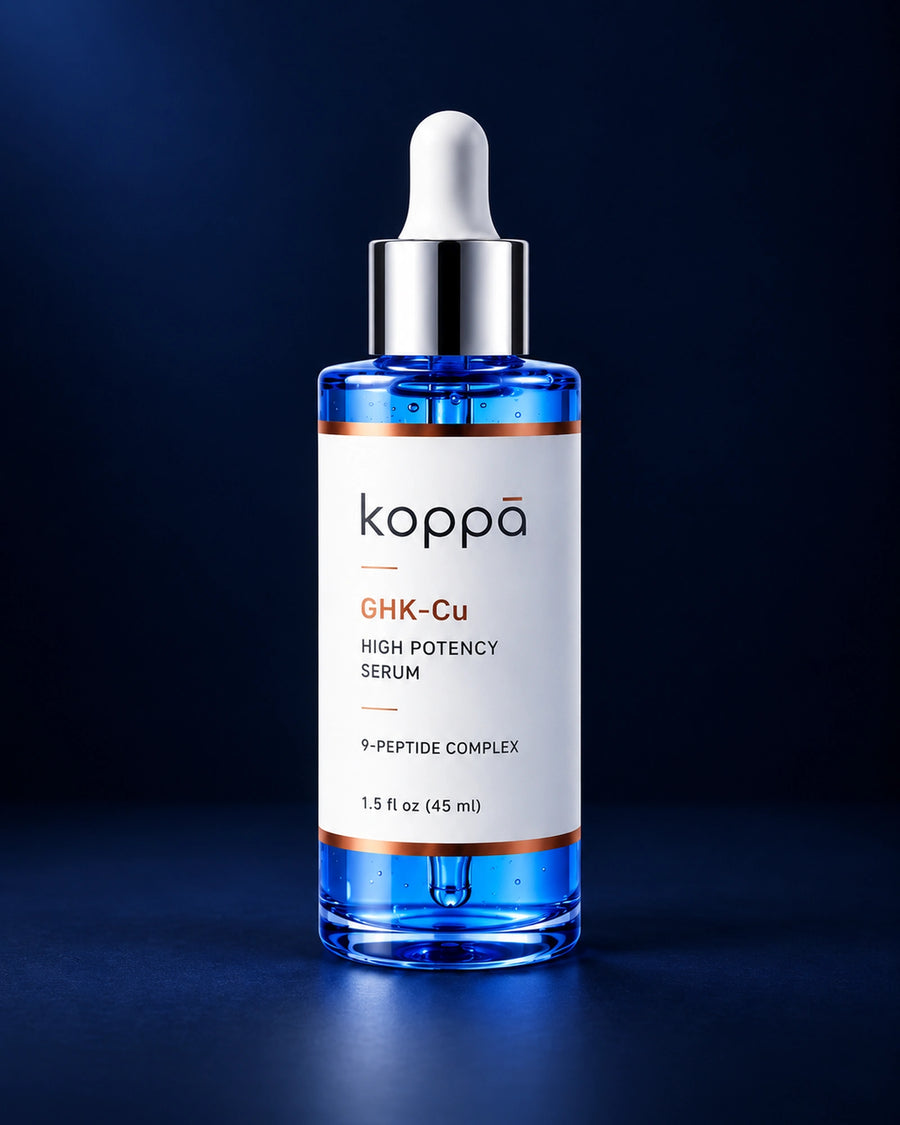 Stated GHK-Cu dose · our own formula
koppāGHK-Cu 2% High Potency Serum
- Peptides, as stated
- 2% GHK-Cu by weight, plus a stated % for every supporting peptide
- Size
- 45 ml
- Your current price
- $75
- Best for
- A stated GHK-Cu dose with every peptide's percentage disclosed, in a fragrance-free serum with ceramides
Our verdict If you want a stated GHK-Cu dose and to know how much of every peptide you are buying, this is the one we would choose. Choose The Ordinary Multi-Peptide + HA or COSRX instead if price per ml matters most, Medik8 if you want the most peptides or a vegan formula, or The Ordinary if you may want to return an opened bottle.
The full ingredient list (26 ingredients) puts Copper Tripeptide-1 fourth, after water, trehalose and glycerin, at a stated 2% by weight of the finished formula. The supporting peptides, each with a percentage on the product page: Acetyl Hexapeptide-8 (Argireline) 0.20%, Palmitoyl Tetrapeptide-7 0.20%, Dipeptide Diaminobutyroyl Benzylamide Diacetate (SYN-AKE) 0.20%, Carnosine 0.10%, Palmitoyl Tripeptide-5 0.05% and Acetyl Octapeptide-3 (SNAP-8) 0.05%, with hydrolyzed collagen 0.50% and collagen 0.10%. That covers carrier, signal and neurotransmitter-modulating peptides in one bottle, alongside two ceramides (EOP and NP), panthenol, polyglutamic acid and sodium hyaluronate. The page does not say whether the smaller percentages are pure peptide or supplier solution, and those peptides sit 13th to 25th in the list: they are minor ingredients. See the full ingredient list.
The formula sits at pH 5.5 to 6.0, inside the range in which GHK-Cu stayed stable in a lab study6. The product page says the studies it cites are not clinical trials of this finished product.
Pros
- 2% GHK-Cu stated by weight of the finished formula, the highest stated GHK-Cu here
- The only serum stating a percentage for every peptide
- Carrier, signal and neurotransmitter-modulating peptides in one bottle
- The only serum here with ceramides (EOP and NP)
- Fragrance-free and silicone-free, per the brand; full ingredient list and pH published
- 10% off on Subscribe & Save with free US shipping; free US return label
Cons and things to know
- US$1.67 per ml: six of the other eight cost less, and COSRX about a tenth as much
- No published test of the finished serum
- Supporting peptides at 0.05% to 0.20%, not stated as pure peptide or supplier solution
- Not the most peptides named (Medik8) or the largest bottle (COSRX, 150 ml)
- Not vegan: contains marine collagen
- Returns accepted unopened only, within 30 days of delivery
- Free shipping on one-time orders only over US$100; US$3 below that
- Its directions keep low-pH vitamin C and exfoliating acids in a separate routine
Against the other eight, label by label. On GHK-Cu, koppā states 2% where The Ordinary's copper serum names "1%" without saying what it measures and COSRX lists Copper Tripeptide-1 eighth with no percentage. The best human trial of GHK-Cu tested a serum in a lipid nanocarrier, not koppā's formula, and was funded by that serum's maker7. On the other peptides, koppā's doses are small, and the human evidence for SNAP-8 applied to skin is missing2. If the peptide you want is Palmitoyl Pentapeptide-4, koppā does not contain it; Olay and Medik8 do.
The other eight, with pros and cons
Each one wins at least one thing koppā doesn't. Prices are US list prices before promotions on the brand's own site, checked 4 November 2026.
-
02Best budget multi-peptide
The OrdinaryMulti-Peptide + HA Serum
- Peptides, as stated
- Seven named peptides; no percentages
- Size
- 30 ml
- US list price
- US$19.90
- Best for
- A broad signal and neurotransmitter peptide blend for little money
Our verdict Choose it if you want many peptides, including the Matrixyl 3000 pair, at a low price per ml, with a year to return it. Accept that no percentage is stated and its own test results are not published.
Formerly called "Buffet". Seven peptides sit fourth to tenth of 51 ingredients: Acetyl Hexapeptide-8 (Argirelox), Pentapeptide-18, Palmitoyl Tripeptide-1 and Palmitoyl Tetrapeptide-7 (the Matrixyl 3000 pair), Palmitoyl Tripeptide-38 (Matrixyl synthe'6), Dipeptide Diaminobutyroyl Benzylamide Diacetate (SYN-AKE) and Acetylarginyltryptophyl Diphenylglycine, with a ferment lysate, amino acids and hyaluronic acid. pH 4.50 to 5.50. The brand reports an independent study of 30 people over eight weeks on crow's feet, smoothness and firmness, without the method or the results. It advises against using it with direct acids, direct vitamin C, resveratrol and ferulic acid, or salicylic acid.
theordinary.comPros
- US$0.66 per ml, or US$0.56 in the 60 ml size (US$33.80)
- Peptides high in the list, fourth to tenth of 51
- Signal and neurotransmitter-modulating peptides together
- Silicone-free and vegan, per the brand
- 365-day returns if at least half full; free US shipping over US$25
Cons and things to know
- US$19.90 for 30 ml on theordinary.com, 4 November 2026
- No peptide percentages stated
- Test of 30 people reported without method or results
- No fragrance claim, though none is listed
- Not to be used with direct vitamin C or direct acids, per the brand
- No return label provided; shipping fees not refunded
-
03Cheapest bottle
The OrdinaryArgireline Solution 10%
- Peptides, as stated
- Acetyl Hexapeptide-8 only; "10%" basis not stated
- Size
- 30 ml
- US list price
- US$9.70
- Best for
- Trying the most-trialled expression-line peptide for under US$10
Our verdict Choose it if you want to try Argireline on its own for the lowest outlay. Expect a modest effect: in human skin samples almost none of it got past the outer layer8.
An 11-ingredient water gel: Acetyl Hexapeptide-8 is third, after water and propanediol, with gellan gum and preservatives. The "10%" in the name is not explained: the page calls it a "high concentration of Argireline" without saying whether the figure is pure peptide or a supplier solution. Directions are a few drops on the forehead and around the eyes, morning and evening. pH 6.00 to 7.00. The page says it suits all skin types, including sensitive, with a patch test first.
theordinary.comPros
Cons and things to know
- What "10%" measures is not stated
- One peptide only, aimed at expression lines
- No test of the finished serum listed
- No fragrance claim, though none is listed
- Not to be used with direct acids or direct vitamin C, per the brand
-
04Budget GHK-Cu blend
The OrdinaryMulti-Peptide + Copper Peptides 1% Serum
- Peptides, as stated
- Copper Tripeptide-1 plus seven peptides; "1%" basis not stated
- Size
- 30 ml
- US list price
- US$32
- Best for
- GHK-Cu and a broad peptide blend in one bottle for under US$35
Our verdict Choose it if you want GHK-Cu with the whole Multi-Peptide + HA blend at a lower price than koppā, and can accept an unexplained "1%" and the brand's advice to keep it away from retinoids and direct vitamin C.
The Multi-Peptide + HA formula with Copper Tripeptide-1 (GHK-Cu) added fourth of 49 ingredients, ahead of the same seven peptides. The page does not say whether "1%" measures GHK-Cu or a copper peptide raw material. pH 6.00 to 7.00. The brand advises not using it with direct acids, direct vitamin C, EUK, retinoids, strong antioxidants or its Multi-Antioxidant Radiance Serum. COSRX also contains GHK-Cu with other peptides for less money, but lists it eighth with no percentage.
theordinary.comPros
- GHK-Cu fourth in the list, with seven further peptides
- US$1.07 per ml, against koppā's US$1.67
- Silicone-free and vegan, per the brand
- 365-day returns if at least half full
Cons and things to know
- What "1%" measures is not stated
- No test of the finished serum found on its page
- The brand says not to combine it with retinoids or direct vitamin C
- No fragrance claim, though none is listed
- 30 ml only
-
05Most peptides named
Medik8Liquid Peptides
- Peptides, as stated
- Ten named peptides plus carnosine; "30% blend" basis not stated
- Size
- 30 ml
- US list price
- US$68
- Best for
- The widest peptide spread, vegan certified, with the largest finished-serum study here
Our verdict Choose it if you want the most peptides in one bottle and a vegan formula, and are comfortable that its copper peptide is not GHK-Cu and its "30%" is not a peptide percentage.
Medik8 describes "10 powerful peptides in a 30% blend". The ingredient list shows carnosine fifth and ten peptides from ninth to eighteenth of 31, covering all three classes: Acetyl Hexapeptide-8, the Matrixyl 3000 pair, Palmitoyl Tripeptide-38, Palmitoyl Pentapeptide-4, Tetrapeptide-21, Pentapeptide-18, Acetyl Tetrapeptide-5, Copper Palmitoyl Heptapeptide-14 and Palmitoyl sh-Hexapeptide-13 Serine SP Amide. Its "copper peptide" is Copper Palmitoyl Heptapeptide-14, not GHK-Cu. A consumer study of 60 people over 8 weeks reports that 98% agreed it was gentle and 97% that hydration lasted, and the "7 days to visible fine line & wrinkle reduction" claim is footnoted to the same self-assessed study. Directions: patch test for 24 hours first, then 6 drops morning and evening.
us.medik8.comPros
- Ten named peptides plus carnosine, the most here
- All three peptide classes in one bottle
- The largest finished-serum study reported here: 60 people, 8 weeks
- Fragrance-free and certified by the Vegan Society; no silicone in the ingredient list
- Returns accepted at least half full within 30 days
Cons and things to know
- US$68 for 30 ml on us.medik8.com, 4 November 2026; US$2.27 per ml
- What "30% blend" measures is not stated (see below)
- Its copper peptide is Copper Palmitoyl Heptapeptide-14, not GHK-Cu
- Study results are self-assessed; no instrument readings stated
- Free US shipping only over US$60; fee below that not published on the pages we checked
- Returns need authorisation
-
06Best mid-price, layers with retinol
NaturiumMulti-Peptide Advanced Serum
- Peptides, as stated
- Argireline, Copper Palmitoyl Heptapeptide-14 and one more peptide; no percentages
- Size
- 30 ml
- US list price
- US$25
- Best for
- A mid-price serum the brand says can be layered with retinol
Our verdict Choose it if you want an inexpensive serum the brand says layers with its retinol and retinaldehyde serums. Its copper peptide is not GHK-Cu, and the peptides are minor ingredients.
A creamier serum with squalane and shea butter in its base. Acetyl Hexapeptide-8, Copper Palmitoyl Heptapeptide-14 and Palmitoyl sh-Hexapeptide-13 Serine SP Amide sit 17th to 19th of 47 ingredients, with hydrolyzed collagen 20th and ferulic acid 15th. The brand describes "encapsulated copper peptides and Argireline Amplified peptide" and gives no percentages. pH 4.79 to 5.85. Its FAQ says it can be layered with any Naturium product, including its retinol and retinaldehyde serums, and that visible results can take up to 6 to 12 weeks of consistent use.
naturium.comPros
- US$0.83 per ml, or US$0.75 in the 60 ml size (US$45)
- The brand says it layers with retinol and retinaldehyde
- Fragrance-free and vegan, per the brand
- Free US shipping over US$40
Cons and things to know
- US$25 for 30 ml on naturium.com, 4 November 2026
- Its copper peptide is Copper Palmitoyl Heptapeptide-14, not GHK-Cu
- No percentages; peptides 17th to 19th of 47
- Contains dimethicone
- No test of the finished serum reported
- Returns on regular-price items only; refund less shipping
-
07Lowest price per ml
COSRXThe 6 Peptide Skin Booster Serum
- Peptides, as stated
- Six peptides including Copper Tripeptide-1; no percentages
- Size
- 150 ml
- US list price
- US$25
- Best for
- A large, inexpensive first-step booster, tested on sensitive skin
Our verdict Choose it if price per ml matters most or your skin is sensitive: it is the only serum here reporting sensitive-skin irritation testing. It is a watery toner-step booster, and its GHK-Cu is a minor ingredient with no percentage.
A toner-like booster used straight after cleansing, before other serums, 2 to 3 pumps twice a day. Six peptides sit seventh to twelfth of 44 ingredients, after niacinamide sixth: Acetyl Hexapeptide-8, Copper Tripeptide-1, sh-Polypeptide-121, SYN-AKE, Oligopeptide-68 and Palmitoyl Tripeptide-8. COSRX reports a trial of 20 people run by Dermacosmetic Skin Science Laboratory from 18 September to 31 October 2023: "deep moisture" +162.5%, texture +76.4%, clarity +40.1%, radiance +24.5% and density +22.2%, with no instrument or control group named. It also states primary irritation, sensitive-skin irritation and non-comedogenic tests. Its FAQ says it layers with vitamin C, retinol, niacinamide and exfoliating acids.
cosrx.comPros
- US$0.17 per ml in the 150 ml bottle, the lowest here; 50 ml for US$14
- The largest bottle here
- The only serum stating sensitive-skin irritation and non-comedogenic testing
- Niacinamide sixth in the list
- The brand says it layers with vitamin C and retinol
Cons and things to know
- The 150 ml size was backordered on 4 November 2026
- No percentages; Copper Tripeptide-1 eighth of 44
- Brand trial of 20 people, with no control group stated
- Toner-like texture
- Returns unopened only, and the buyer pays return shipping
- Free US shipping over US$50; fee below that calculated at checkout
-
08Best-studied signal peptide
OlayCollagen Peptide Visibly Firming Serum
- Peptides, as stated
- Palmitoyl Pentapeptide-4 (Matrixyl); no percentage
- Size
- 1.3 fl oz (38.44 ml)
- US list price
- US$39.99
- Best for
- The signal peptide with the strongest single-ingredient placebo-controlled trial, fragrance-free
Our verdict Choose it if you want Palmitoyl Pentapeptide-4, the peptide with the best placebo-controlled trial on this page, from the company that ran that trial. That trial used 3 ppm in a moisturiser, and Olay states no percentage for this serum.
Sold as Regenerist Collagen Peptide 24. Olay's "Collagen Peptide" is Palmitoyl Pentapeptide-4 (Pal-KTTKS, supplied to brands as Matrixyl), sixth of 16 ingredients, with niacinamide third and panthenol fifth, in a dimethicone base. Procter & Gamble, Olay's parent company, ran the 93-woman, 12-week placebo-controlled trial of this peptide1. The serum's own claims ("after 1 day... firmer", "with 2 weeks... contours visibly tightened") give no number of people, method or duration.
olay.comPros
- Palmitoyl Pentapeptide-4, backed by a 93-person placebo-controlled trial1
- Niacinamide third in the list
- Fragrance-free, per the brand
- US$1.04 per ml; 5% off on subscription
- Free US shipping over US$15
Cons and things to know
- One peptide; no percentage stated
- The trial tested 3 ppm in a moisturiser, not this serum, and was run by Olay's parent company
- Silicone-based: dimethicone second, plus dimethicone crosspolymer
- Timed claims give no number of people or method
- Returns unopened only, and the buyer pays return shipping; the product page's "Free returns" banner conflicts with the policy
-
09Newer peptides, used-product refunds
Paula's ChoicePro-Collagen Multi-Peptide Booster
- Peptides, as stated
- Six newer peptides; no percentages
- Size
- 0.67 fl oz (19.81 ml)
- US list price
- US$59
- Best for
- Newer-generation peptides, with a refund on used product
Our verdict Choose it if you want to try newer peptides and value a refund on an opened bottle. It is the most expensive per ml here, and we found no human trials on PubMed of its headline peptides.
A concentrated booster used alone or mixed into a serum or moisturiser without SPF. Six peptides sit tenth to fifteenth of 33 ingredients: Palmitoyl Tetrapeptide-72 Amide, sh-Polypeptide-121, Palmitoyl Dipeptide-5 Diaminobutyroyl Hydroxythreonine, Palmitoyl Tripeptide-5, Tridecapeptide-1 and Tetradecyl Aminobutyroylvalylaminobutyric Urea Acetate. The brand says they are used "at clinically efficacious levels" without numbers, and that it is "clinically proven" to visibly smooth lines in 15 minutes, lasting up to 4 hours, and to visibly firm in 4 weeks, without stating how many people or what method. Fragrance-free, though its FAQ notes a scent from tridecapeptide-1. We read the ingredient list, size and price from the page's embedded product data, because the page renders in the browser.
paulaschoice.comPros
- Refund within 60 days on used product; store credit to 180 days
- Newer peptides such as tridecapeptide-1 and palmitoyl tetrapeptide-72 amide
- Fragrance-free, per the brand; the brand says it suits sensitive and rosacea-prone skin
- Can be mixed into a serum or moisturiser
- 15% off on auto-delivery; free US shipping over US$35
Cons and things to know
- US$2.98 per ml, the highest here, in the smallest bottle (19.81 ml)
- No percentages stated
- "Clinically proven" claims without a number of people or method
- Contains dimethicone
- Sensitive-skin suitability is a brand statement; no test cited
- Shipping fees not refunded
What do peptide serum labels leave out?
Three things, and they matter more than any single product on this page.
"Copper peptide" does not always mean GHK-Cu. Medik8 and Naturium both sell their serums on copper peptides, and both list Copper Palmitoyl Heptapeptide-14, a different molecule from GHK-Cu (Copper Tripeptide-1). The GHK-Cu research on this page910 does not transfer to it, and we found no human trial of it on PubMed. Of the nine, GHK-Cu is listed by koppā, The Ordinary's copper serum and COSRX.
Medik8's "30% blend" is very unlikely to be 30% peptide. This is our inference from its ingredient list, not something Medik8 states: every one of its peptides is listed after phenoxyethanol, a preservative used at up to 1%, so on the usual ingredient-order rules each peptide is at or below about 1% of the formula. The 30% most probably describes peptide-containing ingredient solutions as supplied. Medik8 does not say what the figure measures.
No other brand says what its headline percentage measures. The Ordinary's "10%" Argireline and "1%" copper peptides and Medik8's "30%" do not say whether they mean pure peptide, a supplier solution or a blend. koppā states its 2% as a percentage of the finished formula by weight, though its smaller supporting-peptide percentages carry the same ambiguity. The other five serums state no peptide percentage at all.
What are the types of peptides in skin care?
Skin care peptides are short chains of amino acids, and reviews group them by what they are designed to do: signal, enzyme-inhibitor, neurotransmitter-inhibiting and carrier peptides11. A later review uses three main groups, leaving out enzyme inhibitors12; one of its authors is affiliated with a peptide company. The nine serums here use those three.
Signal peptides, such as Palmitoyl Pentapeptide-4 (Matrixyl) and the Matrixyl 3000 pair, are designed to prompt skin cells to make collagen and other matrix proteins.
Neurotransmitter-modulating peptides, such as Acetyl Hexapeptide-8 (Argireline), Acetyl Octapeptide-3 (SNAP-8) and SYN-AKE, are designed to soften expression lines by damping the signal that makes facial muscles contract, as botulinum toxin does far more strongly13.
Carrier peptides, chiefly GHK-Cu, bind and deliver copper; in cultured skin cells, GHK-Cu stimulated collagen synthesis at extremely low concentrations9.
A review of peptides with controlled studies in people named copper tripeptide, palmitoyl pentapeptide-4 and carnosine among the best researched, and noted that results for some others are sparse or have not been published in scientific journals14.
| Class | Peptides on this page | Serums that contain them |
|---|---|---|
| Signal | Palmitoyl Pentapeptide-4 (Matrixyl); Palmitoyl Tripeptide-1 and Palmitoyl Tetrapeptide-7 (Matrixyl 3000); Palmitoyl Tripeptide-38 (Matrixyl synthe'6); Palmitoyl Tripeptide-5 |
Olay, both Ordinary multi-peptide serums, Medik8, koppā, Paula's Choice |
| Neurotransmitter-modulating | Acetyl Hexapeptide-8 (Argireline); Dipeptide Diaminobutyroyl Benzylamide Diacetate (SYN-AKE); Acetyl Octapeptide-3 (SNAP-8) |
All three Ordinary serums, Medik8, Naturium, COSRX, koppā |
| Carrier | Copper Tripeptide-1 (GHK-Cu) |
koppā (2%), The Ordinary Multi-Peptide + Copper ("1%"), COSRX (no percentage) |
| Newer, with no human trial found | Copper Palmitoyl Heptapeptide-14, sh-Polypeptide-121, Tridecapeptide-1, Palmitoyl Tetrapeptide-72 Amide, Tetrapeptide-21 |
Medik8, Naturium, COSRX, Paula's Choice |
Signal
- Peptides on this page
Palmitoyl Pentapeptide-4 (Matrixyl); Palmitoyl Tripeptide-1 and Palmitoyl Tetrapeptide-7 (Matrixyl 3000); Palmitoyl Tripeptide-38 (Matrixyl synthe'6); Palmitoyl Tripeptide-5
- Serums that contain them
Olay, both Ordinary multi-peptide serums, Medik8, koppā, Paula's Choice
Neurotransmitter-modulating
- Peptides on this page
Acetyl Hexapeptide-8 (Argireline); Dipeptide Diaminobutyroyl Benzylamide Diacetate (SYN-AKE); Acetyl Octapeptide-3 (SNAP-8)
- Serums that contain them
All three Ordinary serums, Medik8, Naturium, COSRX, koppā
Carrier
- Peptides on this page
Copper Tripeptide-1 (GHK-Cu)
- Serums that contain them
koppā (2%), The Ordinary Multi-Peptide + Copper ("1%"), COSRX (no percentage)
Newer, with no human trial found
- Peptides on this page
Copper Palmitoyl Heptapeptide-14, sh-Polypeptide-121, Tridecapeptide-1, Palmitoyl Tetrapeptide-72 Amide, Tetrapeptide-21
- Serums that contain them
Medik8, Naturium, COSRX, Paula's Choice
What does the research show for each peptide?
Different kinds of study answer different questions. Each card says what kind of study it was, how many people took part, for how long, and who ran or paid for it.
Palmitoyl Pentapeptide-4 (Matrixyl): the best single-peptide trial
In a double-blind, placebo-controlled, split-face trial, 93 white women aged 35 to 55 used a moisturiser with or without 3 ppm Palmitoyl Pentapeptide-4 for 12 weeks; the peptide side showed significantly less wrinkling and fine lines by image analysis and expert grading, and it was well tolerated1. The authors worked for Procter & Gamble, the abstract gives no effect size, and only one sex and ethnicity took part. In a smaller double-blind trial, 21 Indonesian women over 8 weeks in three arms of about seven each, it "appeared to demonstrate better results" for crow's feet than acetyl hexapeptide-3 (Argireline) or placebo15. Found in Olay and Medik8.
Matrixyl 3000 (Palmitoyl Tripeptide-1 + Palmitoyl Tetrapeptide-7): mixed results
In a randomised trial of 60 people (30 per group), once daily for 6 months, a Boots No7 serum containing the Matrixyl 3000 pair, retinyl palmitate and a vitamin C derivative improved 43% of users against 22% on its vehicle, a difference that was not statistically significant (P = 0.10), though deposition of fibrillin-1, a skin-matrix protein, rose significantly. After a further 6-month open phase, 70% had improved against 33% for a projected vehicle group (P = 0.026)16. Boots funded it, and the retinoid in the formula means the peptides' share cannot be isolated. An imaging study by Sederma, the pair's maker, reported better matrix measurements than placebo but gave no number of people and called the work preliminary17. Found in both Ordinary multi-peptide serums and Medik8; koppā has Palmitoyl Tetrapeptide-7.
Palmitoyl Tripeptide-38 (Matrixyl synthe'6): tested with vitamin C
In an open-label study with no control group, 35 women aged 40 and over used a serum with 15% L-ascorbic acid, vitamin E and 5 ppm Palmitoyl Tripeptide-38 once daily for 56 days; roughness fell 8 to 9%, redness 9%, and evenness rose 8%18. The authors were consultants to Alumier Labs, the serum's maker. Found in both Ordinary multi-peptide serums and Medik8.
Acetyl Hexapeptide-8 (Argireline): the most-trialled for expression lines
In lab tests it interfered with the protein complex nerves use to release their signal, with "much lower efficacy than the neurotoxin" it imitates; a small open use of a 10% emulsion reduced wrinkle depth by "up to 30%" in 30 days, with no control described and the number of people not given in the abstract13. In a randomised, placebo-controlled trial of 60 Chinese people, allocated three to one so about 15 had placebo, twice-daily use around the eyes for 4 weeks gave a subjective overall improvement in 48.9% against 0% on placebo, and roughness on skin replicas fell only with the peptide4. A 60-day randomised trial of 24 people in four groups of about six confirmed a fall in roughness and water loss5. In human skin samples, though, almost none of it got past the surface (see penetration, below)8. Found in all three Ordinary serums, Medik8, Naturium, COSRX and koppā.
SYN-AKE: one study, five actives
The only human data we found comes from L'Oréal: a serum combining Acetyl Hexapeptide-8, SYN-AKE, gluconolactone, niacinamide and laminaria extract was tested in two open clinical studies, 50 people with static wrinkles and 42 with expression wrinkles, for 12 weeks. Static-wrinkle scores improved 35 to 69% and expression wrinkles 10 to 13%19. All the authors worked for L'Oréal, no vehicle group is described in the abstract, and with five actives the peptides' own effect cannot be separated. Found in both Ordinary multi-peptide serums, COSRX and koppā.
Acetyl Octapeptide-3 (SNAP-8): no topical human trial
We found no published trial of SNAP-8 applied to skin in a serum or cream. The one human study on PubMed delivered it through hyaluronic acid microneedle patches, which pierce the skin barrier, together with three other actives, in an open 12-week study with no control group: fine lines fell 25.8%2. The number of people is not given in the abstract, the authors came from the patch maker and the test house, and microneedle results do not apply to a serum. Found in koppā, at 0.05%.
GHK-Cu (Copper Tripeptide-1): one controlled facial trial, funded by its maker
In cultured skin cells, GHK-Cu stimulated collagen synthesis from 10⁻¹² M, peaking at 10⁻⁹ M9. In the one randomised, double-blind facial trial we found, 40 women aged 40 to 65 used a GHK-Cu serum in a lipid nanocarrier twice daily for 8 weeks on half the face: against a commercial Matrixyl 3000 product it reduced wrinkle volume 31.6% more (p = 0.004), and against its own base by 55.8% (p < 0.001)7. That trial was funded by Snowberry, the serum's New Zealand maker, with a government grant, used a nanocarrier rather than a plain serum, and is not indexed in PubMed. After CO2 laser resurfacing, a copper peptide regimen showed no objective difference in redness or wrinkles in 13 people, only higher patient satisfaction20, and a 2025 review notes "a surprising absence of clinical studies" of GHK-Cu21. Found in koppā (2%), The Ordinary's copper serum ("1%") and COSRX.
Newer peptides: no human trials found
Copper Palmitoyl Heptapeptide-14 (Medik8, Naturium), sh-Polypeptide-121 (COSRX, Paula's Choice), Tridecapeptide-1 and Palmitoyl Tetrapeptide-72 Amide (Paula's Choice) and Tetrapeptide-21 (Medik8) returned no human trials in our PubMed search, which was not exhaustive. That is not evidence they don't work; it means the support for them is the brands' and suppliers' own data. A review of products for sensitive skin found peptide data "mostly found in patents and supplier brochures, and not in randomized placebo-controlled studies"22.
Can peptides actually get into skin?
Some can reach the skin's outer layer, and none has been shown to reach the deeper skin in people. A widely cited rule of thumb holds that a molecule must be under about 500 daltons (Da) to pass the stratum corneum, the outer layer; virtually all contact allergens and topical drugs are23. Most cosmetic peptides are larger. Of those on this page, only GHK-Cu and SYN-AKE are under 500 Da; brands attach a palmitoyl fatty-acid chain to the others to make them more oil-loving. Molecular weights below are from PubChem, checked 4 November 2026.
| Peptide | Molecular weight | Under 500 Da? |
|---|---|---|
| GHK (without copper) | 340.4 Da |
Yes |
| GHK-Cu (Copper Tripeptide-1) | 402.9 Da |
Yes |
| SYN-AKE | 495.6 Da |
Yes, just |
| Palmitoyl Tripeptide-1 | 578.8 Da |
No |
| Palmitoyl Tetrapeptide-7 | 694.9 Da |
No |
| Palmitoyl Pentapeptide-4 (Matrixyl) | 802.1 Da |
No |
| Acetyl Hexapeptide-8 (Argireline) | 887.0 Da |
No |
| Acetyl Octapeptide-3 (SNAP-8) | 1,075.2 Da |
No |
GHK (without copper)
- Molecular weight
340.4 Da
- Under 500 Da?
Yes
GHK-Cu (Copper Tripeptide-1)
- Molecular weight
402.9 Da
- Under 500 Da?
Yes
SYN-AKE
- Molecular weight
495.6 Da
- Under 500 Da?
Yes, just
Palmitoyl Tripeptide-1
- Molecular weight
578.8 Da
- Under 500 Da?
No
Palmitoyl Tetrapeptide-7
- Molecular weight
694.9 Da
- Under 500 Da?
No
Palmitoyl Pentapeptide-4 (Matrixyl)
- Molecular weight
802.1 Da
- Under 500 Da?
No
Acetyl Hexapeptide-8 (Argireline)
- Molecular weight
887.0 Da
- Under 500 Da?
No
Acetyl Octapeptide-3 (SNAP-8)
- Molecular weight
1,075.2 Da
- Under 500 Da?
No
Argireline barely passes the surface
In human cadaver skin and hairless guinea pig skin, a 10% Acetyl Hexapeptide-8 emulsion was left on for 24 hours. Most of it washed off; in human skin, 0.22% of the dose was found in the stratum corneum, 0.01% in the epidermis, and none in the dermis or beyond8. The study was run by US FDA scientists, independent of any brand. On this evidence, Argireline applied to skin essentially does not reach the muscle it is designed to relax.
Matrixyl 3000 reaches through the outer layer
In 3 women, a serum with Matrixyl 3000 was applied and the outer layer sampled by tape stripping: both peptides were detected through every layer of the stratum corneum, between the cells, decreasing with depth and unchanged from 30 minutes to 5 hours24. At 579 and 695 Da, that shows the 500 Da rule is a guide, not a hard cutoff. But the study had 3 people, looked only at the outer layer, says nothing about the dermis, and two authors worked for No7 Beauty Company.
Copper from GHK-Cu crosses skin samples
In human skin samples, copper from a 0.68% water solution of copper tripeptide permeated dermatomed skin over 48 hours (136.2 µg per cm²), and 97 µg per cm² was retained in the skin10. The study measured copper, not the intact peptide. A review notes that GHK is water-loving and unstable in formulas, and that binding copper or adding a palmitoyl chain increases permeability21.
Do peptides work with retinol or vitamin C?
Published trials have combined peptides with both without reported problems; the cautions that exist are brand advice, mostly about copper peptides. Procter & Gamble's randomised trial in 196 women used a regimen of niacinamide, two palmitoyl peptides (including Palmitoyl Pentapeptide-4), carnosine and 0.3% retinyl propionate, with a vitamin C derivative in the day lotion: at 8 weeks it improved wrinkles more than 0.02% prescription tretinoin, was comparable at 24 weeks, and was better tolerated25. P&G funded it, five authors worked for P&G and six were paid consultants. The Boots trial put the Matrixyl 3000 pair, retinyl palmitate and a vitamin C derivative in one serum for 12 months16, and an open study put 15% L-ascorbic acid and Palmitoyl Tripeptide-38 in one serum for 56 days18.
We found no human trial showing that retinoids or vitamin C inactivate peptides. The Ordinary advises against using its copper serum with retinoids or direct vitamin C, and its other two peptide serums with direct vitamin C or direct acids. For GHK-Cu there is a lab reason for caution, not proof: it broke down under alkaline and oxidising stress, and less under acid, though it stayed stable from pH 4.5 to 7.4 for at least two weeks at 60 °C6. koppā's directions keep low-pH vitamin C and exfoliating acids in a separate routine and retinoids at the other end of the day. Naturium and COSRX say their serums can be layered with retinol, and Medik8 pairs its serum with vitamin C in the morning and vitamin A at night.
How long do peptide serums take to work?
Plan on 8 to 12 weeks of consistent twice-daily use before judging. That is how long the positive trials ran: 4 weeks for Argireline around the eyes4, 8 weeks for the GHK-Cu nanocarrier serum7 and the small Matrixyl versus Argireline trial15, and 12 weeks for Palmitoyl Pentapeptide-41 and L'Oréal's SYN-AKE serum19. The Boots Matrixyl 3000 serum was not significantly better than its vehicle at 6 months, and pulled ahead only at 12 months against a projected comparison group16.
Brand claims run from "15 minutes" (Paula's Choice, a temporary smoothing lasting up to 4 hours) and "7 days" (Medik8, self-assessed) to "4 weeks" (Paula's Choice firming) and up to 6 to 12 weeks (Naturium). Claims measured in minutes or days are far shorter than any peptide trial on this page.
What doesn't the peptide research tell you?
Quite a lot, and it is the reason we hedge every verdict on this page.
The trials are small and short. Most of the peptide trials here enrolled 13 to 93 people, often 20 to 60, for 4 to 12 weeks, and many enrolled only women1155.
Few are properly controlled. A 2019 systematic review of 15 studies of collagen-signalling peptides found only 6 were placebo-controlled, 5 double-blind and 9 in women only, and called the literature "sparse"3.
Most were run or paid for by the maker. Procter & Gamble, Boots, Sederma, Snowberry, L'Oréal and Alumier Labs ran or funded trials of their own peptides or products1161771918. The independent FDA penetration study is the exception, and its result was the least flattering8.
Peptides are rarely tested alone. The Boots, P&G, L'Oréal and Alumier formulas combined peptides with retinoid esters, niacinamide or vitamin C, so the peptide's own contribution cannot be separated25.
Delivery to the deeper skin is unproven. No study here shows a cosmetic peptide reaching the dermis or muscle in people24.
Doses are rarely stated and never compared. Trials used 3 to 5 ppm of Palmitoyl Pentapeptide-4 and Palmitoyl Tripeptide-38 and 10% Argireline; we found no human dose-response data, and only koppā states a percentage for every peptide in its serum. The serum brands' own finished-product tests are smaller still, and none reports a control group.
Are peptide serums safe?
In the published trials, the peptides on this page were well tolerated14, and Argireline caused no primary irritation at high doses in its developers' tests13. Evidence specific to sensitive skin is thin: a review of 88 facial products for sensitive skin found peptides in 17% of them, with supporting data mostly in patents and supplier brochures and only one clinical study that included people with sensitive skin22. COSRX is the only brand here stating sensitive-skin irritation testing of its serum; patch test anything new.
Copper is a very weak skin sensitiser: in a review of patch-test studies, a weighted average of 3.8% of people tested for suspected symptoms reacted to copper26. That matters for the three GHK-Cu serums (koppā, The Ordinary's copper serum and COSRX), and Medik8 and Naturium contain a copper-bound peptide too.
Ask a doctor first if you have a copper allergy or Wilson's disease, or if you are pregnant or breastfeeding. After laser or resurfacing treatment, follow your clinician's aftercare: a copper peptide regimen gave no objective benefit after laser resurfacing20. We found no pregnancy data for cosmetic peptides: that means they have not been studied, not that they are unsafe.
Who is a peptide serum for, and who should look elsewhere?
A peptide serum suits you if you want a gentle treatment step for the look of fine lines and firmness, or something better tolerated than a retinoid. Look elsewhere, or at a different serum on this page, if you:
want the lowest price per ml: COSRX (US$0.17) or The Ordinary Multi-Peptide + HA (US$0.56 to US$0.66);
want to try one expression-line peptide cheaply: The Ordinary Argireline Solution 10% (US$9.70);
want GHK-Cu in a multi-peptide blend under US$35: The Ordinary Multi-Peptide + Copper Peptides 1% (US$32), accepting the unexplained 1%;
want the most peptides, or a certified vegan formula: Medik8;
may want to return an opened bottle: The Ordinary (365 days, half full), Paula's Choice (60 days, used) or Medik8 (30 days, half full);
want a finished serum with any reported test: Medik8, The Ordinary Multi-Peptide + HA or COSRX;
have a copper allergy or Wilson's disease: choose a serum without a copper peptide, such as The Ordinary Multi-Peptide + HA, The Ordinary Argireline, Olay or Paula's Choice;
prefer silicone-free: skip Naturium, Olay and Paula's Choice.
Alternatives with stronger evidence than peptides
Daily sunscreen. In a government-funded, 4.5-year randomised trial of 903 adults under 55, daily broad-spectrum sunscreen users showed no detectable increase in skin ageing, and 24% less ageing than people using sunscreen at their discretion27. It is the best-evidenced anti-ageing step there is.
A retinoid. In a double-blind, vehicle-controlled trial in 36 elderly people (mean age 87), 0.4% retinol applied to one arm up to three times a week for 24 weeks reduced fine wrinkling against the vehicle (P < .001)28. Prescription 0.02% tretinoin is the benchmark the P&G peptide regimen was measured against25. Peptide serums are a gentler companion, not a replacement; see copper peptides vs retinol.
Niacinamide, which COSRX and Olay contain, has its own controlled trials; we cover them in our copper peptide cream guide.
In-office treatment. For expression lines, botulinum toxin acts on the muscle directly; Argireline was designed to imitate it with "much lower efficacy"13. Fillers and lasers are other options to discuss with a dermatologist.
Our method in detail
We compare disclosed formulas against peptide research and any product-specific evidence the brand reports.
| Check | What we looked at | Why it matters |
|---|---|---|
| Peptide identity | The INCI name of every peptide, and its class. |
The research covers a named molecule; "copper peptide" can mean GHK-Cu or Copper Palmitoyl Heptapeptide-14. |
| Stated percentages | Whether the label gives a peptide percentage, and what it says the figure measures. |
A percentage of pure peptide, of a supplier solution and of a blend can describe very different amounts. |
| Complete ingredient list | Where each peptide sits in the order. |
Order cannot tell you an unstated percentage, but it shows whether a peptide is a major or minor ingredient. |
| Human evidence | Published trials of each peptide: design, number of people, length, and who ran or funded them. |
Trials differ hugely in quality; most are small and maker-funded. |
| Finished-serum testing | Any test the brand reports on its own serum, with its method. |
Ingredient research does not prove a finished formula works. |
| Fragrance and silicones | The brand's claim, read against the ingredient list. |
Some people react to fragrance or prefer to avoid silicones. |
| Price per ml | Dated US list price divided by the size. |
A consistent basis across very different bottle sizes. |
| Shipping and returns | The brand's own US shipping and returns pages, the same day. |
The real cost and risk of trying a serum. |
Peptide identity
- What we looked at
The INCI name of every peptide, and its class.
- Why it matters
The research covers a named molecule; "copper peptide" can mean GHK-Cu or Copper Palmitoyl Heptapeptide-14.
Stated percentages
- What we looked at
Whether the label gives a peptide percentage, and what it says the figure measures.
- Why it matters
A percentage of pure peptide, of a supplier solution and of a blend can describe very different amounts.
Complete ingredient list
- What we looked at
Where each peptide sits in the order.
- Why it matters
Order cannot tell you an unstated percentage, but it shows whether a peptide is a major or minor ingredient.
Human evidence
- What we looked at
Published trials of each peptide: design, number of people, length, and who ran or funded them.
- Why it matters
Trials differ hugely in quality; most are small and maker-funded.
Finished-serum testing
- What we looked at
Any test the brand reports on its own serum, with its method.
- Why it matters
Ingredient research does not prove a finished formula works.
Fragrance and silicones
- What we looked at
The brand's claim, read against the ingredient list.
- Why it matters
Some people react to fragrance or prefer to avoid silicones.
Price per ml
- What we looked at
Dated US list price divided by the size.
- Why it matters
A consistent basis across very different bottle sizes.
Shipping and returns
- What we looked at
The brand's own US shipping and returns pages, the same day.
- Why it matters
The real cost and risk of trying a serum.
Our "best for" labels describe the need each serum suits, based on its disclosed formula and the evidence for its peptides. Product information comes from each brand's own US pages on 4 November 2026; Peter Thomas Roth Peptide 21, SkinCeuticals P-Tiox and Good Molecules were left out because their pages could not be opened or their current formula and price could not be verified. If a brand changes its formula or price, our figures will be out of date until our next check.
How to use the koppā peptide serum
A treatment step after cleansing and before moisturiser.
-
01
After cleansing, 3 to 4 drops
Apply to clean face and neck, morning and/or evening, before your moisturiser.
-
02
Finish with moisturiser, and SPF in the morning
SPF 30 or higher every morning; no serum on this page replaces it.
-
03
Keep vitamin C, acids and retinoids apart
Use low-pH pure vitamin C and exfoliating acids in a separate routine, and retinoids at the other end of the day, as the product directions advise.
-
04
Patch test, and give it 8 to 12 weeks
Patch test before first use, and ask a doctor first if you have Wilson's disease or a copper allergy, or are pregnant or breastfeeding. Judge results after 8 to 12 weeks of consistent use.

A peptide serum that states every percentage.
koppā GHK-Cu 2% High Potency Serum states 2% GHK-Cu by weight of the finished formula, with a stated percentage for Acetyl Hexapeptide-8, Palmitoyl Tetrapeptide-7, SYN-AKE, carnosine, Palmitoyl Tripeptide-5 and SNAP-8, and two ceramides, in a fragrance-free, silicone-free 45 ml bottle. It is not the cheapest per ml or the one with the most peptides, and we say so above; it is the serum we would choose for a stated GHK-Cu dose.
- 2% GHK-Cu · every peptide % stated · 45 ml
- Fragrance-free and silicone-free
Questions about peptide serums
What is the best peptide serum?
It depends on the peptide and the goal. For a stated GHK-Cu dose with every peptide's percentage disclosed, we pick koppā GHK-Cu 2% High Potency Serum, which we make (US$75, 45 ml). For a budget multi-peptide blend, The Ordinary Multi-Peptide + HA (US$19.90, 30 ml); for the lowest price per ml, COSRX (US$0.17); for the best-studied single signal peptide, Olay, whose Palmitoyl Pentapeptide-4 has a 93-person, 12-week placebo-controlled trial1. Prices checked 4 November 2026.
What do peptides do in skin care?
Peptides are short chains of amino acids, grouped as signal, enzyme-inhibitor, neurotransmitter-inhibiting and carrier peptides11. Signal peptides such as Matrixyl are designed to prompt collagen production, neurotransmitter peptides such as Argireline to soften expression lines, and carrier peptides such as GHK-Cu to deliver copper; GHK-Cu stimulated collagen synthesis in cultured skin cells9.
Do peptide serums really work?
Some peptides show modest improvements in controlled trials: Palmitoyl Pentapeptide-4 against placebo over 12 weeks in 93 women1, and Argireline against placebo over 4 weeks in 60 people4. But a systematic review found only 6 of 15 signal-peptide studies were placebo-controlled3, and most trials are small, short and run by the ingredient's maker. None of the nine serums on this page reports a controlled trial of the finished product.
Is Argireline "Botox in a bottle"?
No. Acetyl Hexapeptide-8 interferes with nerve-signal release in the lab, but with "much lower efficacy than the neurotoxin"13, and in human skin samples only 0.01% of an applied 10% dose reached the epidermis and none the dermis8. Small trials still found less roughness around the eyes after 4 weeks4.
Matrixyl, Matrixyl 3000 or copper peptides: which is better?
No trial settles it. Matrixyl (Palmitoyl Pentapeptide-4) has the best placebo-controlled single-ingredient trial, 93 women over 12 weeks1. In the only head-to-head we found, a GHK-Cu nanocarrier serum reduced wrinkle volume 31.6% more than a Matrixyl 3000 product over 8 weeks in 40 women, but the trial was funded by the GHK-Cu serum's maker7.
Can peptides penetrate the skin?
Partly. Most cosmetic peptides exceed the roughly 500 Da guide for passing the skin's outer layer23: Argireline is 887 Da and Palmitoyl Pentapeptide-4 802 Da, against 403 Da for GHK-Cu. Matrixyl 3000 peptides were detected throughout the outer layer in 3 people24, and copper from GHK-Cu crossed human skin samples10, but no study shows a cosmetic peptide reaching the dermis in people.
Can I use a peptide serum with retinol?
Trials suggest you can. They combined Palmitoyl Pentapeptide-4 with retinyl propionate in 196 women25 and Matrixyl 3000 with retinyl palmitate for 12 months16 without tolerability problems. The exception brands flag is copper peptides: The Ordinary advises against using its copper serum with retinoids, and koppā's directions put retinoids at the other end of the day, while Naturium and COSRX say their serums layer with retinol.
Can I use peptides with vitamin C?
Signal peptides, yes: a serum combining 15% L-ascorbic acid with Palmitoyl Tripeptide-38 improved roughness and redness over 56 days in 35 women18. Copper peptides are the exception brands flag: The Ordinary advises against mixing its copper serum with direct vitamin C, and GHK-Cu broke down under oxidising stress in a lab study6, so koppā's directions keep low-pH vitamin C in a separate routine.
How long does a peptide serum take to work?
Is a higher peptide percentage better?
Not shown, and most brands state none. The Palmitoyl Pentapeptide-4 trial used 3 ppm1 and the Palmitoyl Tripeptide-38 study 5 ppm18, and we found no human dose-response data. Headline figures such as The Ordinary's "10%" and "1%" and Medik8's "30% blend" do not say what they measure; koppā states 2% GHK-Cu by weight of the finished formula.
Is "copper peptide" always GHK-Cu?
No. Medik8 Liquid Peptides and Naturium Multi-Peptide Advanced Serum use Copper Palmitoyl Heptapeptide-14, a different molecule. GHK-Cu is listed as Copper Tripeptide-1, which koppā, The Ordinary Multi-Peptide + Copper Peptides 1% and COSRX contain, and the GHK-Cu research9107 does not transfer to other copper peptides.
Which peptide serum is best for sensitive skin?
COSRX The 6 Peptide Skin Booster Serum is the only one of the nine stating sensitive-skin irritation and non-comedogenic testing. Peptides were well tolerated in trials14, but evidence specific to sensitive skin is mostly patents and supplier brochures22. Choose a fragrance-free serum and patch test anything new.
Who should avoid copper peptide serums?
People with a copper allergy or Wilson's disease should ask a doctor first; in patch-test studies, 3.8% of people tested for suspected symptoms reacted to copper26. After laser resurfacing, a copper peptide regimen gave no objective benefit20, so follow your clinician's aftercare. The Ordinary Multi-Peptide + HA, The Ordinary Argireline, Olay and Paula's Choice contain no copper peptide.
Are peptides better than retinol?
We found no trial of a peptide alone against retinol. Retinol 0.4% reduced fine wrinkling against its vehicle over 24 weeks in 36 elderly people28, and prescription tretinoin remains the benchmark; a P&G peptide-and-retinoid-ester regimen beat 0.02% tretinoin at 8 weeks but was comparable at 2425. Peptides are a gentler companion to a retinoid, not a proven replacement.
Is this comparison sponsored?
No. No brand paid to be included, and links to other brands earn us nothing. We make the first serum on the page and say so at the top; every other figure links to the brand's own page so you can check it.
Scientific references and product sources
References are numbered as cited. Where a study was in cells, skin samples or the lab, was open-label or uncontrolled, or was run or funded by the ingredient's or product's maker, the text says so. Molecular weights are from PubChem, checked 4 November 2026. Product facts come from each brand's own US pages, linked on each product.
- 1.Robinson LR, Fitzgerald NC, Doughty DG, Dawes NC, Berge CA, Bissett DL. Topical palmitoyl pentapeptide provides improvement in photoaged human facial skin. Int J Cosmet Sci. 2005;27(3):155-160. Read the paper
- 2.Avcil M, Akman G, Klokkers J, Jeong D, Çelik A. Efficacy of bioactive peptides loaded on hyaluronic acid microneedle patches: a monocentric clinical study. J Cosmet Dermatol. 2020;19(2):328-337. Read the paper
- 3.Michalek IM, Lelen-Kaminska K, Caetano Dos Santos FL. Peptides stimulating synthesis of extracellular matrix used in anti-ageing cosmetics: are they clinically tested? A systematic review. Australas J Dermatol. 2019;60(4):e267-e271. Read the paper
- 4.Wang Y, Wang M, Xiao S, Pan P, Li P, Huo J. The anti-wrinkle efficacy of argireline, a synthetic hexapeptide, in Chinese subjects: a randomized, placebo-controlled study. Am J Clin Dermatol. 2013;14(2):147-153. Read the paper
- 5.Raikou V, Varvaresou A, Panderi I, Papageorgiou E. The efficacy study of the combination of tripeptide-10-citrulline and acetyl hexapeptide-3: a prospective, randomized controlled study. J Cosmet Dermatol. 2017;16(2):271-278. Read the paper
- 6.Badenhorst T, Svirskis D, Wu Z. Physicochemical characterization of native glycyl-L-histidyl-L-lysine tripeptide for wound healing and anti-aging: a preformulation study for dermal delivery. Pharm Dev Technol. 2016;21(2):152-160. Read the paper
- 7.Badenhorst T, Svirskis D, Merrilees M, Bolke L, Wu Z. Effects of GHK-Cu on MMP and TIMP expression, collagen and elastin production, and facial wrinkle parameters. J Aging Sci. 2016;4:166. Read the paper
- 8.Kraeling MEK, Zhou W, Wang P, Ogunsola OA. In vitro skin penetration of acetyl hexapeptide-8 from a cosmetic formulation. Cutan Ocul Toxicol. 2015;34(1):46-52. Read the paper
- 9.Maquart FX, Pickart L, Laurent M, et al. Stimulation of collagen synthesis in fibroblast cultures by the tripeptide-copper complex glycyl-L-histidyl-L-lysine-Cu2+. FEBS Lett. 1988;238(2):343-346. Read the paper
- 10.Hostynek JJ, Dreher F, Maibach HI. Human skin penetration of a copper tripeptide in vitro as a function of skin layer. Inflamm Res. 2011;60(1):79-86. Read the paper
- 11.Gorouhi F, Maibach HI. Role of topical peptides in preventing or treating aged skin. Int J Cosmet Sci. 2009;31(5):327-345. (Review.) Read the paper
- 12.Errante F, Ledwoń P, Latajka R, Rovero P, Papini AM. Cosmeceutical peptides in the framework of sustainable wellness economy. Front Chem. 2020;8:572923. (Mini-review.) Read the paper
- 13.Blanes-Mira C, Clemente J, Jodas G, et al. A synthetic hexapeptide (Argireline) with antiwrinkle activity. Int J Cosmet Sci. 2002;24(5):303-310. Read the paper
- 14.Schagen SK. Topical peptide treatments with effective anti-aging results. Cosmetics. 2017;4(2):16. (Review.) Read the paper
- 15.Aruan RR, Hutabarat H, Widodo AA, et al. Double-blind, randomized trial on the effectiveness of acetylhexapeptide-3 cream and palmitoyl pentapeptide-4 cream for crow's feet. J Clin Aesthet Dermatol. 2023;16(2):37-43. Read the paper
- 16.Watson REB, Ogden S, Cotterell LF, et al. Effects of a cosmetic 'anti-ageing' product on photoaged skin. Br J Dermatol. 2009;161(2):419-426. Read the paper
- 17.Mondon P, Hillion M, Peschard O, et al. Evaluation of dermal extracellular matrix and epidermal-dermal junction modifications using MALDI mass spectrometric imaging, in vivo reflectance confocal microscopy, echography, and histology: effect of age and peptide applications. J Cosmet Dermatol. 2015;14(2):152-160. Read the paper
- 18.Lintner K, Gerstein F, Solish N. A serum containing vitamins C & E and a matrix-repair tripeptide reduces facial signs of aging as evidenced by Primos analysis and frequently repeated auto-perception. J Cosmet Dermatol. 2020;19(12):3262-3269. Read the paper
- 19.Zhu M, He X, Zhu Z, et al. The effect of a serum containing acetyl hexapeptide-8, dipeptide diaminobutyroyl benzylamide diacetate and gluconolactone on skin biomarkers, wrinkles and skin texture: ex vivo and clinical studies. Int J Cosmet Sci. 2026;48(5):913-925. Read the paper
- 20.Miller TR, Wagner JD, Baack BR, Eisbach KJ. Effects of topical copper tripeptide complex on CO2 laser-resurfaced skin. Arch Facial Plast Surg. 2006;8(4):252-259. Read the paper
- 21.Mortazavi SM, Mohammadi Vadoud SA, Moghimi HR. Topically applied GHK as an anti-wrinkle peptide: advantages, problems and prospective. BioImpacts. 2025;15:30071. (Review.) Read the paper
- 22.Resende DISP, Ferreira MS, Sousa-Lobo JM, Sousa E, Almeida IF. Usage of synthetic peptides in cosmetics for sensitive skin. Pharmaceuticals (Basel). 2021;14(8):702. (Review.) Read the paper
- 23.Bos JD, Meinardi MM. The 500 Dalton rule for the skin penetration of chemical compounds and drugs. Exp Dermatol. 2000;9(3):165-169. Read the paper
- 24.Trzaska AH, Kotowska AM, Starr NJ, et al. Permeation behaviour of cosmetic actives into the human stratum corneum. Int J Pharm. 2026;705:127447. Read the paper
- 25.Fu JJJ, Hillebrand GG, Raleigh P, et al. A randomized, controlled comparative study of the wrinkle reduction benefits of a cosmetic niacinamide/peptide/retinyl propionate product regimen vs. a prescription 0.02% tretinoin product regimen. Br J Dermatol. 2010;162(3):647-654. Read the paper
- 26.Fage SW, Faurschou A, Thyssen JP. Copper hypersensitivity. Contact Dermatitis. 2014;71(4):191-201. (Review.) Read the paper
- 27.Hughes MC, Williams GM, Baker P, Green AC. Sunscreen and prevention of skin aging: a randomized trial. Ann Intern Med. 2013;158(11):781-790. Read the paper
- 28.Kafi R, Kwak HS, Schumacher WE, et al. Improvement of naturally aged skin with vitamin A (retinol). Arch Dermatol. 2007;143(5):606-612. Read the paper