

GHK-Cu and collagen:
what the research
actually shows.
Most collagen products give your skin more collagen to absorb. GHK-Cu takes a different route — it signals your own skin to build it. Here's the published evidence behind that claim.
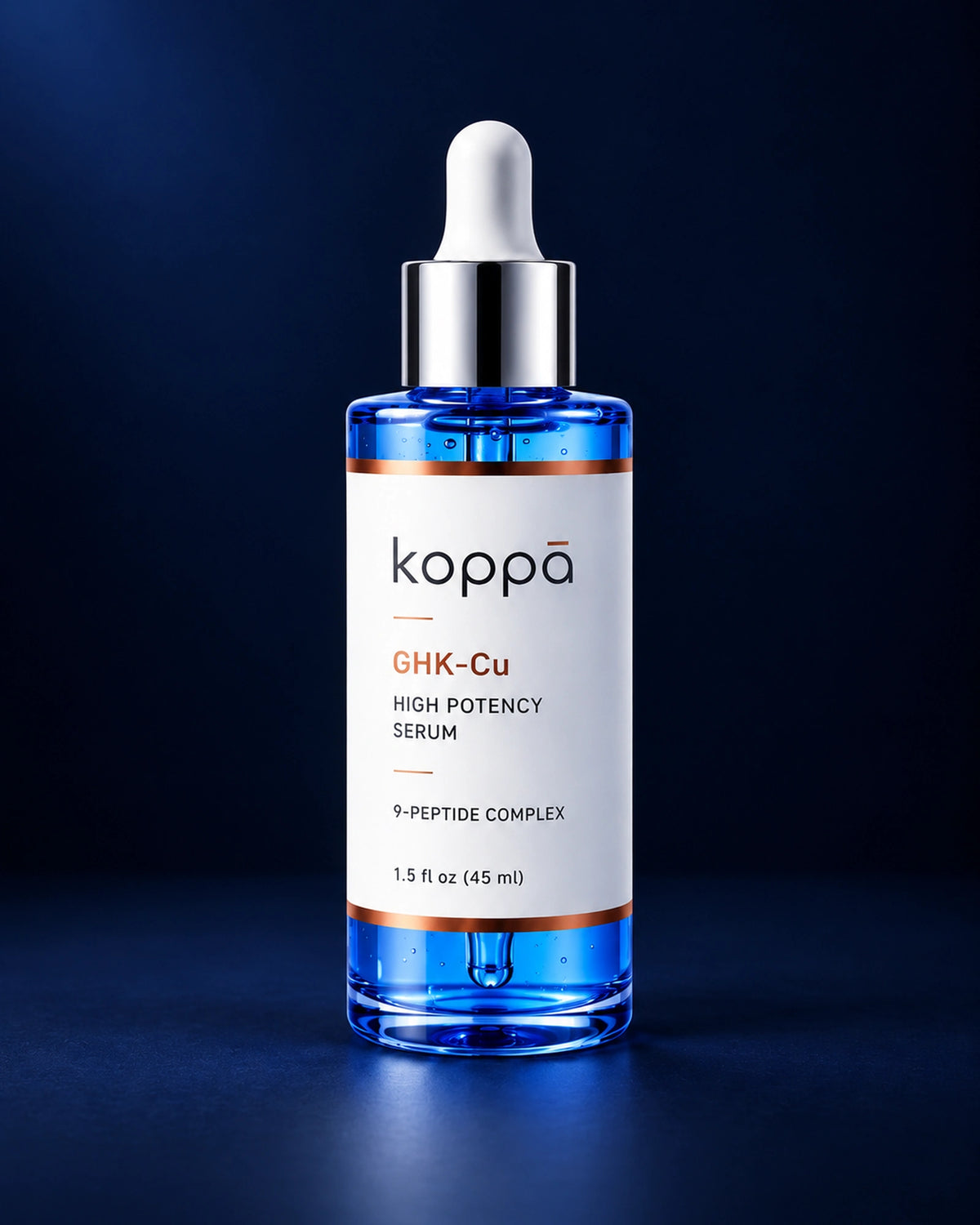
Your skin didn't forget how to
make collagen. It stopped being asked.
Collagen isn't a substance your skin stores — it's a protein your fibroblasts manufacture on demand. They only manufacture it when something signals them to. One of the molecules that carries that signal is GHK-Cu: a copper-binding tripeptide (glycyl-L-histidyl-L-lysine) that occurs naturally in human plasma.
GHK-Cu was first isolated in 1973, when researchers found that plasma from young donors could make older liver cells behave like younger tissue. The active compound responsible turned out to be a peptide already circulating in everyone's blood.
Levels of it fall sharply with age. By your sixties, plasma GHK-Cu sits roughly 60% below where it was in your twenties — and that decline tracks closely with the things people describe as aging skin: slower healing, a thinner dermis, less elasticity.
The fibroblasts are still there. The signal is what's missing.
Shop GHK-Cu skincare →Four things the research says GHK-Cu does to collagen.
Collagen synthesis isn't a single switch. The studies below describe GHK-Cu acting at four separate points in the process — collagen production, elastin, skin thickness and the conditions that break collagen down.
It tells fibroblasts to start building
- In fibroblast cultures, GHK-Cu stimulated collagen synthesis at very low concentrations (Maquart, 1988); later animal work reported more glycosaminoglycans, the water-holding molecules of skin, as well
- Active at concentrations as low as 0.01 nM, suggesting it works as a signalling molecule rather than a raw material (Badenhorst, 2016)
It builds elastin alongside collagen
- Collagen provides firmness; elastin provides recoil. Skin needs both to look resilient rather than merely plumped
- The 2016 nano-carrier study reported increases in both collagen and elastin from the same formulation
It thickens the layer collagen lives in
- Two separate 12-week trials reported measurable increases in dermal and epidermal thickness, not just improved surface appearance (Leyden, 2002; Finkley, 2005)
It calms the conditions that degrade collagen
- A 2018 review documented GHK-Cu suppressing pro-inflammatory signals including IL-6 and TNF-α, and reducing oxidative damage markers
- Inflammation and oxidative stress are two of the primary drivers of collagen breakdown — so this works alongside synthesis, not instead of it
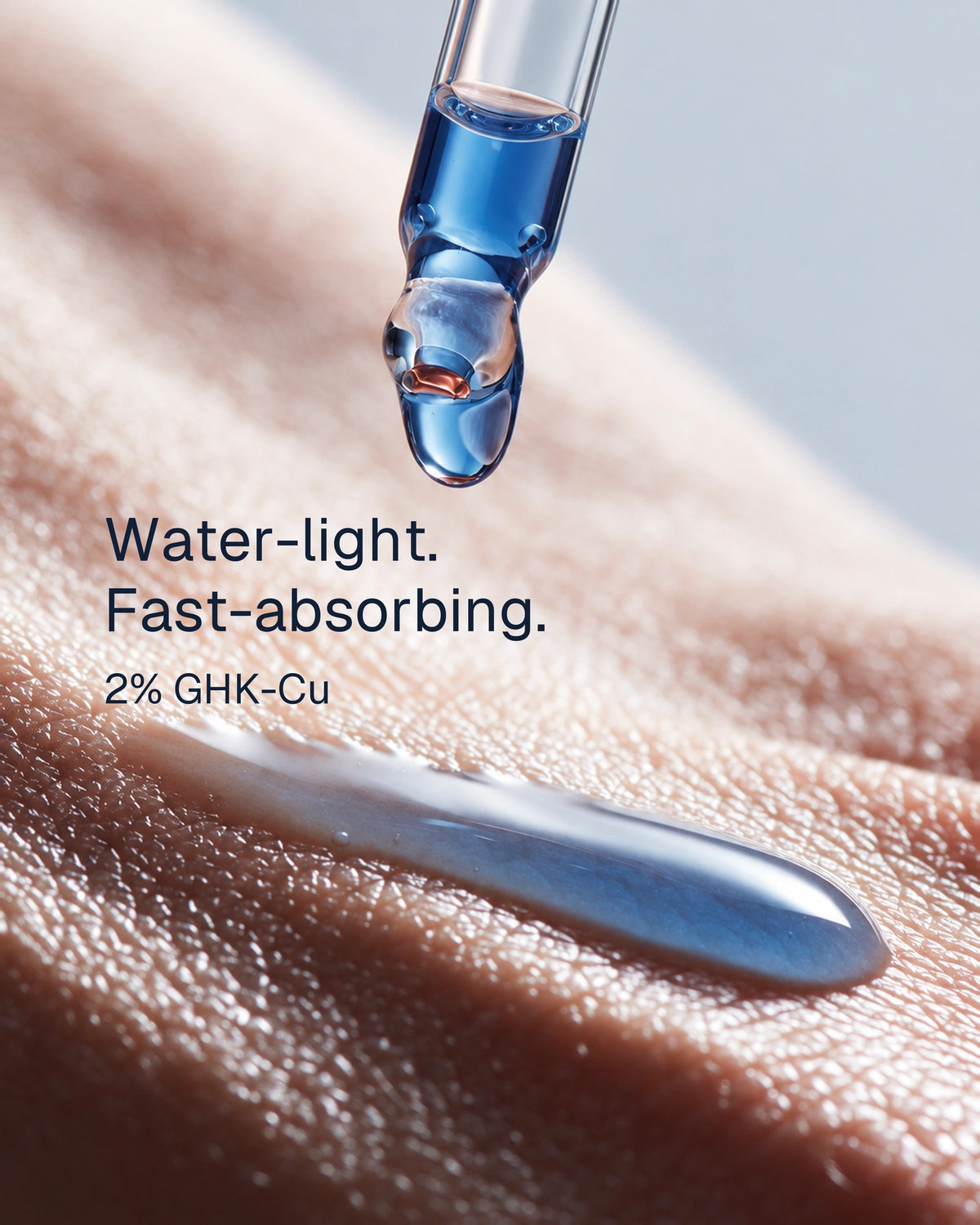
GHK-Cu is naturally blue — the colour comes from the copper ion bound within the peptide. It's the reason a genuine copper peptide serum can't be colourless.
Seven studies on GHK-Cu and collagen.
None of the studies below was run or funded by Koppā. We built our formulas around what they found. Tap any card to read the detail.
Isolation of GHK from Human Plasma
The study that started everything. Biochemist Loren Pickart found that when blood plasma from young donors was added to liver cells from older donors, the older cells began functioning like younger tissue. The active compound was isolated and identified as GHK — a tripeptide naturally present in human blood.
GHK-Cu Stimulation of Collagen, Glycosaminoglycans, and Wound Repair
In cultures of human skin fibroblasts, GHK-Cu stimulated collagen synthesis at very low concentrations. Later work by the same group in animal wound models reported more collagen and glycosaminoglycans, the water-holding molecules of skin, in healing tissue. This is the cell-culture finding the later skin studies build on.
Pilot Study: GHK-Cu vs. Vitamin C vs. Retinoic Acid for Collagen Production
A one-month pilot in 20 healthy volunteers, with creams applied to thigh skin and collagen measured by skin biopsy. Increased collagen production was seen in 7 of 10 people using GHK-Cu, against 5 of 10 for vitamin C and 4 of 10 for retinoic acid (tretinoin, a prescription retinoid). Partly supported by Revlon Research.
GHK-Cu Facial Cream for Photoaged Skin
71 women with mild to advanced photoaging applied a GHK-Cu facial cream twice daily for 12 weeks. The authors reported improved laxity, clarity and overall appearance, fewer fine lines, shallower wrinkles, and increased skin density and thickness. Presented as a conference abstract and summarised in later reviews; the authors were affiliated with ProCyte and Neutrogena.
Half a century of research on one molecule your skin already knows how to use.
Start Your Protocol →Epidermal and Dermal Thickening with GHK-Cu
67 women applied GHK-Cu cream twice daily for 12 weeks. In this study on GHK-Cu, researchers reported measurable changes in epidermal and dermal thickness, associated with improvements in the look of firmness rather than surface hydration alone.
GHK-Cu Nano-Carrier Delivery for Wrinkle Reduction
A randomised, double-blind study of about 40 women over 8 weeks. A GHK-Cu serum in a nano-lipid carrier reduced wrinkle volume by 55.8% and wrinkle depth by 32.8% compared with the carrier alone, and wrinkle volume by 31.6% compared with Matrixyl 3000. In cell culture, the same study found GHK-Cu increased collagen and elastin at concentrations as low as 0.01 nM.
Company Study: GHK-Cu Topical Gel for Collagen Density
21 people applied the company's own GHK-Cu gel daily for 3 months. Collagen density, measured by ultrasound, rose 28% on average and 51% in the top quarter. The results were announced by Yuvan Research, the gel's maker, in a press release.
GHK-Cu vs. vitamin C vs. retinoic acid.
These three actives have all been tested for collagen response, and in a 1998 pilot they were tested side by side on the same protocol.
Drawn from Abdulghani et al., 1998: a one-month pilot of 20 volunteers, with creams applied to thigh skin and collagen measured by biopsy. A response means a measurable increase in collagen production, not how large it was.
Collagen is built on a timeline you can't rush.
The studies above ran between four weeks and three months. That range is a fair guide to how long change takes to become measurable — and a reason to judge a copper peptide by the season, not the week.
The shortest trial in this set measured a collagen response at one month. Visible change at this stage is typically hydration and tone rather than firmness.
Abdulghani, 1998
The 2016 nano-carrier trial recorded reductions in wrinkle volume and depth over an 8-week course, alongside collagen and elastin increases.
Badenhorst, 2016
Both 12-week studies reported measurable increases in dermal and epidermal thickness.
Leyden, 2002 · Finkley, 2005
A company study of a GHK-Cu gel reported a 28% average increase in collagen density at three months, with top responders at 51%. It was announced by the company in 2023.
Yuvan Research, 2023 (press release)
What this evidence shows.
The research on GHK-Cu and collagen is unusually deep for a cosmetic ingredient — five decades of work, and human studies with control groups. Koppā's labels state the GHK-Cu percentage, and the raw GHK-Cu is certified at source.
We didn't fund this research. We read it, and formulated around what it found. Every number on this page links back to its published source so you can check our reading against theirs.
Nothing here is a medical claim, and no skincare product treats a medical condition. What the evidence supports is narrower and more useful than that: GHK-Cu is a naturally occurring peptide that declines with age, and topical application of it has been associated with measurable collagen and skin-thickness changes across multiple human studies.
GHK-Cu and collagen, answered.
Your fibroblasts are waiting for the signal.
Fifty years of research behind one peptide your skin already recognises. See how Koppā formulates with it.


