Safety, honestly

Are copper peptides safe? Side effects, and who should ask a doctor first

For most people topical copper peptides are well tolerated, and the side effects that do happen stop when you stop.

Prefer the full routine? The Protocol, $175
Two faces close together, a stroke of blue capsule cream on one cheek
  • 2% GHK-Cu serum
  • Fragrance-free, silicone-free
  • Cruelty free
  • Full ingredient list on every product
  • Free shipping over $100
Low
Sensitisation potential

Per a dermatology review of the literature

Decades
Of topical use

Cells, animals and human skin

7 to 10 days
Patch test

Inside the arm, twice a day

0.5%
In the capsule cream

The gentler place to start

What it is

What a copper peptide is

Before the safety question, the ingredient itself.

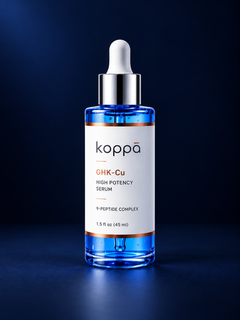
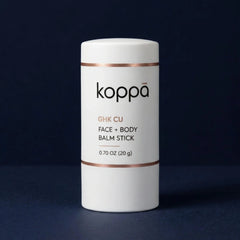
GHK-Cu is a small peptide, three amino acids long, carrying a copper ion. GHK occurs naturally in human plasma, saliva and urine, and its levels decline with age2. Its copper complex is blue, which is why copper peptide serums are blue, and it has been used in cosmetics for decades for how skin looks and feels. koppā's products carry it at 2% in the serum and 0.5% in the capsule cream and the balm stick, with the concentration and the full ingredient list on every product page.

What the science says
What the science saysGHK-Cu / Copper Tripeptide-1

So, are copper peptides safe?

For most people, yes, on the evidence available. Two things are true at once: GHK-Cu has a long, broad research record, and copper is a metal that deserves a light hand.

GHK is a naturally occurring tripeptide in human plasma, saliva and urine, and its levels decline with age2. Its copper complex has been studied in cells, in animals and on human skin for decades; the two reviews by Pickart and colleagues that gather this work describe topical use as well tolerated across the studies they cover12. Laboratory work on human skin samples shows the peptide penetrates and is retained in the skin layers rather than passing straight through5.

The caution is copper itself. Copper delivered through skin can irritate, and one research group has pointed out that this potential is easy to overlook when the focus is on benefits4. True copper allergy is different and appears uncommon: a dermatology review found copper has a low sensitisation potential3. So the realistic risks are irritation from too much, too soon, or from the rest of a formula, not the peptide doing something dangerous.

What's established

Decades of topical use, described as well tolerated across the studies the reviews gather12, and a low sensitisation potential for copper itself3.

What isn't

Studies in pregnancy, while breastfeeding, or on a diagnosed skin condition. Unstudied is not the same as unsafe, but it means ask a doctor first.

What that means

Patch test, start once a night, and treat any reaction as information. Mild dryness: slow down. Itching, swelling or spreading: stop and see a dermatologist.

A fingertip pressing capsule cream into the back of a hand
The gentler place to start0.5% GHK-Cu · Fragrance-free, silicone-free
Side effects

Side effects people actually report

From forums, from customers, and from the research. In rough order of how often they come up.

Dryness or tightness

The most common one, usually in the first two weeks, usually from starting twice a day. Cut back to once a night and moisturise on top.

Redness or stinging

Copper itself can irritate skin4, but more often it is the rest of the formula: fragrance, alcohol, preservatives, or what it's layered with. Fewer extras means fewer suspects.

A blue tint

GHK-Cu is blue because copper is blue. A faint tint means too much product or not enough time to absorb. It washes off.

New bumps

GHK-Cu isn't an exfoliant, so this isn't purging. It's information: the product or the routine may not suit you.

Itching, swelling or a spreading rash

A reaction, not a phase. Stop, and see a dermatologist, who can patch test you properly.

Why we keep it topical

Real people, real skin, nothing you can't check.

Compare all four

We're real people too. We ask the same question you're asking, because our health is everything and the pressure to look good never makes a reaction worth it. We want to be sure we're safe, and we want you to be able to check.

That's why koppā only makes topical GHK-Cu: on the skin, where the human research was done, in formulas with the concentration and the full ingredient list on the label. Nothing you can't check, and nothing you can't stop.

Start with the 2% serum, the capsule cream or the balm stick, or take all three as the Protocol. The research behind them is on the Science page, and the questions people ask next are answered here: copper uglies, copper peptide injections and copper peptides vs retinol.

Ask first

Who should ask a doctor first

Not because copper peptides are known to be a problem in these situations, but because nobody has studied them there, and that's the honest position.

Pregnancy and breastfeeding

There are no studies of topical GHK-Cu in pregnancy or while nursing. Ask your doctor or midwife about anything new, and take their answer over ours.

A diagnosed skin condition

If you're under a dermatologist's care, they should know what's in your routine. Add nothing without asking.

Copper allergy or a metal sensitivity

Rare, but real3. If you've reacted to copper jewellery or had a positive patch test to copper, this isn't the ingredient for you.

Broken skin

Cosmetics are for intact skin. Wait until it has closed.

Anything injected is outside this page entirely. NPR reported in 2026 that there are no published human studies showing injected GHK-Cu is safe6; koppā only makes it for skin.

The routine

How to use copper peptides safely

The same five habits that avoid the copper uglies.

  1. 01

    Patch test

    Patch test. A small amount on the inside of the arm, twice a day, for seven to ten days7.

  2. 02

    Once a night

    Start once a night on clean skin, then moisturise. Add a second application only after a few weeks, if your skin wants it.

  3. 03

    One at a time

    One new product at a time, two weeks apart.

  4. 04

    Separate the strong actives

    Keep strong acids, vitamin C and retinoids in a different step or on different nights while you settle in.

  5. 05

    Read the label

    Read the label. Know the concentration and the full ingredient list, so if something goes wrong you know what to look at. koppā prints both on every product page.

If you're cautious
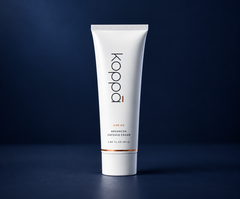
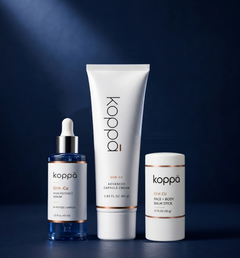
Koppā GHK-Cu Advanced Capsule Cream, an 80 g copper peptide moisturizer tube, against a dark navy background

If you're cautious

The plainest way to find out.

If you're cautious, the capsule cream is the lower concentration in a moisturiser: 0.5% encapsulated GHK-Cu with 5% niacinamide and squalane, fragrance-free and silicone-free. Patch test, start once a night, and step up to the 2% serum only if your skin asks for it.

01

0.5% GHK-Cu

The lower concentration, encapsulated.

02

Fragrance-free, silicone-free

Fewer suspects if your skin does react.

03

Full ingredient list

Printed on the product page, so you know what to look at.

0.5% GHK-Cu in a fragrance-free moisturiser.

GHK-Cu Advanced Capsule Cream: Copper Peptide Moisturizer
If you're cautious

The easy way in: the capsule cream.

If you're cautious, start with koppā's capsule cream: 0.5% encapsulated GHK-Cu with 5% niacinamide and squalane, fragrance-free and silicone-free, in a cream that doubles as your moisturiser. It's the lower concentration and the plainest way to find out how your skin takes to copper peptides before stepping up to the 2% serum.

  • Fragrance-free, silicone-free
  • Cruelty free
  • Full ingredient list and GHK-Cu concentration on every product page
  • Free shipping over $100
$70
GHK-Cu Advanced Capsule Cream
Shop now, $70
Or take all three as the Protocol, $175

Free shipping over $100. See all four products

The Koppā community

Koppā, in everyday life.

Sarah M- I tried to to use an acid treatment to get rid of an old eyebrow tattoo and ended up with a chemical burn (oops).  Once it had started to heal I began using the stick on it a few times a day.  2 days later it was so much better.
Sarah M- I tried to to use an acid treatment to get rid of an old eyebrow tattoo and ended up with a chemical burn (oops). Once it had started to heal I began using the stick on it a few times a day. 2 days later it was so much better.
Amanda G- this is a LOT of product.  I'd never heard of GHK in a stick but I'm so glad I found this one. It's great after shaving my legs.  Soothing, and not messy which I love.
Amanda G- this is a LOT of product. I'd never heard of GHK in a stick but I'm so glad I found this one. It's great after shaving my legs. Soothing, and not messy which I love.
Jay W- I'm a pilot. The air on the plane is so dry, after a long flight I look 100 years old. This GHK cream changed everything. I never leave for work without this cream in my flight bag anymore. Plus its a big tube, but can still take it through security.
Farrah J- the cream actually has the capsules in it.  I find the cream super moisturizing, not sticky.
Farrah J- the cream actually has the capsules in it. I find the cream super moisturizing, not sticky.
Customer feedback

From koppā customers.

Customer feedback on koppā products.

9 customer reviews
Shop the cream
GHK-Cu Advanced Capsule Cream: Copper Peptide Moisturizer
koppā, in useGHK-Cu Advanced Capsule Cream
01 / 09
“Been using it about 6 weeks now. Didn't notice much the first couple weeks, but my skin looks noticeably smoother around my cheeks and my makeup sits better. Will repurchase.”

Sarah M.koppā customer

FAQ

Questions about copper peptide safety

Are copper peptides safe to use every day?

Once a day is the usual starting point and many people stay there. GHK-Cu is not an exfoliant and doesn't accumulate irritation the way acids can, and the reviews describe topical use as well tolerated12. If your skin is comfortable after a few weeks, twice a day is common. If it isn't, once is plenty.

Can copper peptides cause copper toxicity?

There is no evidence that topical use at cosmetic concentrations raises body copper to harmful levels; skin-penetration studies show the peptide is largely retained in the skin5. Ingesting or injecting copper is a different matter and not what any cosmetic is for.

Are copper peptides safe in pregnancy?

Unstudied, which is not the same as unsafe, but it means we can't tell you. Ask your doctor or midwife.

Do copper peptides make skin sun sensitive?

There is no evidence that GHK-Cu increases sun sensitivity, unlike retinoids and some acids. Wear sunscreen every day anyway.

The formulas

Four formulas. Find your next step.

Every koppā formula is fragrance-free and silicone-free, with the GHK-Cu concentration and full ingredient list on its page.

Prices and stock update live.

Sources

References

Research on GHK-Cu the ingredient, not on koppā's finished formulas. Where a study was run in cells or on skin samples rather than on people, we say so in the text.

  1. 1.Pickart L, Margolina A. Regenerative and Protective Actions of the GHK-Cu Peptide in the Light of the New Gene Data. International Journal of Molecular Sciences. 2018;19(7):1987. Read the paper
  2. 2.Pickart L, Vasquez-Soltero JM, Margolina A. GHK Peptide as a Natural Modulator of Multiple Cellular Pathways in Skin Regeneration. BioMed Research International. 2015;2015:648108. Read the paper
  3. 3.Hostynek JJ, Maibach HI. Copper hypersensitivity: dermatologic aspects, an overview. Reviews on Environmental Health. 2003;18(3):153-183. Read the paper
  4. 4.Li H, Toh PZ, Tan JY, et al. Selected Biomarkers Revealed Potential Skin Toxicity in Traditional Chinese Medicine-Derived Copper Peptide Complexes. Scientific Reports. 2016;6:37664. Read the paper
  5. 5.Hostynek JJ, Dreher F, Maibach HI. Human skin penetration of a copper tripeptide in vitro as a function of skin layer. Inflammation Research. 2011;60(1):79-86. Read the paper
  6. 6.NPR. People are injecting copper peptides ahead of the science. 7 September 2026. Read the paper
  7. 7.American Academy of Dermatology Association. How to test skin care products. aad.org. Read the paper

Still not sure?

Ask us about an ingredient, a concentration or how to fit GHK-Cu into your routine. We're real people on the other end, and we'd rather you asked than guessed. If you're managing a diagnosed skin condition, a dermatologist is the right person to ask first.

Page updated 29 September 2026