
Clinical evidence for copper peptides (GHK-Cu): every study, with sources
GHK-Cu has been studied for skin since 1988, when researchers found it stimulates collagen production in skin cells. It has since been tested on people in studies of 20 to 71 participants lasting up to three months; the strongest, a double-blind trial, measured 55.8% less wrinkle volume than the carrier alone after 8 weeks.

- 2% GHK-Cu serum
- Fragrance-free, silicone-free
- Cruelty free
- Full ingredient list on every product
- Free US shipping over US$100
GHK-Cu stimulated collagen synthesis in skin cells
From 20 to 71 participants, up to three months
12 weeks, firmer, denser and thicker skin
Against the carrier alone, double-blind, 8 weeks
Every study, side by side
In date order. Who took part, for how long, what was compared, what was found, where it was published and who wrote or funded it.
| Study | Design | Who took part | How long | What was tested | Compared with | What it found | Published as | Authors | Source |
|---|---|---|---|---|---|---|---|---|---|
| Maquart et al., 1988 | Laboratory, cell culture | Human skin fibroblasts | Not applicable | GHK-Cu added to fibroblast cultures | Untreated cultures | Stimulated collagen synthesis at very low concentrations: the finding the later skin studies build on | FEBS Letters, peer-reviewed | Maquart, Pickart and colleagues | pubmed.ncbi.nlm.nih.gov |
| Abdulghani et al., 1998 | Pilot, skin biopsies | 20 healthy adults | 1 month | GHK-Cu cream on thigh skin | Tretinoin, vitamin C and melatonin creams | Increased collagen production in 7 of 10 GHK-Cu users, against 4 of 10 for tretinoin and 5 of 10 for vitamin C. | Disease Management and Clinical Outcomes, peer-reviewed | Abdulghani and colleagues | doi.org |
| Leyden et al., 2002 (facial cream) | Clinical study | 71 women with mild to advanced sun-ageing | 12 weeks, twice daily | GHK-Cu facial cream | Not stated in the abstract | Improved skin laxity, clarity and overall appearance; reduced fine lines and wrinkle depth; increased skin density and thickness | Conference abstract, American Academy of Dermatology 60th Annual Meeting | Leyden and colleagues | pmc.ncbi.nlm.nih.gov |
| Leyden et al., 2002 (eye cream) | Controlled clinical study | 41 women | 12 weeks | GHK-Cu eye cream around the eyes | Placebo and a vitamin K eye cream | Better than both on lines and wrinkles, overall appearance, skin density and thickness | Conference abstract, American Academy of Dermatology 60th Annual Meeting | Leyden and colleagues | pmc.ncbi.nlm.nih.gov |
| Finkley et al., 2005 | Clinical study | 67 women aged 50 to 59 | 12 weeks, twice daily | GHK-Cu facial cream | Not stated | Improved laxity, clarity and firmness; reduced fine lines, coarse wrinkles and mottled pigmentation; increased skin density and thickness | Book chapter, Cosmeceuticals and Active Cosmetics, 2nd edition | Finkley and colleagues | pmc.ncbi.nlm.nih.gov |
| Badenhorst et al., 2016 | Randomised, double-blind | About 40 women | 8 weeks, twice daily | GHK-Cu serum in a nano-lipid carrier | The carrier alone, and Matrixyl 3000 | Wrinkle volume 55.8% lower and wrinkle depth 32.8% lower than the carrier alone; wrinkle volume 31.6% lower than Matrixyl 3000 | Journal of Aging Science, peer-reviewed | Badenhorst and colleagues | walshmedicalmedia.com |
| Krüger et al., 2003 | Pilot study | Not recorded | Not recorded | Topical GHK-Cu complex on aged skin | Not recorded | Increased epidermal and dermal thickness; improved hydration, smoothness and elasticity; more collagen I | Kosmetische Medizin (German); summarised in Pickart and Margolina, 2018 | Krüger and colleagues | pmc.ncbi.nlm.nih.gov |
| Yuvan Research, 2023 | Company clinical trial | 21 adults | 3 months | The company's GHK-Cu gel | Not stated | Skin collagen density, measured by ultrasound, up 28% on average and 51% in the top quarter | Company press release | Yuvan Research | eurekalert.org |
Conference abstracts, a book chapter and a company press release are labelled as such. Each source links to the paper or to the peer-reviewed review that summarises it.
What the evidence supports
Collagen
GHK-Cu stimulated collagen synthesis in skin cells in 1988. In a 1998 biopsy study, more people using a GHK-Cu cream showed increased collagen production than those using tretinoin or vitamin C.
Firmness, density and lines
Studies of 41 to 71 women over 12 weeks reported firmer, denser, thicker skin and fewer visible lines. A double-blind trial measured 55.8% less wrinkle volume than the carrier alone after 8 weeks.
Everyday use
Participants used GHK-Cu twice daily for up to 12 weeks, without the irritation, dryness and sun sensitivity that limit retinoid use.

The studied peptide, at a stated 2%.
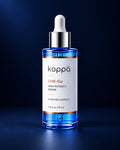
koppā's serum carries the same peptide at a stated 2% concentration in a 45 ml bottle. Supplier documentation specifies at least 99% purity for the raw GHK-Cu, and every ingredient is named on the product page.
- Fragrance-free, silicone-free
- Cruelty free
- Full ingredient list and GHK-Cu concentration on every product page
- Free US shipping over US$100
Free US shipping over US$100. See all four products
Questions about the GHK-Cu evidence
Is GHK-Cu backed by human studies?
Yes. Seven human studies and reports, from 20 to 71 participants and up to three months of use, alongside the 1988 laboratory finding on collagen. The strongest is a 2016 double-blind trial in which a GHK-Cu serum reduced wrinkle volume by 55.8% against its carrier.
Is GHK-Cu better than retinol?
No study has compared them on the face. Copper peptides can be used morning and night without the irritation phase of retinoids, which have the longer trial record. GHK-Cu's studies used it twice daily for up to 12 weeks without the irritation, dryness and sun sensitivity that limit retinoid use.
Which GHK-Cu study is the strongest?
Badenhorst and colleagues, 2016: a randomised, double-blind trial in about 40 women over 8 weeks. Wrinkle volume fell 55.8% and wrinkle depth 32.8% against the carrier alone, and wrinkle volume fell 31.6% against Matrixyl 3000.
How much GHK-Cu is in koppā's products?
2% in the serum and 0.5% in both the capsule cream and balm stick. The percentage is printed on every label, and supplier documentation specifies at least 99% purity for the raw GHK-Cu.
References
The papers and reviews behind the table. Where a study was run in cells, or reported only as an abstract or a press release, the table says so. The studies behind each koppā product, grouped by ingredient, are on the study references page.
- 1.Maquart FX, Pickart L, Laurent M, Gillery P, Monboisse JC, Borel JP. Stimulation of collagen synthesis in fibroblast cultures by the tripeptide-copper complex glycyl-L-histidyl-L-lysine-Cu2+. FEBS Letters. 1988;238(2):343-346. Read the paper
- 2.Abdulghani AA, Sherr A, Shirin S, et al. Effects of topical creams containing vitamin C, a copper-binding peptide cream and melatonin compared with tretinoin on the ultrastructure of normal skin. Disease Management and Clinical Outcomes. 1998;1(4):136-141. Read the paper
- 3.Pickart L, Vasquez-Soltero JM, Margolina A. GHK Peptide as a Natural Modulator of Multiple Cellular Pathways in Skin Regeneration. BioMed Research International. 2015;2015:648108. Summarises Leyden 2002 and Finkley 2005. Loren Pickart discovered GHK and founded a GHK-Cu skincare company. Read the paper
- 4.Badenhorst T, Svirskis D, Merrilees M, Bolke L, Wu Z. Effects of GHK-Cu on MMP and TIMP Expression, Collagen and Elastin Production, and Facial Wrinkle Parameters. Journal of Aging Science. 2016;4(3):166. Read the paper
- 5.Pickart L, Margolina A. Regenerative and Protective Actions of the GHK-Cu Peptide in the Light of the New Gene Data. International Journal of Molecular Sciences. 2018;19(7):1987. Summarises Krüger 2003. Read the paper
- 6.Yuvan Research. Epigenetic mechanisms activated by GHK-Cu increase skin collagen density in clinical trial. Press release, EurekAlert, 25 May 2023. Read the paper
GHK-Cu, at a stated percentage.
2% in the serum, 0.5% in the capsule cream and the balm stick, each with the full ingredient list.
Prices and stock update live.
 For this question
koppā 2% GHK-Cu Copper Peptide Serum
Concentrated peptides for firmer, smoother-looking skin.
In stock
Shop now Step 2, nourish
koppā 0.5% GHK-Cu Copper Peptide Moisturizer (Capsule Cream)
Capsule-released peptides for deep, lasting hydration.
In stock
Shop now Step 3, seal
koppā 0.5% GHK-Cu Copper Peptide Face + Body Balm Stick
Collagen support and hydration, from face to body.
In stock
Shop now The Protocol
koppā GHK-Cu Copper Peptide Skincare Routine Set
Your complete peptide routine, for less.
In stock
Shop nowSave $15 versus buying separately
Keep reading
Still not sure?
Ask us about an ingredient, a concentration or how to fit GHK-Cu into your routine. We're real people on the other end, and we'd rather you asked than guessed.
Page updated 11 October 2026