


buying guide
Why Is Copper Peptide Serum Blue?

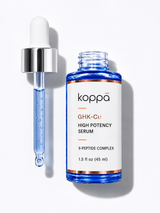
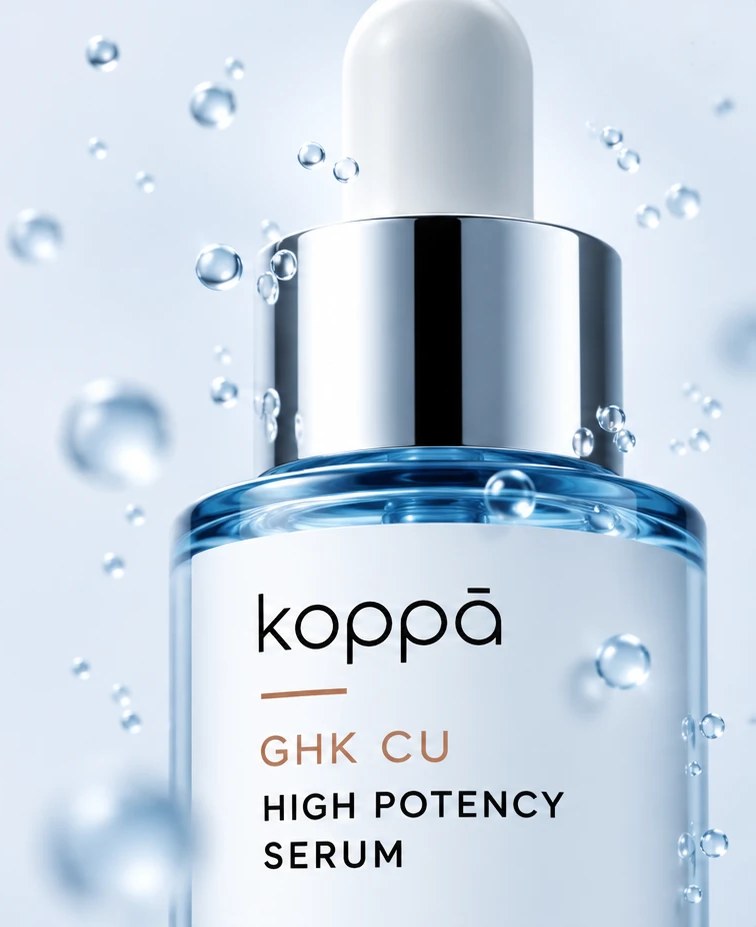
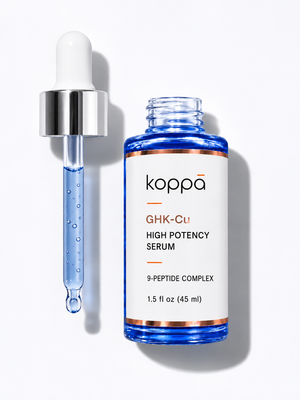
Copper peptide serum is blue because GHK-Cu is a copper complex, and copper(II) complexes absorb light in a way that makes them look blue. The colour comes from the ingredient itself, not from a dye. It tells you copper is in the formula, but it is not a measure of strength: the percentage on the label is the thing to compare.
Below: the chemistry behind the colour, what a deeper or paler blue does and doesn't mean, and what to look at on the label instead.
Why is copper peptide serum blue?
GHK-Cu is a small peptide (glycyl-histidyl-lysine) holding a copper ion. When copper is bound in this way, it absorbs some of the orange and red part of visible light, so the solution that is left looks blue. That is ordinary colour chemistry, the same reason many copper compounds in a lab are blue or blue-green.
Chemists have studied this complex in detail. A 2001 study in Biochimica et Biophysica Acta[1] by Conato and colleagues used UV-visible spectroscopy, among other methods, to map how GHK binds copper. A 2012 study in the Journal of Biological Inorganic Chemistry[2] by Trapaidze and colleagues measured how tightly it holds it: about as tightly as the copper-carrying site on albumin, the main protein in blood.
So the blue is not decoration. It is what the ingredient looks like when the copper is bound to the peptide.
Does a deeper blue mean the serum is stronger?
No. Depth of colour depends on how much copper complex is in the bottle, but also on the rest of the formula, how it was made and how the light hits it. Two serums with the same percentage can look different, and a darker one is not automatically doing more. The percentage on the label is the better thing to compare. Our guide to what 2% GHK-Cu means explains how to read it.
Why are some copper peptide serums not blue at all?
A serum can look clear, pale or tinted for several reasons: a lower amount of the copper complex, a different type of copper peptide, or a formula built around other peptides with only a trace of copper. Colour alone will not tell you which. Check the ingredient list for GHK-Cu or copper tripeptide-1 and the stated percentage.
Is the blue colour safe for skin and clothes?
The tint is part of the ingredient, so it is expected. A few drops is plenty, since too much can leave a faint blue cast on the surface, and let it absorb before it meets light fabrics. Our article on copper peptide irritation covers the difference between a colour cast and a reaction.
What does GHK-Cu do in skincare?
In research contexts GHK-Cu has been studied for its role in how skin cells signal and make structural proteins. In skincare it is used to support the look of firmer, smoother skin. For the research itself, start with what GHK-Cu is.
How to use a blue copper peptide serum
- Clean, dry skin first.
- 3 to 4 drops. That is enough for the face and neck, morning and night.
- Let it absorb before moisturiser, and before your collar or pillowcase touches it.
- Moisturise, then SPF 30 or higher in the morning.
What should you look for instead of the colour?
Three things on the label: the ingredient name (Copper Tripeptide-1 or GHK-Cu), a stated GHK-Cu percentage, and a formula you can use every day. The blue tells you copper is there; the percentage and the formula tell you what you are buying.
Frequently asked questions
Is blue copper peptide serum dyed?
It doesn't need to be. GHK-Cu is blue on its own, because the bound copper absorbs orange and red light. Check the ingredient list if you want to be sure about any product.
Does a darker blue serum work better?
No. Colour depends on the formula, how it was made and the light, as well as on how much copper complex is present. Compare the stated GHK-Cu percentage instead.
Why is my copper peptide serum clear?
It may have less copper complex, a different copper peptide, or other peptides with only a trace of copper. Look for GHK-Cu or copper tripeptide-1 on the ingredient list, and a stated percentage.
Will blue serum stain my skin or pillow?
Use a few drops and let them absorb. Too much can leave a faint blue cast on the surface. Let it sink in before it touches light fabrics.
The short version
Copper peptide serum is blue because GHK-Cu is a copper complex, and bound copper absorbs orange and red light. The colour is the ingredient, not a dye, and not a sign of strength. To compare serums, read the label: the ingredient name, the stated percentage and the rest of the formula. If you want to try one, use 3 to 4 drops on clean skin and let it absorb before anything else goes on.
Sources
- Conato C, Gavioli R, Guerrini R, et al. Copper complexes of glycyl-histidyl-lysine and two of its synthetic analogues: chemical behaviour and biological activity. Biochimica et Biophysica Acta. 2001;1526(2):199-210. Read the paper
- Trapaidze A, Hureau C, Bal W, Winterhalter M, Faller P. Thermodynamic study of Cu2+ binding to the DAHK and GHK peptides by isothermal titration calorimetry (ITC) with the weaker competitor glycine. Journal of Biological Inorganic Chemistry. 2012;17(1):37-47. Read the paper
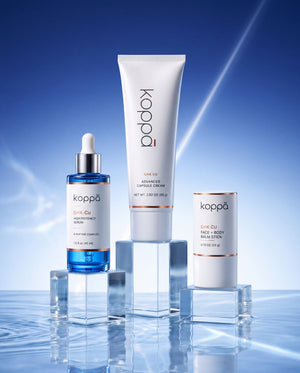
koppā, who publish this journal, make the GHK-Cu 2% High Potency Serum, a fragrance-free serum with 2% GHK-Cu on the label.