


clinical research
Do Collagen Supplements Work for Skin? Collagen vs GHK-Cu

Do collagen supplements work for skin? The trials disagree. Reviews that pool every study find small gains in skin hydration and elasticity, but a 2025 review in The American Journal of Medicine found no effect in the higher-quality trials or in those without industry funding. Swallowed collagen is digested like any other protein, so it can't be sent to your face. GHK-Cu (copper tripeptide-1) works differently: it's a small peptide your skin already uses as a signal to manage its own collagen, applied where you want the change.
Below: what happens to collagen you swallow, what four recent reviews found and why they disagree, whether supplements are safe, what actually protects skin collagen, and how GHK-Cu compares.
What is collagen, and why does skin lose it?
Collagen is the main protein in the scaffolding under your skin. It gives skin its structure and some of its bounce. The cells that make it, called fibroblasts, slow down as you get older, and sun exposure speeds the loss up.
That is the whole reason both products exist. Supplements try to top up the supply. Copper peptides try to nudge the cells that make it. Our piece on skin aging and collagen goes deeper on why levels fall.
What happens when you swallow collagen?
Most supplements contain hydrolyzed collagen, also called collagen peptides: collagen already broken into smaller pieces to make it easier to digest. Your gut treats it like any protein, breaking it down into amino acids and short peptides before absorbing it. Your body then uses those pieces wherever it needs protein. It can't route swallowed collagen to your face.
A 2023 review in Nutrients[1] describes studies in which some collagen-derived peptides, such as Gly-Pro-Hyp, were detected in the blood after supplements, and the theory is that they act as a signal to skin cells to make more collagen. That's plausible. Showing a peptide reaches the bloodstream isn't the same as showing a supplement visibly changes skin, though. For that, you need clinical trials.
Do collagen supplements work for skin? What the trials found
Four recent reviews have pooled the trials, and the difference between them is the useful part.
The positive reviews
The 2023 Nutrients review pooled 26 randomized trials with 1,721 people, mostly running two to twelve weeks. Collagen was linked with better skin hydration and elasticity than placebo. The authors also noted big differences between the products, doses and measurements used, and called for larger, better-designed studies.
A 2025 review in the Indian Journal of Dermatology, Venereology and Leprology pooled 10 randomized trials with 646 people. It found improved hydration and elasticity, usually at around 4 g a day over one to three months, mostly in women, with results that varied a fair amount between studies.
What happened when quality and funding were taken into account
A 2025 review in The American Journal of Medicine[2] pooled 23 randomized trials with 1,474 people. Taken together, collagen looked helpful for hydration, elasticity and wrinkles. But the trials without funding from pharmaceutical companies showed no effect, and neither did the high-quality trials. The authors concluded there is currently no clinical evidence to support collagen supplements for preventing or treating skin aging.
That doesn't prove collagen does nothing. It does mean the positive results lean heavily on industry-funded trials.
The latest review
A 2026 review in the Journal of Aesthetic Medicine[3] looked at 15 randomized trials and found that collagen may improve measured hydration and elasticity. The authors called the effects moderate and uncertain: the elasticity result no longer held when one multi-ingredient trial was left out, most trials ran only 12 to 16 weeks, and ties to manufacturers were common. They suggested treating collagen cautiously, as an add-on rather than a proven treatment.
Why do collagen studies disagree?
- The products differ. Trials use different collagen sources, peptide mixes, doses and lengths, and many test multi-ingredient drinks, so one result can't be applied to every powder or capsule.
- The measurements differ. Better hydration doesn't mean fewer wrinkles, or that skin has made meaningful new collagen.
- Quality and funding matter. Small trials, short follow-up and conflicts of interest can all shift results, which is exactly what the 2025 review found when it split the studies.
- Measurable isn't the same as visible. A reading can change enough to register in a trial without a difference you'd notice in the mirror.
Can collagen supplements reduce wrinkles?
There isn't enough reliable evidence to say they do. Some trials report better wrinkle measurements, but the 2025 review found no significant benefit in its higher-quality studies. When a supplement says it's clinically proven, it's worth asking what was measured, in how many people, for how long, and whether anyone independent repeated it. Our article on what clinical skincare claims actually mean goes through those questions.
How long does collagen take to work on skin?
The four, eight or twelve weeks on supplement labels usually reflect how long individual trials ran. Because the higher-quality evidence hasn't shown a dependable benefit, there's no reliable timeline for visible results.
Are collagen supplements safe?
Collagen was generally well tolerated in the trials, but supplements aren't checked the way medicines are. The FDA explains[4] that manufacturers are responsible for evaluating the safety and labeling of their supplements before they're sold, and the agency acts once products are on the market. Marine collagen is made from fish, which matters if you have a fish allergy.
If you take collagen, choose a product that has been independently tested, and check with your doctor first if you take medication, are pregnant or breastfeeding, or have allergies or a medical condition.
What actually protects skin collagen?
- Daily sunscreen. Sun is a major driver of collagen loss, and in a randomized trial over about four and a half years, daily sunscreen use slowed measurable skin aging. Our article on that trial covers it.
- Enough protein and vitamin C. Skin needs both to make and maintain collagen, and a balanced diet provides them without a specialized supplement.
- Sleep and everyday habits. Sleep, smoking and overall health all show on skin; our article on sleep and skin looks at the evidence.
What is GHK-Cu, and how does it work?
GHK-Cu is a small peptide your body already makes, three amino acids long, carrying a copper ion. It isn't a source of collagen. It's closer to an instruction. A 2018 review in the International Journal of Molecular Sciences[5] puts blood levels at about 200 ng/mL at 20 and about 80 ng/mL at 60.
In research settings, the same review reports GHK-Cu increasing collagen, elastin and the water-holding molecules around them. It carries copper, which skin needs for the enzymes that build and cross-link collagen. A 2015 review in BioMed Research International[6] adds that it adjusts the enzymes that break collagen down, so old collagen gets cleared as new collagen is laid down. Our explainer on what GHK-Cu is covers the background.
Collagen vs GHK-Cu: what the evidence shows
The GHK-Cu study cited most often is from the same 2018 review: 71 women with visible sun aging used a facial cream containing GHK-Cu for 12 weeks. Their skin measured denser and thicker, looked less lax, and showed shallower fine lines.
No study has put oral collagen and topical GHK-Cu head to head. Here is how they compare:
| Collagen supplements | Topical GHK-Cu | |
|---|---|---|
| What it is | Protein, broken down in the gut | A small peptide your skin already uses |
| How it reaches skin | Through the bloodstream, not targeted | Put directly on the area you want to change |
| Independent evidence for skin | No effect in unfunded or high-quality trials, per a 2025 review | Cosmetic studies since 1998, lots of lab work |
| How long the studies ran | Mostly one to four months | 12 weeks in the most cited facial study |
Where should you put your money?
- If skin is your only goal: the independent collagen supplement trials showed no effect. A topical product you apply where you want the change, plus daily sunscreen, is the more direct route.
- If you already take collagen and like it: there's no reason it clashes with a topical routine, so keep both.
- If you're taking other supplements or medication, or you're pregnant: check with your doctor before adding anything you swallow.
Protein in your diet matters for your body in general. That's a different question from whether a collagen powder changes how your face looks.
If you're losing weight on a GLP-1 medicine and wondering whether collagen powder will help your face, our guide to Ozempic face and collagen loss covers what changes in the skin and what a routine can do.
How to use GHK-Cu: a simple routine
- Cleanse with something gentle.
- Apply the serum.
- Moisturize on top.
- Sunscreen in the morning, SPF 30 or higher. It protects the collagen you already have.
Keep vitamin C and strong acids in a different step from copper peptides. Our 3-step GHK-Cu routine lays out morning and night, and copper peptides and collagen explains the connection in more depth. Take a photo in the same light before you start: it's the fairest way to judge any product.
Frequently asked questions
Do collagen supplements actually work for skin?
The evidence is mixed. Reviews that pool every trial find small improvements in hydration and elasticity. A 2025 review that split trials by quality and funding found no effect in trials without industry money, and none in the high-quality trials. So the honest answer is: maybe a little, and the strongest support comes from sponsored studies.
Can collagen supplements reduce wrinkles?
Some trials report better wrinkle measurements, but the higher-quality evidence hasn't shown a consistent benefit, so there isn't enough reliable evidence to say oral collagen meaningfully reduces facial wrinkles.
Does eating collagen increase collagen in your face?
Not directly. Collagen is digested into amino acids and smaller peptides before it's absorbed. Some of those peptides reach the blood and may act as signals, but that hasn't been shown to raise facial collagen or visibly change skin.
Is collagen powder better than collagen capsules?
There's no good evidence that one form works better for skin. The collagen source, peptide mix, dose and overall formula matter more than whether it comes as a powder or a capsule.
Is marine collagen better for skin?
There isn't enough good comparative evidence to say marine collagen works better than bovine or other sources, and claims of better absorption don't necessarily mean better results for skin.
Can you take collagen and use GHK-Cu at the same time?
Yes. One is swallowed and one goes on skin, and there's no known interaction. For skin specifically, the topical step and sunscreen are the more direct route.
Does GHK-Cu contain collagen?
No. GHK-Cu is a small peptide carrying copper, not a piece of collagen. It works by nudging the cells that make collagen rather than supplying collagen itself. That's also why a copper peptide serum is blue: the color comes from the copper-peptide complex, not from any protein.
Is GHK-Cu better than collagen?
They work by different routes, with different evidence behind them: GHK-Cu goes on the skin you want to change and has cosmetic studies since 1998 behind it, while the independent collagen supplement trials in a 2025 review showed no effect.
The short version
Collagen supplements are broken down in the gut and can't be sent to your face. Pooled trials look positive, but in a 2025 review the independent and high-quality trials showed no effect, and a 2026 review called the gains moderate and uncertain. GHK-Cu goes on the skin you want to change and works on the system that makes collagen, with cosmetic studies since 1998 behind it. Sunscreen comes before both. To add GHK-Cu, start with 3 to 4 drops of a serum that states its concentration, morning and night.
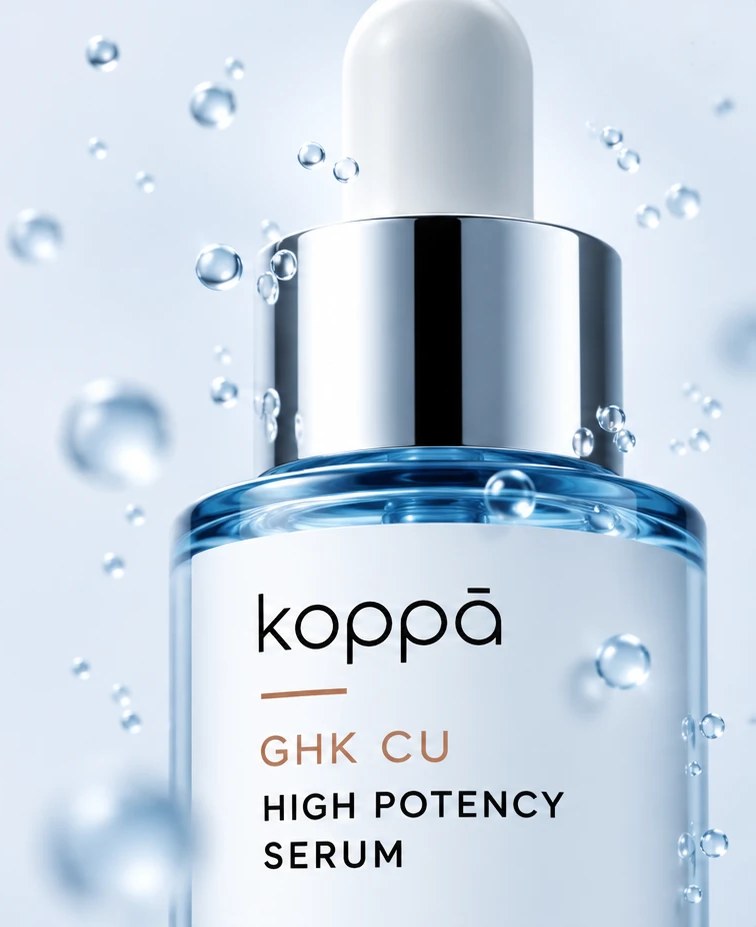
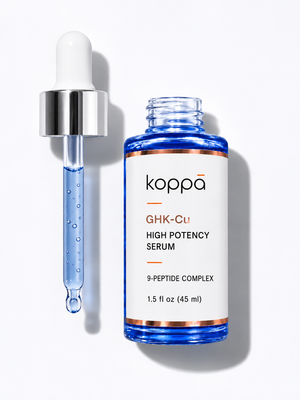
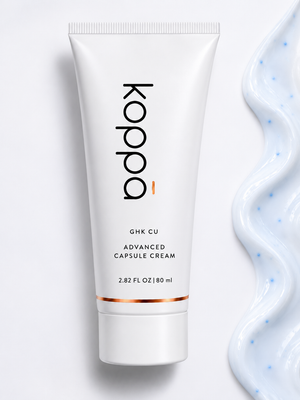
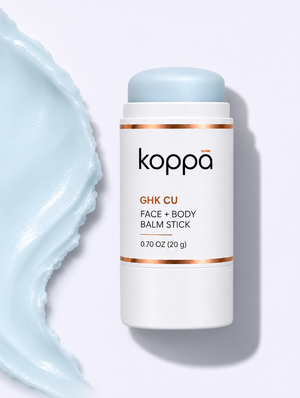
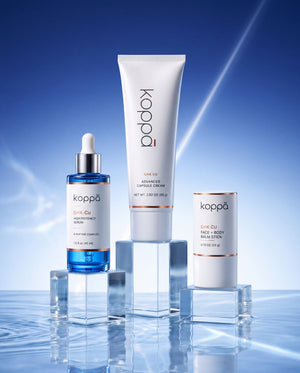
koppā, who publish this journal, make the GHK-Cu 2% High Potency Serum, a fragrance-free serum with 2% GHK-Cu on the label.
Sources and further reading
- A 2023 review in Nutrients pmc.ncbi.nlm.nih.gov
- A 2025 review in The American Journal of Medicine doi.org
- A 2026 review in the Journal of Aesthetic Medicine mdpi.com
- FDA explains fda.gov
- Loren Pickart et al. (2018). Regenerative and Protective Actions of the GHK-Cu Peptide in the Light of the New Gene Data. International Journal of Molecular Sciences. DOI: 10.3390/ijms19071987 mdpi.com
- Loren Pickart et al. (2015). GHK Peptide as a Natural Modulator of Multiple Cellular Pathways in Skin Regeneration. BioMed Research International. DOI: 10.1155/2015/648108 pubmed.ncbi.nlm.nih.gov