

Clinically Proven. But What, Exactly, Has Been Proven?

I have a question. It is one I keep asking as co-founder of koppā, whose GHK-Cu 2% High Potency Serum pairs a stated 2% GHK-Cu with six additional peptides in a water-light, fragrance-free formula.
When you see the words clinically proven on a skincare product, what do you think they mean?
That the product has been tested on people? That scientists in white coats have established beyond reasonable doubt that it does exactly what the packaging promises? That someone, somewhere, has measured wrinkles and watched them disappear?
I suspect most of us assume some combination of the above.
After all, clinically proven sounds reassuringly official. It has authority. It suggests that the science is settled and we can stop asking questions.
Which is rather convenient when there's a $150 moisturiser waiting patiently in our shopping cart.
But the more time I've spent reading skincare research, the more I've realised that two words can carry an extraordinary amount of meaning, sometimes considerably more than the evidence behind them.
And now that I'm on the other side of the beauty industry, developing products rather than simply buying them, I've become even more interested in the distinction.
Because good science deserves to be understood properly.
So let's talk about what those two words actually mean.
What Does Clinically Proven Mean in Skincare?
Here's the first thing worth understanding.
Clinically proven is not a universal scientific certification awarded to skincare products.
Generally, the phrase is used to indicate that a product or ingredient has been studied in people and that the findings support a particular claim.
But those two words alone don't tell us how many people participated, how long the study lasted, whether there was a control group, what was measured or how meaningful the results actually were.
And clinically proven does not mean a cosmetic has been approved by the FDA.
In the United States, cosmetics generally don't require FDA premarket approval, although companies remain responsible for product safety and appropriate marketing claims.
The Federal Trade Commission also requires advertising claims to be truthful, not misleading and supported by suitable evidence.
So the question isn't simply whether a company can point to a clinical study.
It's whether that study actually supports what the company is promising.
Clinical Testing and Clinical Proof Are Not Quite the Same Thing
A product can be clinically tested without necessarily being proven to deliver every benefit on its packaging.
Imagine a moisturiser tested on 30 people over four weeks.
At the end of the study, 85% say their skin feels more hydrated.
That's encouraging.
But what have we actually learned?
We've learned that most of those participants reported improved hydration during the study.
We haven't necessarily established that the product stimulates collagen, reverses wrinkles or will produce the same results for everyone who buys it.
Those would be different claims requiring different supporting evidence.
Researchers might use specialised instruments to measure hydration, wrinkle depth or skin elasticity.
Alternatively, they might ask participants whether their skin feels softer.
Both can provide useful information.
But subjective satisfaction and objectively measured changes aren't interchangeable.
And yet, once that 85% appears in enormous lettering on a beautifully designed box, it's surprisingly easy to forget what was actually measured.
I don't think that's necessarily because consumers are gullible.
I think it's because the language is designed to sound conclusive.
Science, unfortunately for marketing departments, rarely fits quite so neatly into two words.
The Ingredient May Be Studied. The Finished Product May Not Be.
This is one of the most important distinctions I've learned.
Imagine a skincare ingredient that has been investigated for decades.
Researchers have studied its biological mechanisms, observed how it behaves in laboratory conditions and published papers about its potential relationship with skin health.
A skincare company then includes that ingredient in a serum.
Can the company explain that the ingredient has been scientifically studied?
Yes, provided the evidence supports what they're saying.
Can it automatically claim its finished serum has been clinically proven to produce the same results?
No.
Because an ingredient and a finished skincare formula aren't interchangeable.
Concentration matters. Stability matters. The surrounding ingredients matter.
So does whether the ingredient remains intact, reaches the relevant part of the skin and is available to perform the function being discussed.
And skin, rather inconveniently, doesn't behave exactly like a laboratory dish.
None of this makes ingredient research irrelevant.
Quite the opposite.

Good ingredient research helps us understand which ingredients are worth investigating, what biological processes they may influence and what further questions need answering.
But there's a difference between understanding what an ingredient can do under certain conditions and demonstrating what a particular finished product does when someone applies it at home.
Those are related questions.
They are not identical ones.
Not All Scientific Evidence Is Created Equal
Research isn't simply divided into two categories: proven and unproven.
Different kinds of studies answer different questions.
Laboratory studies help scientists investigate mechanisms and biological activity. They may use isolated cells, tissues or chemical systems. They can be incredibly useful, but they don't necessarily predict what will happen on human skin.
Animal studies can provide further biological information, although their findings don't always translate directly to humans.
Human clinical studies investigate effects in actual people. They may measure hydration, elasticity, pigmentation, fine lines or other outcomes. The strength of the conclusions depends on the study's design and quality.
Randomised, controlled clinical trials can offer particularly persuasive evidence when they're appropriately designed and conducted, because they help researchers separate the product's effects from other possible explanations.
And then there's something I think deserves considerably more attention.
Replication.
One encouraging study is interesting.
Several well-designed studies producing consistent findings are much more convincing.
The number of people involved matters. The study duration matters. The comparison group matters. The measurement methods matter.
And so does the relationship between the results and the claims being made.
Science builds confidence through accumulated evidence, not one spectacular headline.
What Does a Certificate of Analysis Actually Prove?
Here's another term worth understanding.
A Certificate of Analysis, usually shortened to COA, sounds reassuringly scientific.
And it can be.
A COA reports whether a particular ingredient or product batch meets specified quality criteria, based on the tests listed in the document.
Depending on what's being assessed, those tests might examine ingredient identity, purity, concentration, pH, microbiological quality or other characteristics.
But not all COAs tell us the same thing.
A certificate for a raw ingredient provides information about that material before it becomes part of a finished product.
A certificate for the completed formulation may tell us whether the finished batch meets particular specifications.
And testing performed by an independent laboratory can provide additional verification, assuming the methods are appropriate.

Here's why the distinction matters.
Imagine a serum marketed as containing a particular percentage of an active ingredient.
A raw-material certificate might verify the purity of the ingredient supplied to the manufacturer.
But it doesn't necessarily establish how much of that ingredient remains intact in the finished serum, particularly after manufacturing and storage.
For that, we may need an appropriate analytical method applied to the completed formulation.
And even then, confirming the concentration doesn't establish that the serum reduces wrinkles.
A COA helps establish what has been measured in a product. A clinical efficacy study investigates what the product actually does.
Both have value.
Neither should be expected to prove something it hasn't tested.
Stability Testing: The Part Nobody Talks About
There's another question that I find genuinely interesting.
What happens to an ingredient after it's been added to a formula?
We tend to imagine that skincare ingredients remain exactly as they were when they entered the manufacturing process.
But formulations are complex chemical environments.
Ingredients interact. Temperature changes. Packaging affects exposure to air and light. Some compounds are more sensitive to these conditions than others.
Stability testing helps manufacturers understand whether a product maintains appropriate characteristics throughout its intended shelf life.
That might involve assessing appearance, odour, pH, separation, microbiological quality or changes in particular ingredients.
For some active ingredients, analytical testing can also establish whether the relevant chemical form remains present over time.
And that matters.
A formula might contain a carefully selected ingredient on the day it's manufactured.
But we'd also like to understand what happens to it after several months in a bathroom cupboard.
The beautifully designed bottle is only part of the story.
What's happening inside it matters too.
So Does Every Skincare Product Need Its Own Clinical Trial?
Not necessarily.
But every product needs appropriate evidence for the claims being made.
A claim about moisturizing dry skin is different from a claim about reversing biological aging or treating a medical condition.
The stronger and more consequential the claim, the stronger the supporting evidence may need to be.
Proper clinical trials require planning, suitable participants, qualified researchers, appropriate measurements and time.
They can also be expensive.
Larger companies may have more resources to commission extensive testing programmes, but that doesn't automatically make every one of their products better.
And smaller brands don't get a free pass simply because clinical studies are costly.
I think the responsible approach is fairly straightforward.
Understand the available evidence.
Formulate carefully.
Assess quality and safety.
Communicate what the evidence reasonably supports.
And acknowledge what hasn't yet been established.
It sounds rather less exciting than promising to erase ten years by next Thursday.
But it has the advantage of being sensible.
What About Real People's Experiences?
Now, here's where I think the conversation needs a little balance.
Because I don't believe everything useful about skincare comes out of a laboratory.
People use products in their actual lives. They notice how their skin feels, how a product fits into their routine, whether they enjoy using it and whether they observe changes over time.
Those experiences matter.
I've seen photographs and heard stories from people describing what they noticed while using skincare products.
Sometimes the differences are striking.
And sometimes the stories themselves are more compelling than an entire page of clinical terminology.
I don't think we need to dismiss those experiences simply because they aren't controlled studies.
But we do need to understand what they tell us.
A personal experience can be genuine and meaningful without establishing that a product caused every change someone observed.
Skin changes naturally. Hydration fluctuates. Other products may be involved. Environmental conditions, time and individual differences all play a part.
And this is especially important when we're looking at photographs.
A real before-and-after photograph is not automatically a controlled experiment.
Even when both photographs are completely genuine, lighting, facial expression, camera angle and other factors can influence what we see.
A personal experience tells us what happened to one person. A well-designed clinical study helps investigate what a product is likely to do across a broader group of people.
I think there's room to respect both.
What we shouldn't do is turn one person's experience into a universal promise.
There's an important difference between someone describing what they genuinely experienced and a brand suggesting everyone should expect the same result.
The honesty is in making that distinction.
Not in making every genuine story sound as though it was written by a legal department.
Which Brings Me to GHK-Cu
Because a Formula Is More Than One Ingredient
There's something else I've learned while developing koppā.
We talk a great deal about GHK-Cu, understandably, because it's the ingredient that started koppā. But a serum isn't simply its headline ingredient floating around in a bottle.
Our formula also includes peptides such as Acetyl Hexapeptide-8 and Palmitoyl Tripeptide-5, ingredients investigated for their potential relationship with the appearance of fine lines and skin firmness.
Then there's glycerin, trehalose, polyglutamic acid and sodium hyaluronate, which help attract and retain moisture. Hydration alone can make an appreciable difference to how smooth and plump skin looks, particularly when fine lines are accentuated by dryness.
We've also included two ceramides, panthenol and allantoin to support skin conditioning and comfort.
It illustrates why I find formulation science so interesting.
It's not simply a question of choosing an ingredient with impressive research behind it. It's about understanding what each component contributes, how those ingredients work together and whether the finished product delivers what we intended.
And that last part is precisely why testing the finished formula matters.
If you've read any of my previous articles, you'll know that GHK-Cu is the ingredient that eventually led us to create koppā.
Not because it appeared overnight as the latest skincare obsession.
And certainly not because someone on social media announced that copper peptides were a miracle in a blue bottle.
The science interested me first.
GHK, a naturally occurring tripeptide composed of glycine, histidine and lysine, was identified in human plasma in the 1970s.
Its copper-binding form, GHK-Cu, has since attracted decades of scientific investigation.
Researchers have examined its relationship with collagen regulation, extracellular-matrix remodelling, cellular signalling and biological processes involved in tissue maintenance.
Some of that research has been conducted in laboratories. Some involves animal models. And some human studies have investigated topical copper-peptide formulations.
A scientific review published in 2015 by Pickart and colleagues provides a useful overview of this research.
I find it fascinating.
But here's the important part.
Decades of research on GHK-Cu don't mean every serum containing it has been clinically proven to reproduce every finding from that literature.
We chose GHK-Cu because the research gave us a compelling reason to investigate it.
Where koppā fits in your routine
Our serum was formulated around a manufacturer's stated 2% GHK-Cu concentration, alongside complementary peptides, hydrating ingredients and barrier-supporting components.
Those were deliberate decisions.
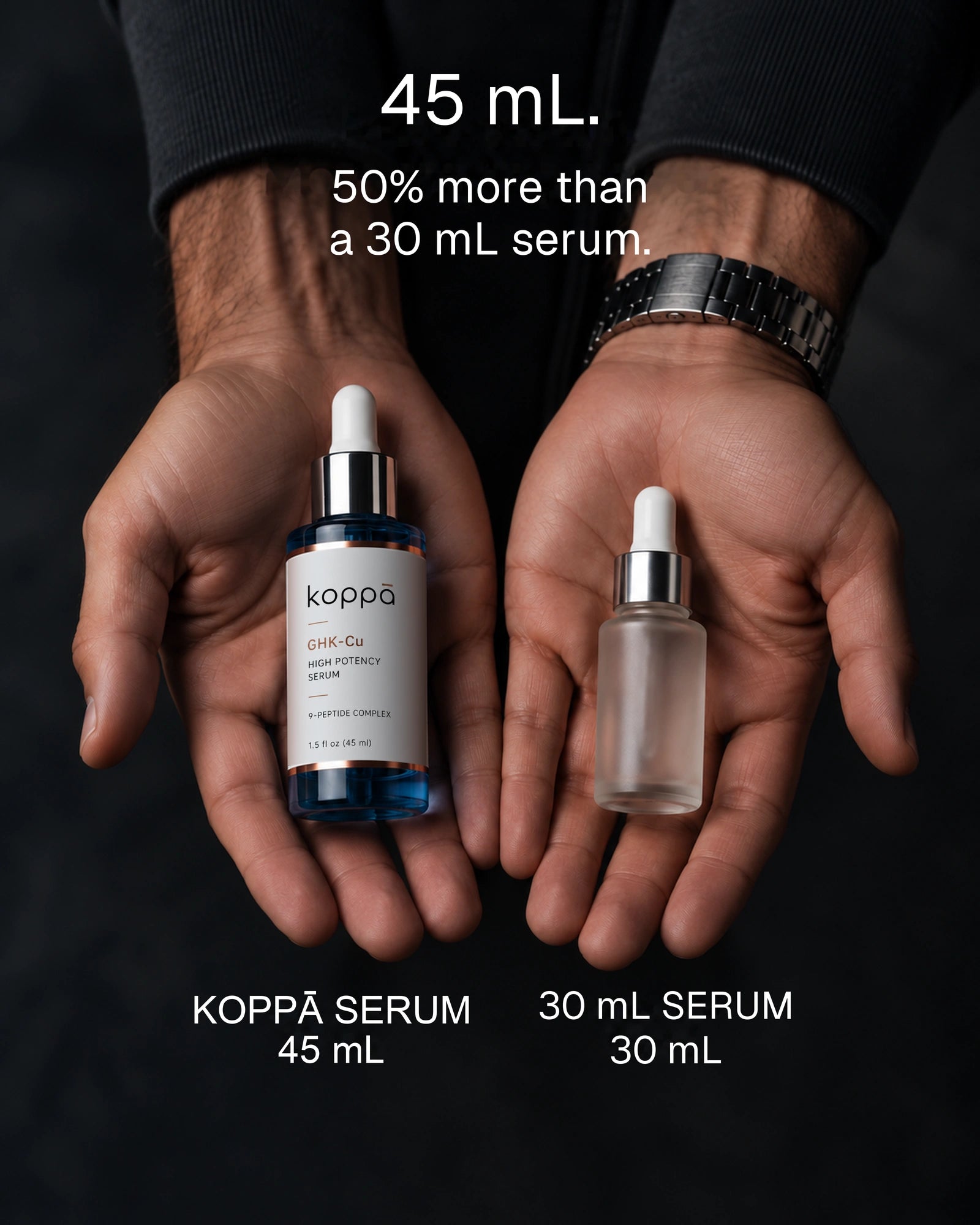
The result is a water-light serum that absorbs fast with a non-greasy finish, fragrance-free, in a 45 ml bottle, 50% more than a 30 ml serum. Three to four drops on clean skin, morning and night, for smoother, firmer-looking skin.
I think we can be genuinely enthusiastic about the research and precise about what it shows.
That, to me, is what being research-led should mean: understanding what the studies establish, and formulating with care around them.
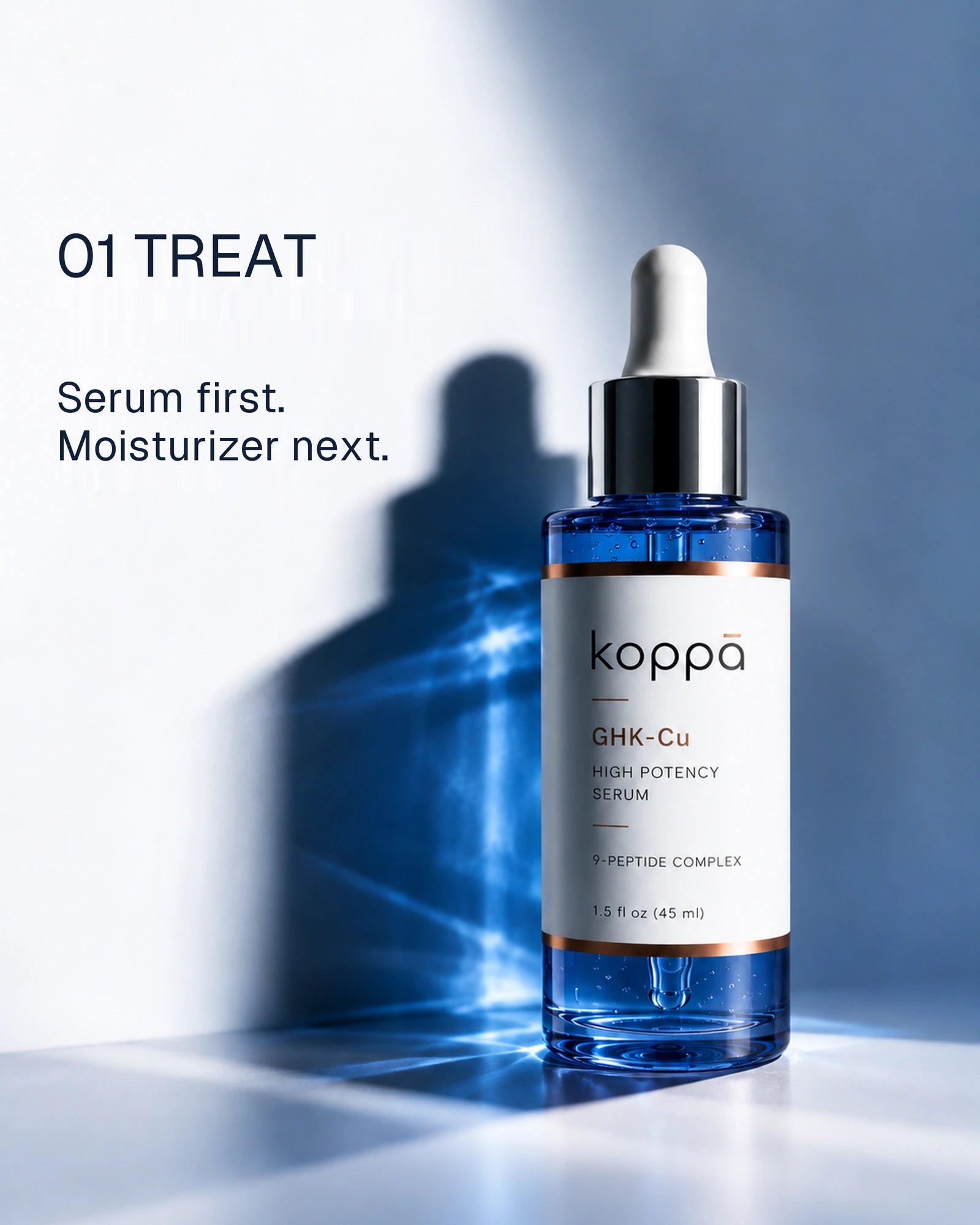
To start, smooth 3 to 4 drops over clean skin on your face and neck, morning and night, before your moisturizer, and finish mornings with sunscreen.
Does a Higher Ingredient Percentage Mean Better Results?
This deserves its own conversation.
Because somewhere along the way, skincare started to resemble a competition in which the largest percentage wins.
10% this. 15% that. Double strength. Maximum potency.
I've occasionally wondered whether we're buying skincare or entering a mathematical contest.
But more isn't automatically better.
The relationship between concentration and effectiveness depends on the ingredient, its formulation, stability, availability to the skin and tolerability.
Sometimes increasing the concentration is beneficial.
Sometimes the benefit levels off.
And sometimes the larger number simply makes for more impressive marketing.
There's also another question worth asking.
What does the percentage actually represent?
Pure active ingredient?
A diluted commercial solution?
A blend containing several different compounds?
These details can be important.
At koppā, we disclose our manufacturer's stated GHK-Cu concentration because we believe consumers deserve meaningful formulation information.
On any label, a disclosed percentage tells you what went into the formula; independent analytical verification and clinical testing answer different questions.
I'd rather people understand that distinction than assume the largest number must automatically be the best choice.
And What About Before-and-After Photographs?
Ah, before-and-after photographs.
I understand why they're persuasive.
A picture is worth a thousand words, particularly when the lighting appears to have removed a thousand wrinkles.
But photography can be extraordinarily misleading, even without deliberate manipulation.

Lighting, camera angle, facial expression, skin hydration and the distance from the camera can all influence how skin appears.
Someone photographed under harsh overhead lighting and then photographed four weeks later beside a lovely window may look considerably different.
That doesn't necessarily establish what caused the change.
And while we're here, I'd very much like to see more real skin in skincare advertising.
Pores. Fine lines. A little redness. Some texture.
The things that make skin look like skin.
We've become so accustomed to artificially perfected faces that perfectly normal skin can start to look like a problem requiring treatment.
It isn't.
Real photographs and genuine experiences have value.
They just shouldn't be presented as proof of something they cannot establish.
Five Questions Worth Asking Before You Buy
You don't need a scientific background to become a more informed skincare consumer.
But I do think a few questions are worth asking.
1. Was the ingredient studied, or was the finished product tested?
Both can be useful. They simply establish different things.
2. What did the research actually measure?
Hydration? Wrinkle depth? Elasticity? Participant satisfaction? A biological response in cultured cells?
These aren't interchangeable outcomes.
3. How strong is the evidence?
Consider the study design, number of participants, duration, controls and whether other research supports the findings.
4. Has the product's quality or concentration been verified?
A relevant COA or independent laboratory report can be useful, but only for the characteristics actually measured.
5. Is the brand willing to explain what isn't known?
For me, this might be the most revealing question of all.
Scientific uncertainty isn't an embarrassment.
It's part of science.
And a company that understands the boundaries of its evidence is often more interesting to me than one promising absolute certainty.
So Where Does That Leave Us?
I started koppā because I believe skincare should be informed by credible research, thoughtful formulation and a long-term approach to skin health and appearance.
I still believe that.
In fact, the more I've learned, the more convinced I've become that we need to ask better questions.
Not because skincare science is meaningless.
Quite the opposite.
Because good research deserves to be understood properly, rather than reduced to a few impressive words on a label.
There's a place for ingredient studies, independent analytical testing, stability assessments, clinical trials and real-world experience.
They each contribute something different.
And we shouldn't need to exaggerate one to make the others seem worthwhile.
I don't expect everyone to spend their evenings reading scientific journals. I sometimes wonder why I spend so many of mine doing exactly that.
But I do think we deserve to understand what we're buying, why it was formulated that way and what the evidence actually supports.
And perhaps the next time we see clinically proven printed across a very expensive jar, we'll ask one more question before reaching for our credit cards.
Proven to do what, exactly?
With much love,
Chantelle
koppā co-founder
Frequently asked questions
What does clinically proven mean on a skincare product?
It generally means a product or ingredient has been studied in people and the findings support a particular claim. The phrase alone does not tell you how many people took part, how long the study lasted, whether there was a control group or what was measured.
Does clinically proven mean FDA approved?
No. In the United States, cosmetics generally do not require FDA premarket approval, although companies remain responsible for product safety and appropriate marketing claims, and the FTC requires advertising claims to be supported by suitable evidence.
What is the difference between clinically tested and clinically proven?
Clinically tested means a product was studied in people; it does not mean every benefit on the packaging was demonstrated. If 85% of 30 people in a four-week study say their skin feels more hydrated, that supports a hydration claim, not a claim about collagen.
What does a certificate of analysis prove?
A certificate of analysis shows whether a specific ingredient or product batch meets the quality criteria listed in it, such as identity, purity, concentration, pH or microbiological quality. What a product does on skin is the job of a clinical efficacy study.
Does a higher ingredient percentage mean better results?
Not automatically. The effect depends on the ingredient, its formulation, stability, availability to the skin and tolerability, and it helps to know whether the percentage means pure active ingredient or a diluted commercial solution.
What is in koppā's GHK-Cu 2% High Potency Serum?
It contains 2% GHK-Cu (copper tripeptide-1), stated on the label, with six additional peptides including Acetyl Hexapeptide-8 and Palmitoyl Tripeptide-5, plus Hydrolyzed Collagen and Collagen, in a water-light, fragrance-free formula. A 45 ml bottle is $75; use 3 to 4 drops on clean skin, face and neck, morning and night.
The short version
"Clinically proven" means something was studied in people, not that it was certified or approved by the FDA. Ask what was measured, in how many people, for how long and against what comparison, and whether the claim matches the study. A disclosed concentration tells you what went into a formula, which is why koppā puts 2% GHK-Cu on the label. To try it, use 3 to 4 drops of the GHK-Cu 2% High Potency Serum on clean skin, face and neck, morning and night.
Further Reading & Scientific References
1. Federal Trade Commission: Health Products Compliance Guidance
An explanation of the evidence required to substantiate advertising claims, including clinical research and consumer testimonials.
https://www.ftc.gov/business-guidance/resources/health-products-compliance-guidance
2. U.S. Food and Drug Administration: Cosmetics Labeling Claims
Explains cosmetic labeling claims and the distinction between cosmetic and drug claims.
https://www.fda.gov/cosmetics/cosmetics-labeling/cosmetics-labeling-claims[1]
3. American Academy of Dermatology: How to Select Anti-Aging Skin Care Products
Consumer guidance on interpreting skincare marketing and selecting products with realistic expectations.
https://www.aad.org/public/everyday-care/skin-care-secrets/anti-aging/selecting-anti-aging-products[2]
4. Pickart, Vasquez-Soltero & Margolina (2015): GHK Peptide as a Natural Modulator of Multiple Cellular Pathways in Skin Regeneration
A peer-reviewed scientific review exploring GHK-related cellular mechanisms, skin biology and the evidence available at publication.
https://pmc.ncbi.nlm.nih.gov/articles/PMC4508379/[3]
5. FDA: Modernization of Cosmetics Regulation Act of 2022 (MoCRA)
Information about cosmetic safety substantiation and related regulatory responsibilities.
https://www.fda.gov/cosmetics/cosmetics-laws-regulations/modernization-cosmetics-regulation-act-2022-mocra[4]
6. FTC: Endorsements, Influencers and Reviews
Guidance about genuine testimonials, material connections and advertising claims.
https://www.ftc.gov/business-guidance/advertising-marketing/endorsements-influencers-reviews
Sources and further reading
- https://www.fda.gov/cosmetics/cosmetics-labeling/cosmetics-labeling-claims fda.gov
- https://www.aad.org/public/everyday-care/skin-care-secrets/anti-aging/selecting-anti-aging-products aad.org
- Loren Pickart et al. (2015). GHK Peptide as a Natural Modulator of Multiple Cellular Pathways in Skin Regeneration. BioMed Research International. DOI: 10.1155/2015/648108 pmc.ncbi.nlm.nih.gov
- https://www.fda.gov/cosmetics/cosmetics-laws-regulations/modernization-cosmetics-regulation-act-2022-mocra fda.gov


