
balm
GHK-Cu Tallow Balm: What the Evidence Says, and the Copper Peptide Balm Without Tallow

Most GHK-Cu balms sold online are whipped beef tallow with manuka honey, and most of them don't say how much GHK-Cu is inside. No published study shows tallow reacting with or deactivating GHK-Cu, so a tallow balm isn't "wrong". But the base, the label and the format still decide what you're putting on your skin.
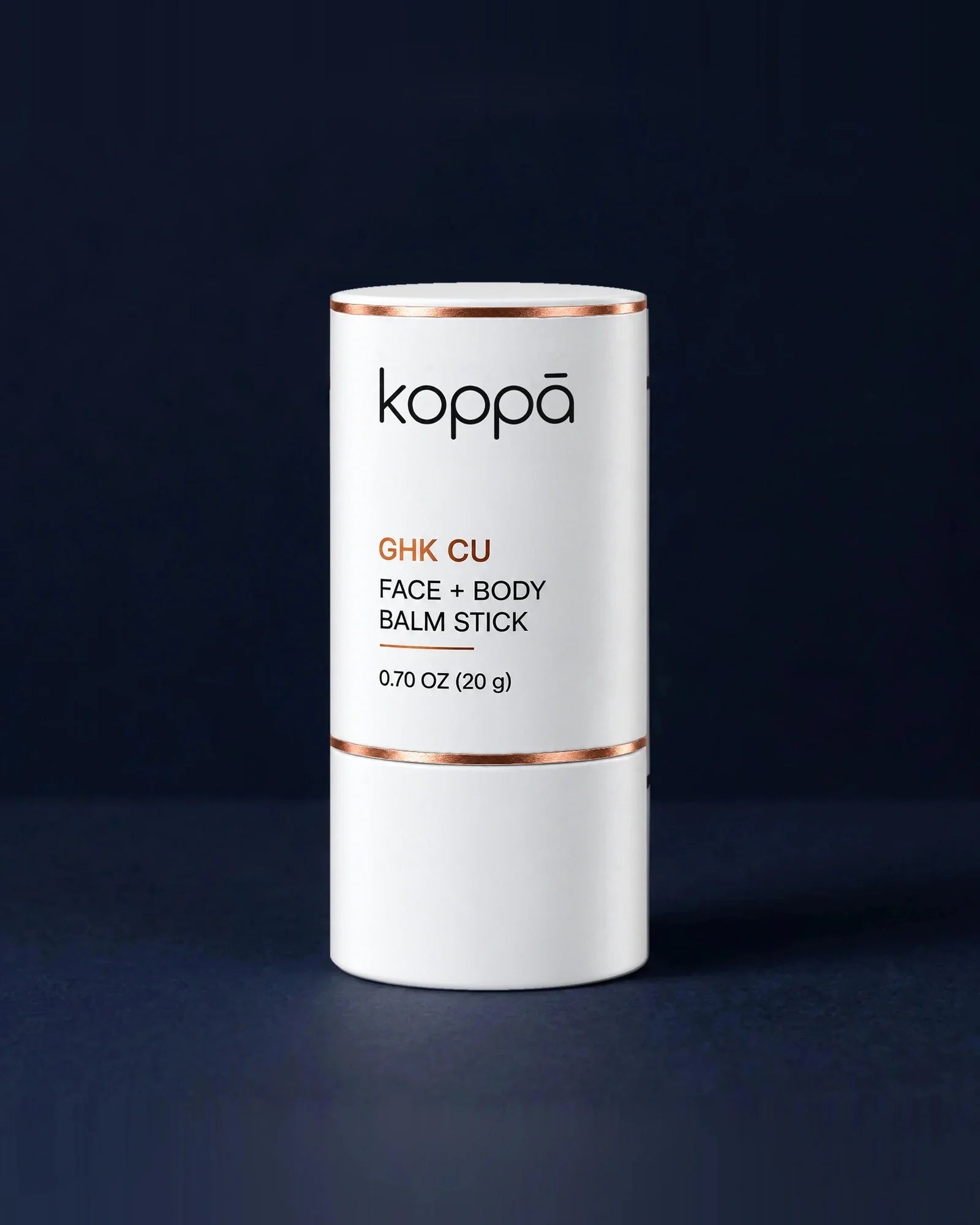
If you want a copper peptide balm without tallow, koppā's GHK-Cu Face + Body Balm Stick states 0.5% GHK-Cu on the label, names all eight other peptides, and sits in a water-free stick of jojoba, squalane and candelilla wax. We make it, so we say so, and we show our reasoning below.
What is a GHK-Cu tallow balm?
A GHK-Cu tallow balm is rendered beef fat, usually whipped, with copper peptide (GHK-Cu, listed as Copper Tripeptide-1) stirred in. Most add raw or manuka honey, some add jojoba or an essential oil, and they're usually sold as a soft balm you scoop out. They grew out of the tallow skincare trend: tallow is rich, cheap, and has a "what our grandparents used" appeal.
GHK-Cu is a small peptide your body makes, carrying a copper ion, and your levels fall with age. A 2018 review by Pickart and Margolina[1] reports a 12-week study of 71 women using a GHK-Cu cream, with denser, thicker skin. So the peptide has real research behind it. The question is what it comes in.
Does tallow deactivate GHK-Cu?
There's no evidence that it does. We looked for a study showing tallow reacting with, binding or degrading GHK-Cu and found none. Tallow is also fairly stable as fats go, because it's low in the polyunsaturated fats that go rancid fastest.
What the research does show is that GHK-Cu has conditions it doesn't like. In a 2016 preformulation study[2], GHK-Cu stayed intact in solutions between pH 4.5 and 7.4 and broke down under alkaline and oxidising stress. So whatever a balm is made of, a base that oxidises as it ages is an oxidising environment for the peptide in it. That's the standard koppā used to build its balm, and it's a fair standard to hold any balm to, tallow or not.
What does the koppā balm use instead of tallow, and why?
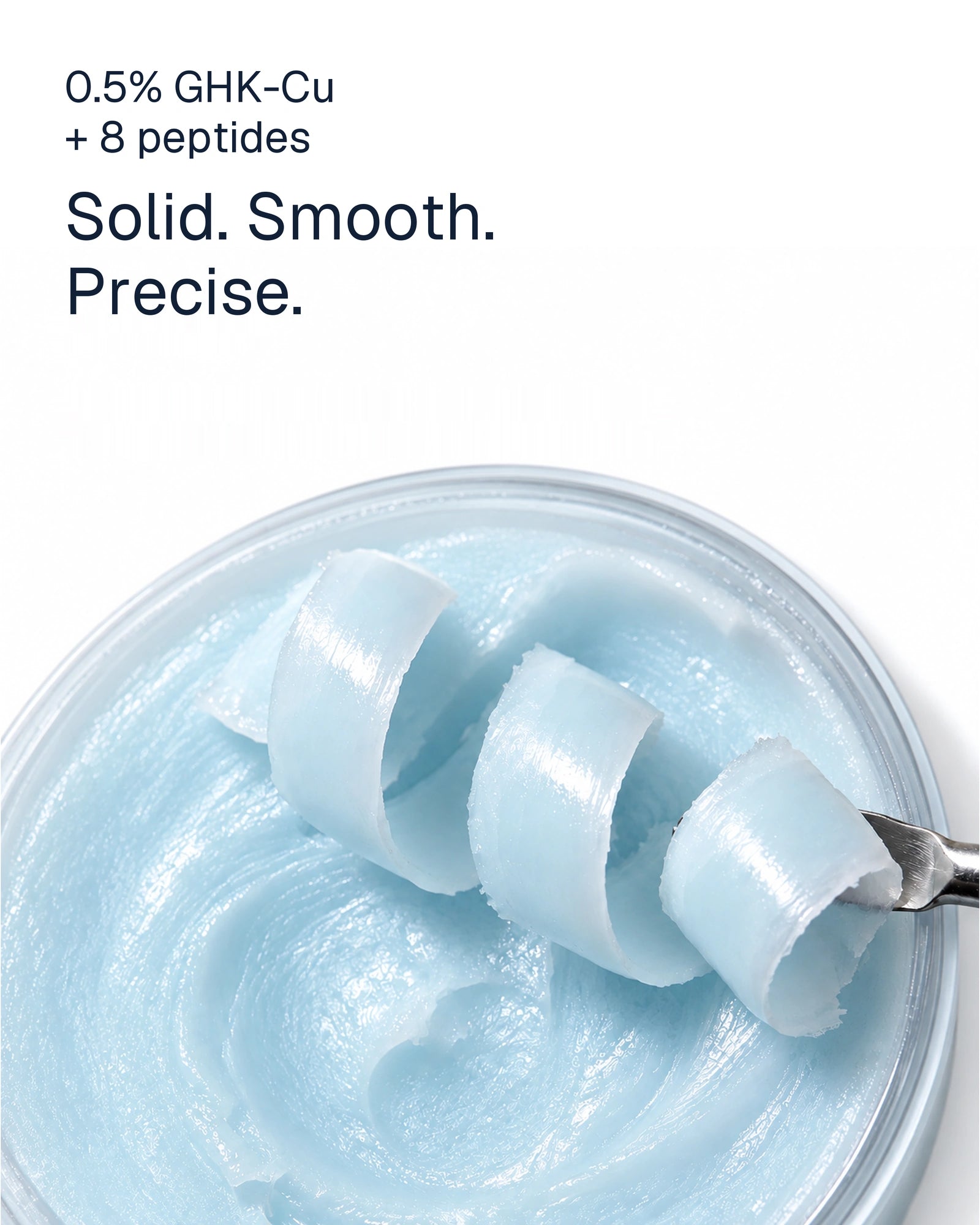
The koppā balm stick is built around keeping the peptide in a stable, water-free environment. Here's the base, ingredient by ingredient:
- Jojoba, 15%. Jojoba isn't a triglyceride oil like tallow. It's a liquid wax, about 98% wax esters (Gad et al., 2021[3]). In a 60-day test at 60 °C, it was the most stable of the three oils compared against oxidation (Tsuchimoto, 2022).
- Squalane, 10%. The fully saturated form of squalene. It has no double bonds left to form peroxides, and it gives the balm its light slip.
- Candelilla wax. A plant wax that gives the stick its structure and a layer that slows moisture loss, without beeswax.
- Olive, coconut and meadowfoam oils. For softness on dry skin.
- Vitamin E (tocopherol). An antioxidant that protects the oils from oxidation.
No water and no honey leaves very little in the stick for microbes to grow in, which is why it needs no preservative. The finished balm has been tested for hydration and ingredient stability.
Why doesn't koppā use tallow?
Not because tallow spoils fast. It doesn't. The reasons are these three.
1. A stick, not a jar
A twist-up stick goes straight onto the skin and only exposes the surface you are using. Tallow is a soft fat that comes in jars and tins; the koppā base of candelilla wax and plant oils holds the shape of a stick.
2. Honey brings water
Most tallow balms add manuka or raw honey. Honey contains water and sugars, so it adds both to what is otherwise a water-free fat. Whether that needs a preservative is a question the tallow listings we checked don't answer. koppā's stick has neither water nor honey.
3. It's an animal fat
Some people want that. Many don't, for diet, ethics or religion. The koppā balm stick lists no animal-derived ingredients, and we don't test on animals.
GHK-Cu tallow balms compared with the koppā balm stick
We checked each brand's own product page in October 2026; the November figures are in our balm guide. Where a listing doesn't state something, the table says so; it doesn't mean the product lacks it.
| Balm | Base | GHK-Cu stated? | Other peptides named | Water or honey | Format |
|---|---|---|---|---|---|
| koppā GHK-Cu Balm Stick | Olive, coconut and jojoba oils, candelilla wax, squalane, meadowfoam | Yes, 0.5% | 8, every one named | Neither | 20 g twist-up stick |
| Celvara Labs GHK-Cu Copper Renewal Balm | 60% grass-fed tallow, manuka honey, jojoba | Yes, 0.5% | Not listed (no full ingredient list); 2% niacinamide | Honey | Balm |
| HealthyDerm Whipped Tallow Honey Balm | Grass-fed beef tallow, manuka honey, jojoba, methylene blue | No | None stated | Honey | Whipped balm, size not stated |
| Happy Soul Organics Tallow Balm GHK-Cu | Grass-fed beef tallow, manuka honey | No | None stated | Honey | Balm |
Read it this way. If you specifically want a tallow balm, Celvara is the one that states its percentage. If you want a copper peptide balm with no animal fat and no honey, a full published ingredient list, a stated 0.5% and eight more peptides, that's the koppā balm stick. The full eight-balm comparison, including the non-tallow sticks, is in our guide to the best GHK-Cu balm.
Is the koppā balm stick stronger than a tallow balm?
On GHK-Cu alone, it's the same 0.5% as Celvara, the only tallow balm we found that states a percentage. You can't compare against the others, because they don't say. Where the koppā balm differs is what comes with the copper peptide. Every peptide in it is named on the label:
- Copper Tripeptide-1 (GHK-Cu), 0.5%, for the look of firmer, smoother skin over time.
- Palmitoyl Pentapeptide-4. In a 12-week, placebo-controlled, split-face study of 93 women, a moisturiser with it improved the look of wrinkles and fine lines against the same moisturiser without it (Robinson, 2005).
- Acetyl Hexapeptide-8. Gave smoother-looking eye-area lines in a randomised, placebo-controlled trial of 60 people (Wang et al., 2013[4]).
- Palmitoyl Tripeptide-5, Palmitoyl Tetrapeptide-7, Tridecapeptide-1, Dipeptide Diaminobutyroyl Benzylamide Diacetate, Arginine/Lysine Polypeptide and Carnosine complete the blend.
These studies were on the ingredients, in other formulas, and they explain why each one is in the stick. Every GHK-Cu study we rely on is listed, with sources, on our GHK-Cu evidence page.
See the full ingredient list on the balm stick page.
Why a stick instead of a jar?
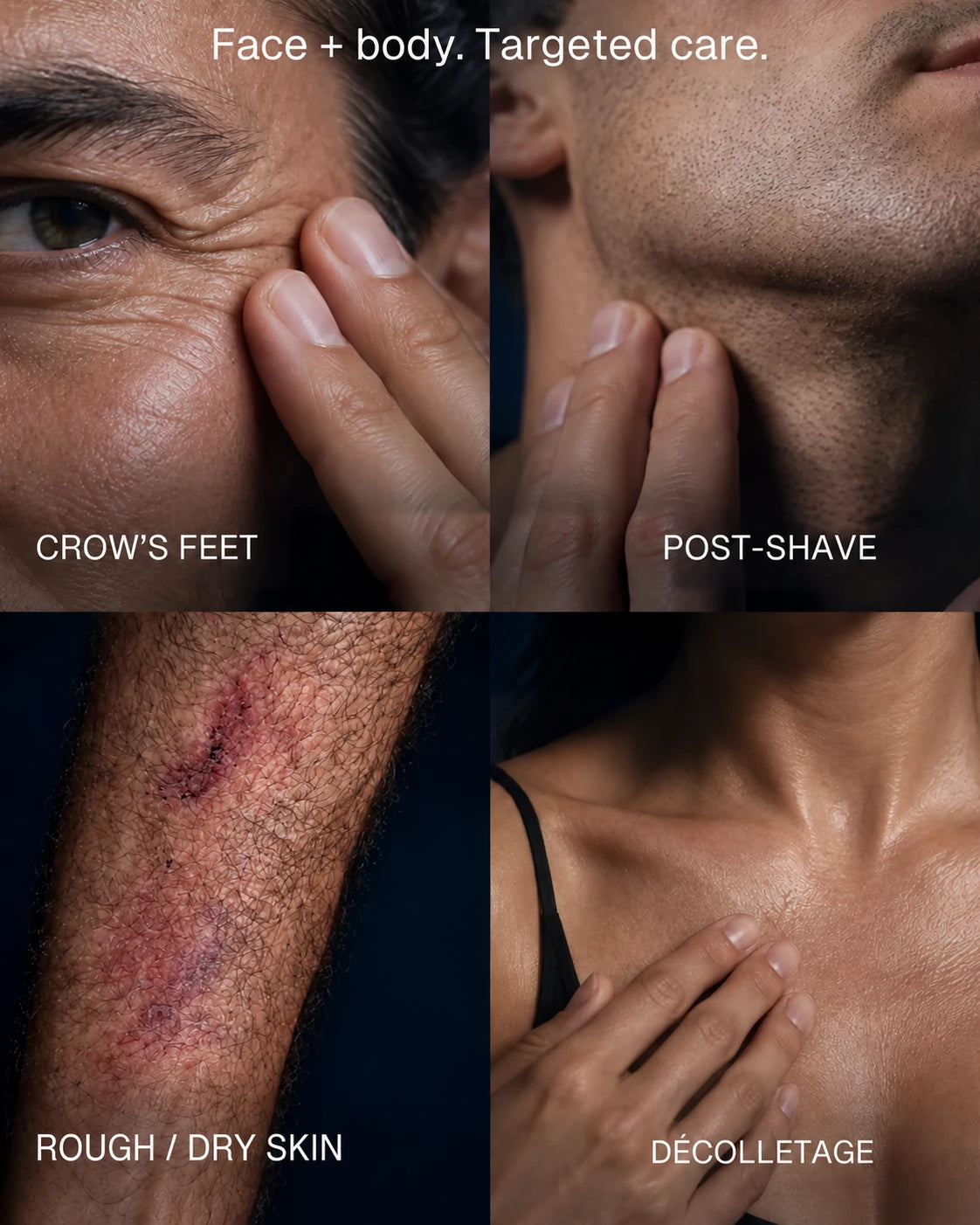
A balm in a jar or tin is opened to the air every time you use it, and scooped out with fingers. A twist-up stick only exposes the surface you're using, and it goes straight onto the skin. For the places a balm is actually for, that's simply easier:
- the neck and jawline
- the backs of the hands, elbows and knees
- the sides of the eyes and around the mouth
- post-shave dryness and winter-dry patches
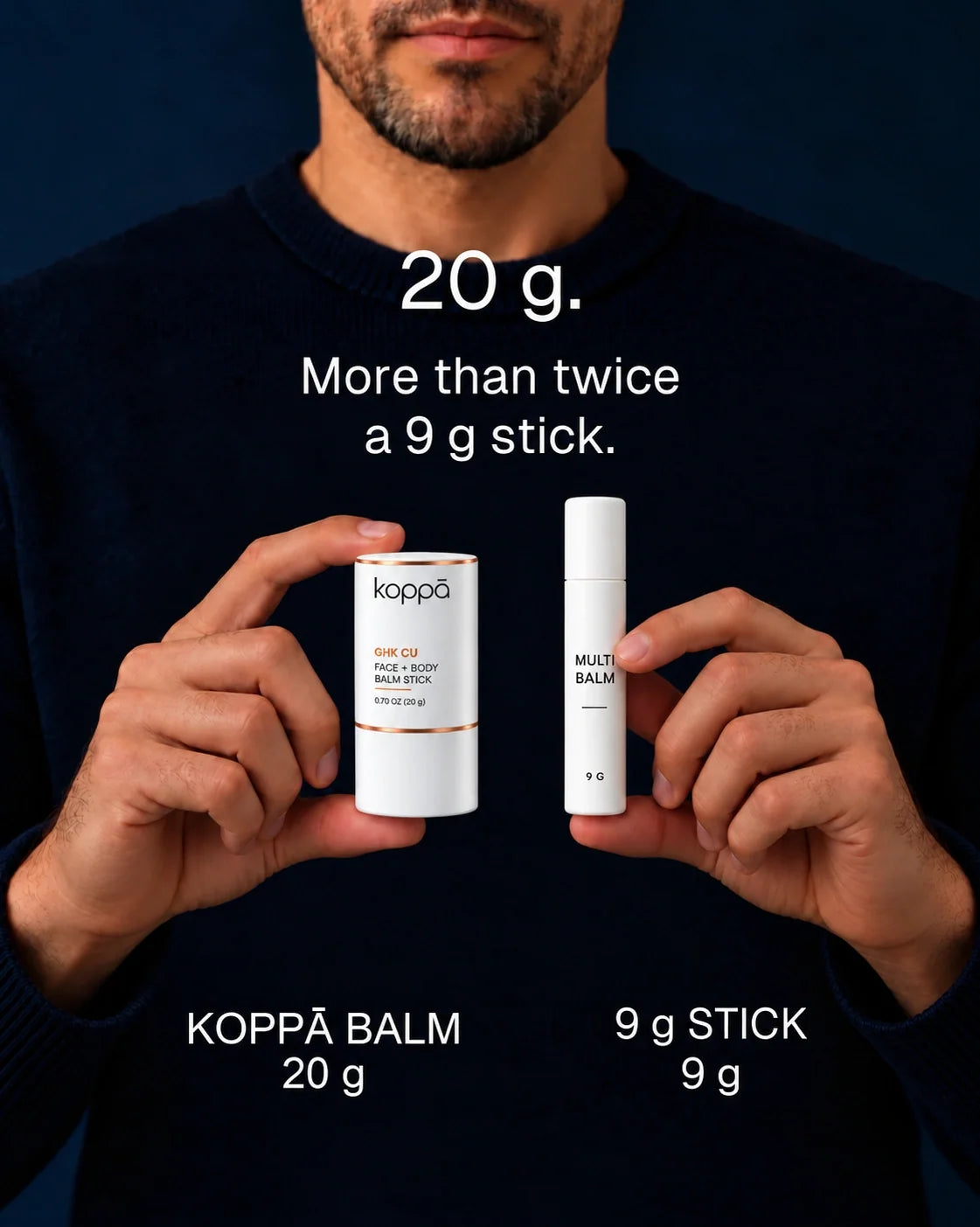
The koppā stick is 20 g, more than twice a typical 9 g stick. It's a solid, so it doesn't leak in a bag, though it's worth checking current airline rules.
How do you use a copper peptide balm?
One light pass on clean, dry-feeling skin. Skin warmth softens it, so there's no need to rub it in. On the face, use it as the last step, after serum and moisturiser. On hands and body, use it on its own. Finish mornings with sunscreen; none of koppā's products contain SPF.
If you want copper peptide across the whole face, a balm isn't the best way to get it there. That's a serum's job. koppā's GHK-Cu 2% High Potency Serum carries four times the balm's percentage, and the GHK Protocol puts serum, moisturizing cream and balm stick together in one set.
Who should still choose a tallow balm?
If you've used tallow on your skin for years, it suits you, and you want a copper peptide version, pick one that states its GHK-Cu percentage, so you know what you're paying for. If your skin is oily or breakout-prone, if you'd rather avoid animal fat, or if you want every ingredient named, a water-free balm with every ingredient named is the more predictable choice. For that, we'd point you to ours.
Frequently asked questions
Is tallow good with GHK-Cu?
Tallow doesn't harm GHK-Cu as far as any study shows. The concerns with tallow balms are elsewhere: most don't state a GHK-Cu percentage, most add honey, which brings water into the fat, and it is an animal fat that many people prefer to avoid. The koppā balm stick avoids all three, with a stated 0.5% GHK-Cu in a water-free, tallow-free base.
Is there a GHK-Cu balm without tallow?
Yes. The koppā GHK-Cu Face + Body Balm Stick uses olive, coconut and jojoba oils, candelilla wax, squalane and meadowfoam seed oil, with no animal fat, no beeswax and no honey. It carries 0.5% GHK-Cu plus eight named peptides. Our tallow-free GHK-Cu balm comparison sets it beside the tallow balms.
Does tallow clog pores?
Tallow is often described as pore-clogging, but the evidence is a rabbit-ear model that is harsher than human skin. If you are breakout-prone, patch test any rich balm, tallow or not.
How much GHK-Cu is in a tallow balm?
Usually you can't tell. Of the tallow balms we checked in November 2026, only Celvara states a percentage (0.5%). The koppā balm stick also states 0.5%, and the koppā serum states 2%.
Does a GHK-Cu balm contain animal ingredients?
Tallow balms are rendered beef fat, and most add honey. The koppā balm stick lists no animal-derived ingredients and is not tested on animals.
Does a water-free balm need a preservative?
A balm with no water gives microbes very little to grow in, which is why koppā's needs none. Once honey or water is added to a balm, that changes, and it's worth checking the label.
Can I use a copper peptide balm under my eyes?
Yes. The koppā stick is made for the face, including the sides of the eyes, as well as the body. Keep it out of the eyes themselves.
The short version
Tallow doesn't deactivate GHK-Cu, and anyone who says so is ahead of the evidence. What separates copper peptide balms is the label and the base. Most tallow balms don't state a GHK-Cu percentage, and add honey to the fat. The koppā balm stick states 0.5% GHK-Cu, names eight more peptides, and puts them in a water-free, tallow-free stick of jojoba, squalane and candelilla wax with vitamin E. That's the base we chose around the peptide.
Sources and further reading
- Loren Pickart et al. (2018). Regenerative and Protective Actions of the GHK-Cu Peptide in the Light of the New Gene Data. International Journal of Molecular Sciences. DOI: 10.3390/ijms19071987 mdpi.com
- 2016 preformulation study pubmed.ncbi.nlm.nih.gov
- Gad et al., 2021 pmc.ncbi.nlm.nih.gov
- Wang et al., 2013 pubmed.ncbi.nlm.nih.gov


