


GHK-Cu
How Much Does GHK-Cu Skincare Cost? How to Compare Prices (2026)
GHK-Cu skincare is priced by four things: how much GHK-Cu the label states, how much product is in the pack, what the formula is (serum, cream or balm), and whether it is a finished cosmetic or something else entirely, such as a compounded prescription or a research powder. Two products with the same price can hold very different amounts of the peptide, so the useful comparison is price per ml or per gram, read next to the stated GHK-Cu percentage.
Below: what drives the price, how to work out cost per ml and per milligram of GHK-Cu from a label, a worked example, how GHK-Cu compares with other actives on price, and what a prescription or a powder is not. Figures in the worked example were checked on 15 November 2026.
What sets the price of a GHK-Cu product?
Four things do most of the work.
- Stated concentration. GHK-Cu is listed on ingredient labels as copper tripeptide-1. Some brands also state a percentage, for example 0.5% or 2%. More peptide in the formula costs more to make.
- Pack size. A 15 ml bottle and a 45 ml bottle at similar prices are not similar products. Always find the ml or gram figure.
- Format. A water-light serum, an emulsion cream and an anhydrous balm use different bases and packaging, and a cream with other actives (niacinamide, ceramides) carries their cost too.
- Everything else. Supporting peptides, fragrance-free formulation, airless packaging, brand and retailer margins, shipping and duty. These change the price without changing how much GHK-Cu you get.
For what a 1% or 2% figure does and does not tell you, see 1% vs. 2% GHK-Cu: what concentration can and can't tell you.
How do you compare GHK-Cu prices fairly?
Use two numbers, both from the label.
- Price per ml (or per gram). Divide the price by the pack size. This is the number to use when comparing two serums, or two creams.
- Price per milligram of GHK-Cu. Multiply the pack size by the stated percentage to estimate the GHK-Cu in the pack, then divide the price by that. This is the number to use when comparing a serum with a cream.
The second number is an estimate. Brands rarely say whether a percentage is by weight or by volume, and a serum does not weigh exactly one gram per ml. It is still close enough to show when one product holds four times the peptide of another.
If a product lists copper tripeptide-1 but states no percentage, you cannot do the second calculation. You can still check where it sits in the ingredient list: US cosmetic labels list ingredients in descending order of predominance, with ingredients at 1% or less allowed in any order at the end (FDA, Cosmetics Labeling Guide[1]).
A worked example: three formats from one range
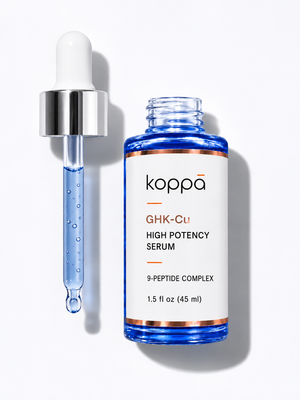
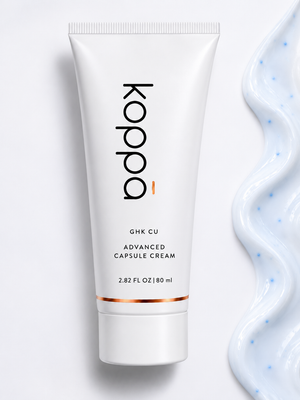
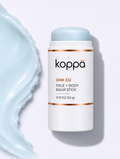
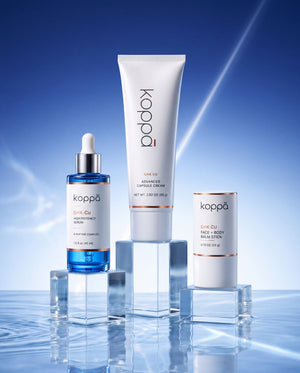
Here is the arithmetic for three products from the journal's own range, as priced on koppabeauty.com on 15 November 2026. Prices change; the product page and checkout show the current figure.
| Format | Stated GHK-Cu | Size | Price | Per ml or g | Estimated GHK-Cu in pack |
|---|---|---|---|---|---|
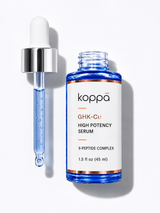
| Serum | 2% | 45 ml | $75 | about $1.67 per ml | about 900 mg |
| Cream | 0.5% | 80 g | $70 | about $0.88 per g | about 400 mg |
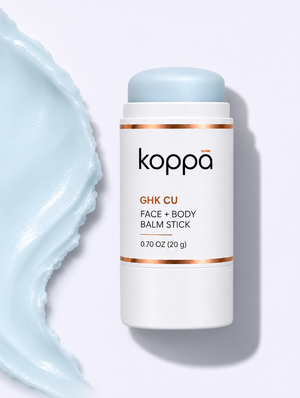
| Balm stick | 0.5% | 20 g | $45 | $2.25 per g | about 100 mg |
Read this way, the cream is the cheapest per gram, the serum is the cheapest per milligram of GHK-Cu, and the balm stick costs the most on both counts, because you are paying for a solid stick format made to be carried and used on hands, elbows and other small areas. None of those makes one product better. They do different jobs, which is covered in GHK-Cu serum, cream or stick: how to choose the right format.
How does GHK-Cu compare on price with other actives?
Comparing GHK-Cu with retinol, vitamin C or niacinamide on sticker price says little, because the amount of active and the pack sizes differ so much. The same two numbers work across ingredients: price per ml, and the stated percentage of the active. A low-percentage product in a large bottle will nearly always look cheaper per ml than a higher-percentage one in a small bottle.
The more useful question is what each ingredient is for. GHK-Cu sits alongside retinoids, vitamin C and niacinamide rather than replacing them, so for most routines the choice is about which steps you want, not which single active is cheapest. If cost is the main concern, Cheap copper peptide serum: what you give up, and what you don't goes through where a lower price matters and where it does not.
Why are prescription creams and peptide powders priced differently?
Because they are different kinds of product.
- Compounded prescription GHK-Cu. Some telehealth services sell GHK-Cu creams on prescription, priced as a monthly plan. A compounded product is made by a pharmacy for a patient, under drug rules rather than cosmetic rules, and its price includes the consultation and the pharmacy. It is not a like-for-like comparison with a cosmetic serum.
- Injectable GHK-Cu. The FDA lists GHK-Cu for injectable routes among bulk substances that may present significant safety risks in compounding, noting a possible risk of immunogenicity and limited data in humans (FDA[2]). See Injectable GHK-Cu: why I tried it once and stopped.
- Research powders. GHK-Cu powder sold by the gram, often labelled for research use, is a raw material, not skincare. Its price per gram tells you nothing about a finished, preserved formula.
Frequently asked questions
What is the average price of a GHK-Cu serum?
There is no reliable published average, and prices vary with concentration and size. Rather than an average, compare price per ml and the stated GHK-Cu percentage of the products you are choosing between.
Is a more expensive GHK-Cu product stronger?
Not necessarily. Price reflects size, format, other ingredients, packaging and margins as well as the peptide. The stated percentage and the pack size are the only way to tell how much GHK-Cu you are buying.
Do I need a prescription for GHK-Cu skincare?
No. Topical GHK-Cu serums, creams and balms are sold as cosmetics in the US without a prescription. Prescription GHK-Cu products are compounded by a pharmacy and are a separate category.
How long does a bottle of GHK-Cu serum last?
It depends on how much you use and how often. Note the date you open it and how many weeks it lasts with your routine, then divide the price by those weeks to get your real cost per month.
Why does a GHK-Cu balm cost more per gram than a cream?
A balm stick is a small, solid, water-free format in its own packaging, made for targeted use. You use less of it at a time, so its cost per gram is higher even when the stated GHK-Cu percentage is the same as a cream's.
The short version
To compare GHK-Cu prices, ignore the sticker and use the label: price divided by ml or grams, and the stated GHK-Cu percentage to estimate how much peptide is in the pack. Compare serums with serums and creams with creams on price per ml, and use price per milligram of GHK-Cu when comparing across formats. Prescription creams, injectables and research powders are different products and do not belong in the same comparison.
koppā, who publish this journal, make the 2% GHK-Cu High-Concentration Copper Peptide Serum and the other products in the worked example. Prices are koppā's own, checked on 15 November 2026.