


Comparison
Peptides vs copper peptides for loss of elasticity: a fair comparison

Copper peptides are peptides, so this is a comparison inside one family, not between two rivals. For skin that looks less firm, GHK-Cu (the main copper peptide) has two 12-week studies that graded firmness and laxity directly, but they are known only from a conference presentation and a book chapter, so their design cannot be checked in full. Signal peptides such as palmitoyl pentapeptide-4 have better controlled trials, but those measured wrinkles, not elasticity. Neurotransmitter-type peptides such as acetyl hexapeptide-8 are studied for expression lines, and results are mixed.
Product facts
Checked on koppabeauty.com, 17 November 2026. Prices in US dollars; checkout shows your local currency.
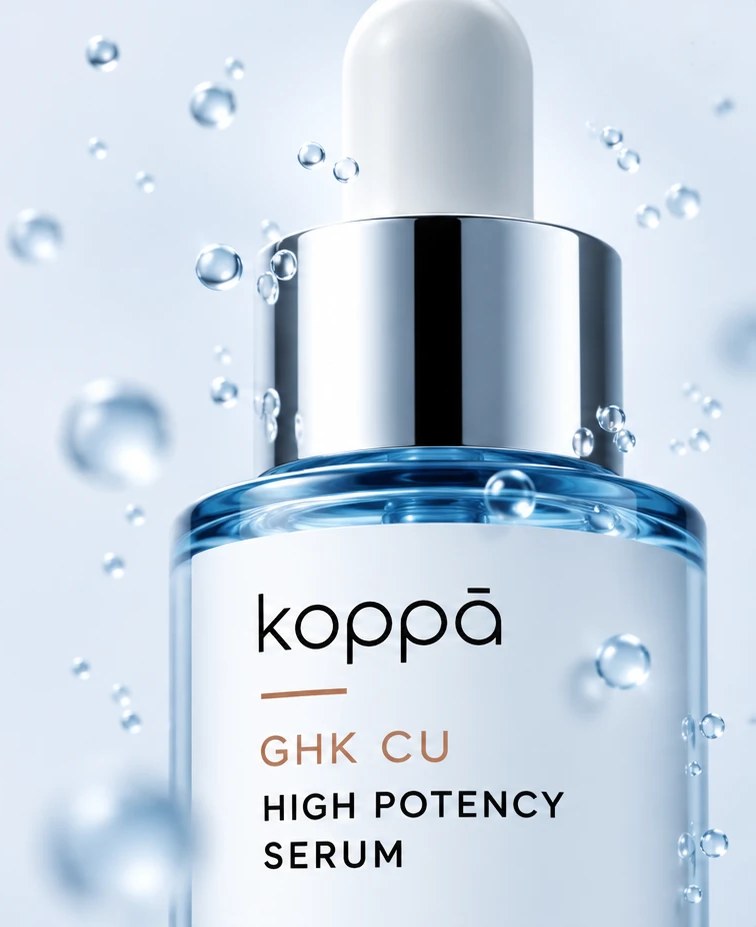
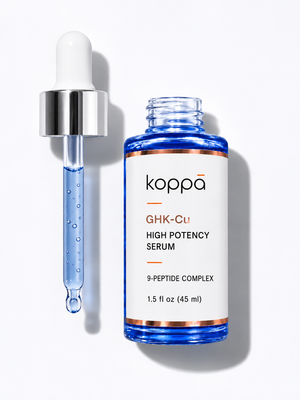
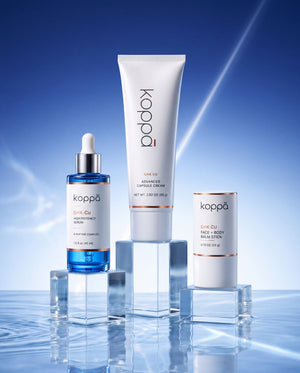
koppā 2% GHK-Cu High-Concentration Copper Peptide Serum
- GHK-Cu: 2% (Copper Tripeptide-1).
- Also contains: six supporting peptides, Ceramide EOP, Ceramide NP, sodium hyaluronate, polyglutamic acid, trehalose, glycerin, betaine and panthenol.
- Size and price: 45 mL, US$75 (US$1.67 per mL).
- Format: water-light serum; fragrance-free, silicone-free, paraben-free, no added color (the blue comes from the copper). pH held at 5.5 to 6.0.
- How to use: three to four drops on clean face and neck, morning and/or evening, before moisturizer. In the morning, finish with broad-spectrum SPF 30 or higher.
Full ingredients
Aqua, Trehalose, Glycerin, Copper Tripeptide-1, 1,2-Hexanediol, Betaine, Hydrolyzed Collagen, Panthenol, Polyglutamic Acid, Ceramide EOP, Pullulan, Sodium Hyaluronate, Acetyl Hexapeptide-8, Allantoin, Palmitoyl Tetrapeptide-7, Dipeptide Diaminobutyroyl Benzylamide Diacetate, Arginine, Carbomer, Hydrolyzed Sclerotium Gum, Ceramide NP, Dipotassium Glycyrrhizate, Carnosine, Collagen, Palmitoyl Tripeptide-5, Acetyl Octapeptide-3, Ethylhexylglycerin.
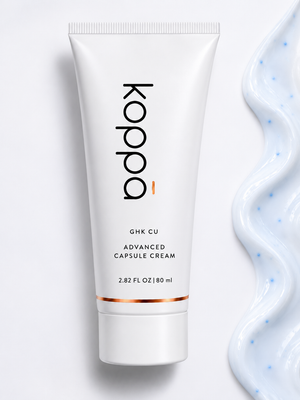
koppā GHK-Cu Moisturizing Cream: 0.5% Copper Peptide Face Cream (Advanced Capsule Cream)
- GHK-Cu: 0.5%, held in blue capsules that break as you massage.
- Also contains: 5% niacinamide, 4% squalane, 3% jojoba oil, Sodium Hyaluronate and Hydrolyzed Sodium Hyaluronate, glycerin and trehalose.
- Size and price: 80 g, US$70 (US$0.88 per g).
- Format: capsule cream; fragrance-free, silicone-free, colored only by the copper.
- How to use: on clean face and neck, morning and/or evening, after serum if used. Massage until the capsules disperse. SPF in the morning.
Full ingredients
Aqua, Glycerin, Niacinamide, Squalane, Butylene Glycol, Trehalose, Simmondsia Chinensis (Jojoba) Seed Oil, Euglena Gracilis Polysaccharide, Pentylene Glycol, Isononyl Isononanoate, Caprylic/Capric Triglyceride, Cetearyl Olivate, 1,2-Hexanediol, C14-22 Alcohols, Sorbitan Olivate, Copper Tripeptide-1, Tocopheryl Acetate, Tremella Fuciformis Polysaccharide, Portulaca Oleracea Extract, Arginine, Hydrolyzed Collagen, Leontopodium Alpinum Callus Culture Extract, Crithmum Maritimum Callus Culture Filtrate, Carbomer, C12-20 Alkyl Glucoside, Hydrolyzed Sodium Hyaluronate, Adenosine, Sodium Hyaluronate, Disodium EDTA, Algin, Acetyl Hexapeptide-8, Mannitol, Collagen, Tripeptide-1, Pentapeptide-3, Agar, Hydroxyethylcellulose, Gellan Gum.
Shipping and returns
- US: orders leave within 1 to 2 business days; standard delivery takes 5 to 9 business days from dispatch, about 6 to 11 business days in total. Standard shipping is US$3, free over US$100.
- Canada: orders leave within 1 to 2 business days, then about 5 to 9 business days in transit; customs can add 2 to 5 business days.
- Returns: unopened, unused products with intact seals within 30 days of delivery. US returns get a free prepaid label; outside the US the customer pays return postage.
Copper peptides are one kind of peptide
A peptide is a short chain of amino acids. Reviews of cosmetic peptides sort them into groups by what they are designed to do: signal peptides, neurotransmitter-inhibitor peptides, carrier peptides and enzyme-inhibitor peptides [1]. This page covers the first three, which are the ones you will see most often on a label.
- Signal peptides are studied for prompting skin cells to make more of the proteins that give skin its structure.
- Neurotransmitter-type peptides are studied for softening the look of expression lines.
- Carrier peptides bind a trace metal. GHK-Cu is a three-amino-acid peptide bound to copper, listed as Copper Tripeptide-1.
So "peptides or copper peptides?" really means "which peptide family, and how good is its evidence for firmness?" Our GHK-Cu guide covers the molecule itself in more depth.
How the evidence compares
None of the studies below tested koppā's finished products. They are studies of ingredients or of other companies' formulas.
| Peptide type | Example INCI names | What it is studied for | Strongest human evidence | Limits |
|---|---|---|---|---|
| Signal | Palmitoyl Pentapeptide-4 | The look of fine lines and wrinkles | 93 women, 12 weeks, double-blind, placebo-controlled, split-face: fewer visible wrinkles and fine lines than the plain moisturizer [2] | Run by Procter & Gamble scientists. Elasticity is not reported in the abstract. |
| Signal | Palmitoyl Tripeptide-1, Palmitoyl Tetrapeptide-7 | The look of wrinkles and firmness | We found no independent controlled human trial to cite. A commercial product with this pair was the comparator in the GHK-Cu trial below [5] | Thin published human evidence. |
| Neurotransmitter-type | Acetyl Hexapeptide-8 | The look of expression lines | 60 adults, 4 weeks, randomized, placebo-controlled: smoother skin replicas around the eyes [3]. A 19-woman, 4-week split-face study found no proven effect [4] | Short and small. Mixed results. Neither measured elasticity. |
| Carrier (copper peptide) | Copper Tripeptide-1 (GHK-Cu) | The look of firmness, laxity, density and wrinkles | 71 and 67 women, 12 weeks, facial creams: improved laxity and density in both, and firmness in the 67-woman study [6]. 40 women, 8 weeks, randomized, double-blind: 55.8% less wrinkle volume than the carrier serum [5] | The two firmness studies are cited from a conference presentation and a book chapter, not full peer-reviewed papers, so their controls cannot be checked. The randomized trial measured wrinkles, used a nano-carrier formula and measured elastin only in cells. |
The pattern is clear enough to state plainly. The family with the cleanest trial design measured wrinkles. The family with firmness findings got them from studies whose design cannot be checked in full. Nobody has run a large, independent, placebo-controlled trial of any cosmetic peptide with elasticity as the main outcome, as far as the studies cited here show.
What the copper peptide studies do and do not show
The two 12-week facial cream studies are the reason GHK-Cu is linked with firmness. They are summarized in a review by authors at Skin Biology's research department [6]. The review describes them as placebo-controlled, but the originals are a conference presentation and a book chapter, so the methods cannot be checked in full.
The randomized trial is published with its methods, but it is smaller. It also compared GHK-Cu with a commercial product containing palmitoyl tripeptide-1 and palmitoyl tetrapeptide-7, and reported 31.6% less wrinkle volume on the GHK-Cu side [5]. That is one study of one formula, so it does not settle which peptide is better.
The full study table, with designs and sample sizes, is on our GHK-Cu evidence page. The cell work on collagen is covered in GHK-Cu and collagen.
What matters more than the peptide you pick
How firm skin looks over time depends heavily on sun exposure. In a randomized trial of 903 adults in Australia, people asked to use sunscreen daily showed no detectable increase in skin aging over about 4.5 years, and 24% less skin aging than those who used it when they chose to [7]. No peptide study comes close to that size or length.
Retinoids are the other long-studied option. A randomized, vehicle-controlled study of 36 older adults found 0.4% retinol lotion applied to the arm reduced fine wrinkle scores over 24 weeks [8]. Retinoids do not suit everyone, so see copper peptides vs retinol for how the two compare and how to alternate them.
Niacinamide is not a peptide, but it is one of the few everyday ingredients with elasticity measured by instrument. In a 12-week, double-blind, split-face study of 50 women, 5% niacinamide improved elasticity along with fine lines [9]. That study was run by Procter & Gamble scientists.


Which peptide to choose for loss of elasticity
| Choose this | If |
|---|---|
| Daily broad-spectrum sunscreen | You do not already wear it every morning. Start here before any peptide. |
| A retinoid | Your skin tolerates it and you want the ingredient with the longest research record. |
| A copper peptide (GHK-Cu) | The look of firmness is your main concern and you accept that the firmness studies are not available as full peer-reviewed papers. |
| A signal peptide such as palmitoyl pentapeptide-4 | Fine lines matter more to you than firmness and you want placebo-controlled data. |
| Acetyl hexapeptide-8 | Expression lines are the concern and you are comfortable with mixed evidence. |
| A formula that combines them | You would rather not pick one. Check that the label states the percentage of the main peptide. |
The koppā serum is in that last group: 2% GHK-Cu plus six supporting peptides, which are named in full on our ingredients page. For other options, see our peptide serum comparison.
How to give a peptide a fair test
- Wear broad-spectrum SPF 30 or higher every morning, or you will not be able to tell what the peptide is doing.
- Add one new peptide product at a time.
- Use it daily for 8 to 12 weeks, the length of the studies above, before you judge it.
- Take a photo in the same light at the start and at the end.
- Keep copper peptides at the other end of the day from low-pH vitamin C and exfoliating acids, and alternate with retinol instead of layering.
Our GHK-Cu routine guide covers the order step by step.
Frequently asked questions
How do peptides and copper peptides compare for loss of elasticity?
Copper peptides are a type of peptide. GHK-Cu has two 12-week studies that graded firmness and laxity, but they are not available as full peer-reviewed papers. Signal peptides such as palmitoyl pentapeptide-4 have better controlled trials, though those measured wrinkles and not elasticity.
Are copper peptides better than other peptides for firmness?
The evidence does not settle it. One 40-woman randomized trial reported less wrinkle volume with a GHK-Cu serum than with a commercial palmitoyl peptide product, but it is a single small study of one formula and it did not measure elasticity.
Can I use copper peptides with other peptides?
Yes. Many formulas combine them, including the koppā serum, which has 2% GHK-Cu with six supporting peptides. The pairings to space apart are low-pH vitamin C and exfoliating acids.
Does any peptide study measure elasticity directly?
Very few. The peptide studies cited here measured wrinkles, fine lines, or graded firmness and laxity. The study on this page that measured elasticity by instrument tested 5% niacinamide, which is a vitamin and not a peptide.
How long before skin looks firmer?
The studies that reported firmness or elasticity changes ran for 12 weeks. No study can tell you what your own skin will do, so allow 8 to 12 weeks of daily use as a fair trial period.
Should I use sunscreen or peptides for skin that looks less firm?
Sunscreen first. A 903-adult randomized trial found daily sunscreen use led to 24% less skin aging over about 4.5 years than discretionary use. Peptides are an addition to that habit, not a replacement.
Are copper peptides safe to use every day?
The koppā serum is made for daily use, morning and/or evening. Patch test any new product first, and see are copper peptides safe for the detail.
The short version
Copper peptides are peptides, and the honest comparison is between peptide families. GHK-Cu has the firmness and laxity findings, from two 12-week studies that are not available as full papers. Palmitoyl pentapeptide-4 has the cleaner controlled trial, on wrinkles. Acetyl hexapeptide-8 has mixed results on expression lines. None has the size or length of evidence behind daily sunscreen, so wear that first, add a retinoid if it suits you, and pick a peptide whose label states its percentage. The koppā serum offers 2% GHK-Cu with six supporting peptides in 45 mL for US$75.
Sources
- Gorouhi F, Maibach HI. Role of topical peptides in preventing or treating aged skin. International Journal of Cosmetic Science, 2009. pubmed.ncbi.nlm.nih.gov
- Robinson LR, Fitzgerald NC, Doughty DG, Dawes NC, Berge CA, Bissett DL. Topical palmitoyl pentapeptide provides improvement in photoaged human facial skin. International Journal of Cosmetic Science, 2005. pubmed.ncbi.nlm.nih.gov
- Wang Y, Wang M, Xiao S, Pan P, Li P, Huo J. The anti-wrinkle efficacy of argireline, a synthetic hexapeptide, in Chinese subjects: a randomized, placebo-controlled study. American Journal of Clinical Dermatology, 2013. pubmed.ncbi.nlm.nih.gov
- Henseler H. Investigating the effects of Argireline in a skin serum containing hyaluronic acids on skin surface wrinkles using the Visia Complexion Analysis camera system for objective skin analysis. GMS Interdisciplinary Plastic and Reconstructive Surgery DGPW, 2023. pubmed.ncbi.nlm.nih.gov
- Badenhorst T, Svirskis D, Merrilees M, Bolke L, Wu Z. Effects of GHK-Cu on MMP and TIMP expression, collagen and elastin production, and facial wrinkle parameters. Journal of Aging Science, 2016. walshmedicalmedia.com
- Pickart L, Vasquez-Soltero JM, Margolina A. GHK peptide as a natural modulator of multiple cellular pathways in skin regeneration. BioMed Research International, 2015 (review summarizing the Leyden 2002 and Finkley 2005 facial studies). pubmed.ncbi.nlm.nih.gov
- Hughes MC, Williams GM, Baker P, Green AC. Sunscreen and prevention of skin aging: a randomized trial. Annals of Internal Medicine, 2013. pubmed.ncbi.nlm.nih.gov
- Kafi R, Kwak HS, Schumacher WE, et al. Improvement of naturally aged skin with vitamin A (retinol). Archives of Dermatology, 2007. pubmed.ncbi.nlm.nih.gov
- Bissett DL, Oblong JE, Berge CA. Niacinamide: a B vitamin that improves aging facial skin appearance. Dermatologic Surgery, 2005. pubmed.ncbi.nlm.nih.gov