


Sourcing
Are there brands known for transparent GHK-Cu sourcing?

There is no recognized ranking of brands for transparent GHK-Cu sourcing, and US cosmetic labeling rules do not ask a brand to name its raw-material supplier. What you can do is check what each brand puts in writing: the GHK-Cu percentage, the full ingredient list, a purity specification, independent verification, the manufacturing standard, and whether a supplier name or certificate of analysis is published. Of the 23 copper peptide products in koppā's label registry, 8 state a GHK-Cu percentage. koppā states its percentages and publishes its ingredient lists, but does not publish its supplier's name, a certificate of analysis or its lab report.
Product facts
Checked on koppabeauty.com, 17 November 2026. Prices in US dollars; checkout shows your local currency.
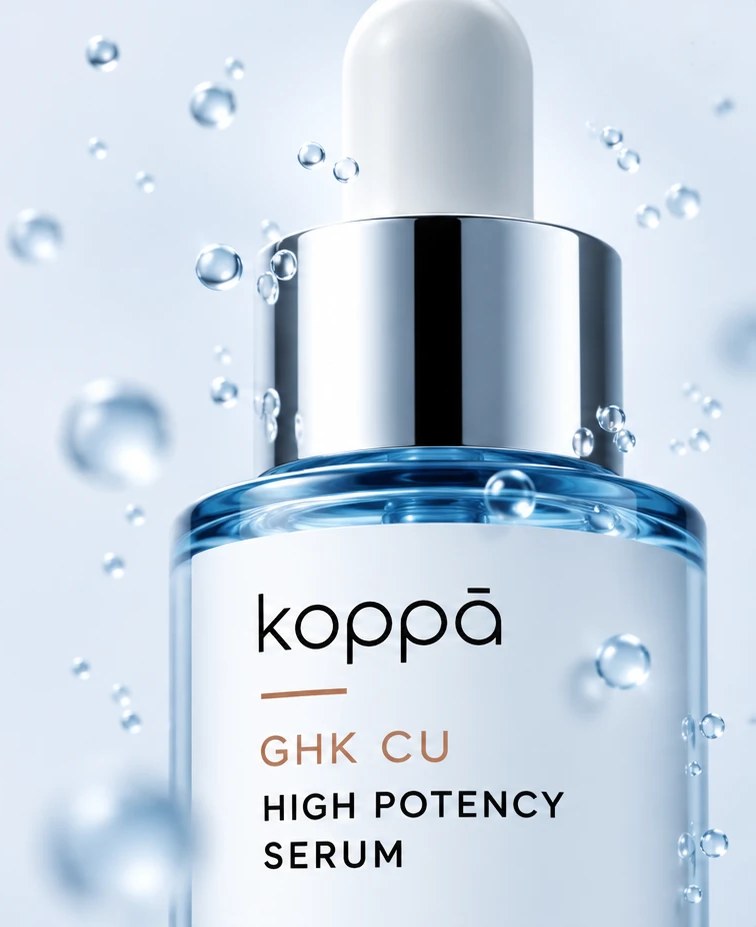
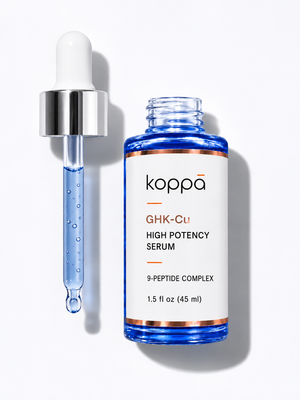
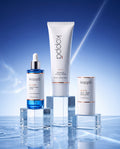
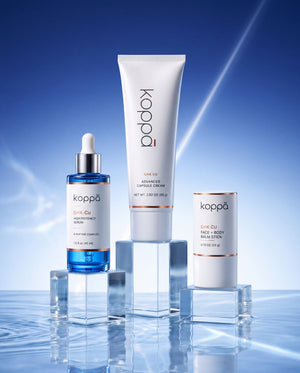
koppā 2% GHK-Cu High-Concentration Copper Peptide Serum
- GHK-Cu: 2% GHK-Cu (Copper Tripeptide-1), stated on the label.
- Also contains: six supporting peptides, Ceramide EOP, Ceramide NP, sodium hyaluronate, polyglutamic acid, trehalose, glycerin, betaine and panthenol.
- Size and price: 45 mL, US$75 (US$1.67 per mL).
- Format: water-light serum, fragrance-free, silicone-free, paraben-free, no added color. The blue comes from the copper. pH held at 5.5 to 6.0.
- How to use: three to four drops on clean face and neck, morning and/or evening, before moisturizer. In the morning, finish with broad-spectrum SPF 30 or higher.
Full ingredients
Aqua, Trehalose, Glycerin, Copper Tripeptide-1, 1,2-Hexanediol, Betaine, Hydrolyzed Collagen, Panthenol, Polyglutamic Acid, Ceramide EOP, Pullulan, Sodium Hyaluronate, Acetyl Hexapeptide-8, Allantoin, Palmitoyl Tetrapeptide-7, Dipeptide Diaminobutyroyl Benzylamide Diacetate, Arginine, Carbomer, Hydrolyzed Sclerotium Gum, Ceramide NP, Dipotassium Glycyrrhizate, Carnosine, Collagen, Palmitoyl Tripeptide-5, Acetyl Octapeptide-3, Ethylhexylglycerin.
koppā Protocol Trio
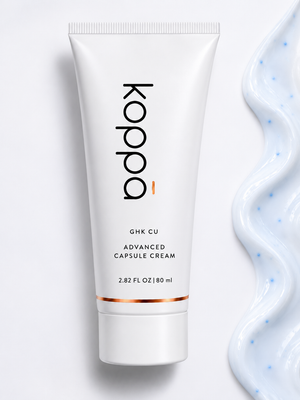
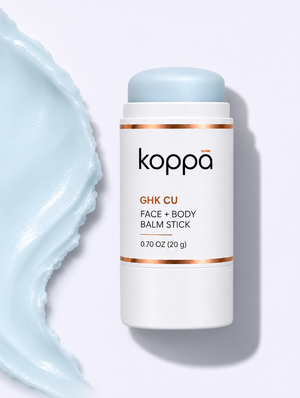
- GHK-Cu: 2% in the serum, 0.5% in the cream and 0.5% in the balm stick, each stated on its label.
- Also contains: the serum above, the cream (5% niacinamide, 4% squalane, 3% jojoba oil) and the balm stick (15% jojoba oil, 10% squalane).
- Size and price: three full sizes, 45 mL, 80 g and 20 g. US$175 (US$190 bought separately).
- Format: serum, capsule cream and water-free solid stick. All fragrance-free and silicone-free.
- How to use: serum first, then cream, then the balm last where skin feels dry.
Shipping and returns
- US: orders leave within 1 to 2 business days; standard delivery takes 5 to 9 business days from dispatch, about 6 to 11 business days in total. Standard shipping is US$3, free over US$100.
- Canada: orders leave within 1 to 2 business days, then about 5 to 9 business days in transit; customs can add 2 to 5 business days.
- Returns: unopened, unused products with intact seals within 30 days of delivery. US returns get a free prepaid label; outside the US the customer pays return postage.
What transparency about GHK-Cu can actually mean
The phrase covers at least seven different disclosures. Some sit on the label, some on a website, and some only come out when you ask. The table lists each one, what it tells you, and what koppā does.
| Check | What it tells you | koppā |
|---|---|---|
| 1. GHK-Cu percentage stated on the label | How much of the formula is the copper peptide itself | Yes. 2% serum, 0.5% cream, 0.5% balm |
| 2. Full INCI list published | Everything in the formula, in label order | Yes. For every product |
| 3. Raw-material purity specification | The grade of GHK-Cu the brand buys | Yes. Specified by the supplier at a minimum purity of 99% |
| 4. Independent verification of content | Whether someone outside the brand checked the amount | Partly. GHK-Cu content is verified by an independent laboratory; the lab report is not published on the site |
| 5. Manufacturing standard | The quality system the product is made under | Yes. Manufactured by suppliers certified to GMP and ISO 22716 |
| 6. Named supplier or published certificate of analysis | Who made the raw GHK-Cu, with a document you can read | No. Neither is published on the site |
| 7. Cited studies, with their limits | Whether claims trace back to papers and say what those papers cannot show | Yes. See the evidence table and editorial policy |
Two of these need a caution. A purity specification describes the raw ingredient before it goes into a formula. koppā's own editorial policy puts it this way: "A supplier specification describes the raw ingredient, not the finished product." ISO 22716 is the international guideline for good manufacturing practice in cosmetics [4]. It covers how a product is made, stored and shipped, not whether it works.
What brands state on their labels today
The copper peptide label registry records what 23 serums, creams and balms said on each brand's own product page [1]. It is published by koppā, three of the 23 products are koppā's, and the figures are what brands state, not test results.
| What the brand's page states | Products, of 23 |
|---|---|
| A GHK-Cu percentage | 8 |
| A figure for something other than GHK-Cu itself, such as a blend or complex | 6 |
| No percentage | 9 |
| No full ingredient list on the page (not recorded for a further 4) | 3 |
Labels were checked between 6 October and 4 November 2026. Source: koppā label registry, updated 6 November 2026.
One example was confirmed on the brand's own site on 17 November 2026. NIOD's page for Copper Amino Isolate Serum 3 1:1 states 1% GHK-Cu and publishes a full ingredient list [3]. For serum-by-serum detail, see copper peptide serums compared [2].

Why most brands do not name their supplier
The rules do not ask for it. The FDA's cosmetics labeling guide requires ingredients to be listed in descending order of predominance, and notes that concentrations "need not be declared by regulation" [5]. The same guide allows an ingredient accepted as a trade secret to be left off the label. The system is built to tell you what is in a product, not who supplied it or how much of it there is.
Beyond the rules, supplier relationships are generally treated as commercially confidential. A named supplier tells competitors where to buy the same material, and supply contracts can restrict what a brand may disclose. So silence on this point is not, by itself, a mark against a brand. That is the reason checks 1 to 5 matter: they are what a brand can disclose without naming a partner.
koppā is in the same position. The supplier's name and the certificate of analysis are not on the site. The ingredients page carries the full list for each product, and the concentration guide explains what a stated percentage does and does not tell you.
Five questions to email any brand
If a product page leaves gaps, ask. A brand that takes sourcing seriously should be able to answer most of these in writing.
- What percentage of the finished product is GHK-Cu (Copper Tripeptide-1) itself, not a blend or complex?
- What minimum purity is the raw GHK-Cu specified at, and who sets that specification?
- Has an independent laboratory verified the GHK-Cu content, and can you share the report or a summary?
- Is the product made in a facility certified to GMP or ISO 22716?
- Can you share a certificate of analysis for the batch I would receive?
You can send the same list to koppā through the contact page. Expect the answers in the table above, including the "no" on a published certificate.
How to read the evidence a brand cites
The seventh check is the easiest to skip. A brand can cite real studies and still leave out what they cannot show. Look for three things: the paper is linked, the study design is described, and the page says whether the product tested was the brand's own.
One example: Badenhorst and colleagues (2016) ran a randomized, double-blind study in 40 women over 8 weeks and reported 55.8% less wrinkle volume with a GHK-Cu serum in a nano-carrier than with the carrier alone [6]. That was a different formula. The studies koppā cites are studies of ingredients or other formulas, not of koppā's finished products.
Frequently asked questions
Are there brands known for transparent GHK-Cu sourcing?
No recognized ranking exists, so "known for" is hard to support. What can be checked is what each brand publishes. In koppā's registry of 23 copper peptide products, 8 state a GHK-Cu percentage.
Does koppā name its GHK-Cu supplier?
No. koppā does not publish the supplier's name, a certificate of analysis or the lab report on its site. It does state that the raw GHK-Cu is specified by the supplier at a minimum purity of 99%.
Is koppā's GHK-Cu content independently tested?
koppā states that GHK-Cu content is verified by an independent laboratory. The report itself is not published on the site, which is why the table above marks this check as "partly".
What is a certificate of analysis?
It is a document, usually issued per batch, that records test results for a material or product against its specification. Not every brand publishes them. You can ask any brand for one.
Do brands have to state the GHK-Cu percentage?
Not in the US. The FDA's labeling guide requires ingredient names in descending order of predominance and says concentrations need not be declared. A stated percentage is voluntary.
Does a 99% purity specification mean the product is 99% GHK-Cu?
No. It describes the raw ingredient before formulation. The amount in the finished product is the label percentage: 2% in the koppā serum and 0.5% in the cream and the balm.
The short version
No list of brands "known for" transparent GHK-Cu sourcing can be backed with a source, and naming a supplier is not something US labeling rules require. Use the seven checks instead: stated percentage, full ingredient list, purity specification, independent verification, manufacturing standard, named supplier or certificate of analysis, and cited studies with their limits. koppā states its GHK-Cu percentages, publishes its full ingredient lists, uses raw GHK-Cu specified by the supplier at a minimum purity of 99%, has content verified by an independent laboratory and uses suppliers certified to GMP and ISO 22716. It does not publish the supplier's name, a certificate of analysis or the lab report.
Sources
- koppā. Copper peptide label registry: what 23 products state on the label. Updated 6 November 2026; checked 17 November 2026. koppabeauty.com
- koppā. Copper peptide serums compared. Checked 17 November 2026. koppabeauty.com
- NIOD. Copper Amino Isolate Serum 3 1:1, product page. Checked 17 November 2026. niod.com
- International Organization for Standardization. ISO 22716:2007, Cosmetics, Good Manufacturing Practices (GMP), Guidelines on Good Manufacturing Practices. iso.org
- US Food and Drug Administration. Cosmetics Labeling Guide. Checked 17 November 2026. fda.gov
- Badenhorst T, et al. Effects of GHK-Cu on MMP and TIMP expression, collagen and elastin production, and facial wrinkle parameters. 2016. walshmedicalmedia.com