


Layering guide
Which peptide serums work best under sunscreen?

The peptide serums that layer best under sunscreen are water-based, silicone-free, ideally fragrance-free, only lightly thickened, and built on humectants such as glycerin and hyaluronic acid so you can often skip a separate moisturizer. Those traits matter more than the brand or the type of peptide. You can check every one of them on the ingredient list before you buy.
Product facts
Checked on koppabeauty.com, 17 November 2026. Prices in US dollars; checkout shows your local currency.
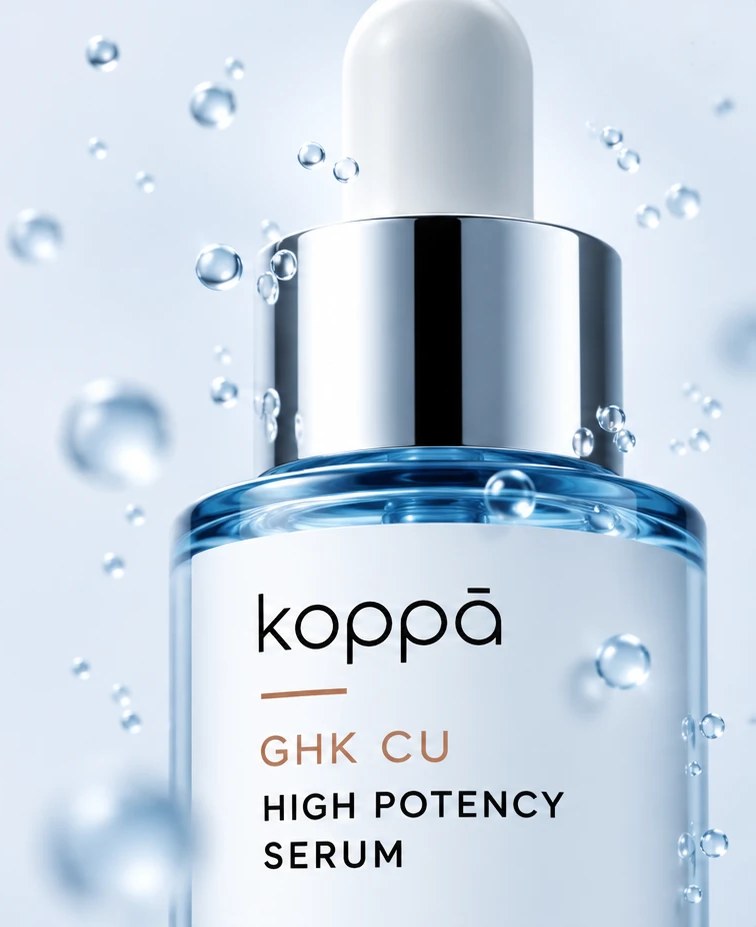
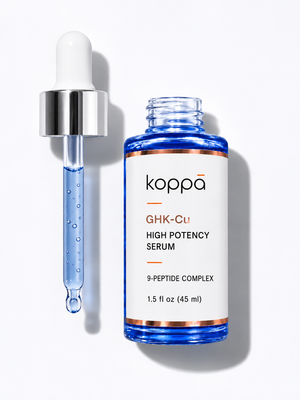
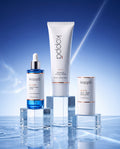
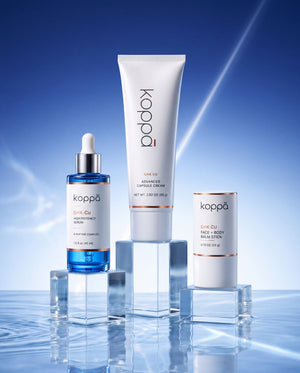
koppā 2% GHK-Cu High-Concentration Copper Peptide Serum
- GHK-Cu: 2% (Copper Tripeptide-1)
- Also contains: six supporting peptides, Ceramide EOP, Ceramide NP, sodium hyaluronate, polyglutamic acid, trehalose, glycerin, betaine and panthenol
- Size and price: 45 mL, US$75 (US$1.67 per mL)
- Format: water-light serum; fragrance-free, silicone-free, paraben-free, no added color (the blue comes from the copper); pH held at 5.5 to 6.0
- How to use: three to four drops on clean face and neck, morning and/or evening, before moisturizer; mornings finish with broad-spectrum SPF 30 or higher
Full ingredients
Aqua, Trehalose, Glycerin, Copper Tripeptide-1, 1,2-Hexanediol, Betaine, Hydrolyzed Collagen, Panthenol, Polyglutamic Acid, Ceramide EOP, Pullulan, Sodium Hyaluronate, Acetyl Hexapeptide-8, Allantoin, Palmitoyl Tetrapeptide-7, Dipeptide Diaminobutyroyl Benzylamide Diacetate, Arginine, Carbomer, Hydrolyzed Sclerotium Gum, Ceramide NP, Dipotassium Glycyrrhizate, Carnosine, Collagen, Palmitoyl Tripeptide-5, Acetyl Octapeptide-3, Ethylhexylglycerin.
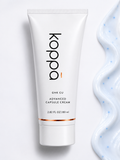
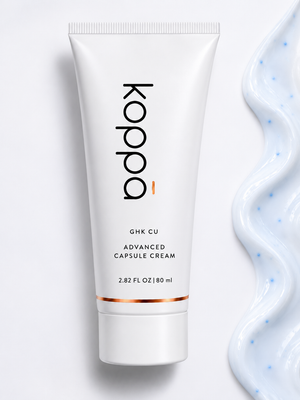
koppā GHK-Cu Moisturizing Cream: 0.5% Copper Peptide Face Cream (Advanced Capsule Cream)
- GHK-Cu: 0.5%
- Also contains: 5% niacinamide, 4% squalane, 3% jojoba oil, two forms of hyaluronic acid, glycerin and trehalose
- Size and price: 80 g, US$70 (US$0.88 per g)
- Format: cream with blue capsules that hold the GHK-Cu and break as you massage; fragrance-free, silicone-free
- How to use: clean face and neck, morning and/or evening, after serum if used; massage until the capsules disperse; SPF in the morning
Full ingredients
Aqua, Glycerin, Niacinamide, Squalane, Butylene Glycol, Trehalose, Simmondsia Chinensis (Jojoba) Seed Oil, Euglena Gracilis Polysaccharide, Pentylene Glycol, Isononyl Isononanoate, Caprylic/Capric Triglyceride, Cetearyl Olivate, 1,2-Hexanediol, C14-22 Alcohols, Sorbitan Olivate, Copper Tripeptide-1, Tocopheryl Acetate, Tremella Fuciformis Polysaccharide, Portulaca Oleracea Extract, Arginine, Hydrolyzed Collagen, Leontopodium Alpinum Callus Culture Extract, Crithmum Maritimum Callus Culture Filtrate, Carbomer, C12-20 Alkyl Glucoside, Hydrolyzed Sodium Hyaluronate, Adenosine, Sodium Hyaluronate, Disodium EDTA, Algin, Acetyl Hexapeptide-8, Mannitol, Collagen, Tripeptide-1, Pentapeptide-3, Agar, Hydroxyethylcellulose, Gellan Gum.
Shipping and returns
- US: orders leave within 1 to 2 business days; standard delivery takes 5 to 9 business days from dispatch, about 6 to 11 business days in total. Standard shipping is US$3, free over US$100.
- Canada: orders leave within 1 to 2 business days, then about 5 to 9 business days in transit; customs can add 2 to 5 business days.
- Returns: unopened, unused products with intact seals within 30 days of delivery. US returns get a free prepaid label; outside the US the customer pays return postage.
What makes a peptide serum sit well under sunscreen
Sunscreen is the last layer of a morning routine, and the general rule is to apply products from thinnest to thickest.3 A serum earns its place under it by being thin, setting quickly and leaving as little on the surface as possible.
Some ingredients linked to pilling are known. In an interview about why sunscreen pills, dermatologist Dr Macrene Alexiades names silicones (dimethicone, amodimethicone, cyclomethicone), xanthan gum at higher concentrations and carbomer that is not properly neutralized as ingredients to check for. She was describing sunscreen formulas; applying the same check to the serum underneath is our reading.4 None of these is a bad ingredient. The question is how much of each your serum carries into the next layer.
| Trait | Layers well | Tends to fight sunscreen | Example INCI names to look for |
|---|---|---|---|
| Base | Water first on the list | Oils or butters near the top | Aqua; versus Caprylic/Capric Triglyceride, Butyrospermum Parkii Butter |
| Silicones | None, or very low on the list | Several silicones high on the list | Dimethicone, Amodimethicone, Cyclomethicone |
| Thickeners and gums | One or two, low on the list | Thick gel texture, gums near the top | Carbomer, Xanthan Gum |
| Film-formers | Few and low on the list | Several, or high on the list | Pullulan, Acrylates Copolymer, PVP |
| Humectants | Several near the top, so skin feels comfortable with one fewer layer | None, so you need a moisturizer in between | Glycerin, Sodium Hyaluronate, Betaine, Trehalose, Panthenol |
| pH | Mildly acidic, close to 5 to 6 | Low-pH actives better kept for another time of day | Ascorbic Acid, Glycolic Acid, Salicylic Acid |
| Fragrance | None | Added scent | Parfum, Fragrance, Linalool, Limonene |
One honest note on the last row: fragrance does not change how a serum layers. It is on the list because a product you wear under sunscreen every day is better with one less thing that can irritate.

How to check a serum's ingredient list
Cosmetic ingredients are listed in descending order of predominance, and anything at 1% or less can appear in any order after that.5 So position tells you a lot, though not everything.
- Read the first five names. You want water and humectants there, not oils or silicones.
- Scan for silicones. Dimethicone and its relatives are easy to spot. A serum can be good with them, but it is one more film under your SPF.
- Find the thickeners and film-formers. Note where carbomer, gums and pullulan sit. Low on the list is the better sign.
- Look for fragrance. It appears as Parfum or Fragrance.
- Check the stated pH and percentage. If a brand states neither, you are guessing. Our copper peptide label registry records what 23 products state on the label.
We have not ranked other brands' serums here. Formulas change, and a list of traits you can check yourself stays accurate for longer than a ranking. For a wider view of what else to weigh, see our guide to choosing a peptide serum.
How the koppā serum scores against those traits
The full list for every product is on our ingredients page. Here is the serum checked against the same traits, including the ones where it does not score a clean yes.6
| Trait | What the koppā serum label shows | Verdict |
|---|---|---|
| Water-based, light texture | Aqua is first; water-light serum | Yes |
| Silicone-free | No silicones on the list | Yes |
| Fragrance-free | No fragrance and no added color | Yes |
| Low film-former and thickener load | Contains pullulan (11th of 26 ingredients), carbomer (18th) and hydrolyzed sclerotium gum, a polysaccharide (19th) | Partly. They are present, in the middle and lower part of the list. Pullulan is a film-forming ingredient. |
| Humectants | Trehalose and glycerin are second and third, with betaine, panthenol, polyglutamic acid and sodium hyaluronate | Yes |
| pH that suits a morning routine | Held at 5.5 to 6.0 | Yes |
| Set time | We do not publish one | Unknown. |
So the fair summary is this: silicone-free and fragrance-free, but not film-former-free. Because of the pullulan and carbomer, more serum is not better. Stay with three to four drops.
One outside observation: Shifts! Magazine used the routine for four weeks and reported that the serum absorbed without stickiness and sat under both mineral and chemical sunscreens with no pilling.7 That is an editorial review, written with samples supplied by koppā, not a clinical study, and your sunscreen may behave differently. If yours does roll, our page on sunscreen pilling with copper peptides covers the fixes.
The morning order: serum, cream, then sunscreen
- CleanseStart with a clean face and neck.
- SerumThree to four drops of the 2% GHK-Cu serum on face and neck.
- Cream, if you need itAdd the cream if skin feels dry; skip it if the serum's humectants are enough.
- Sunscreen lastBroad-spectrum SPF 30 or higher, every morning.
If you would rather wear one layer than two, the koppā cream on its own under sunscreen is the simpler route: 0.5% GHK-Cu with 5% niacinamide, also silicone-free. For evening pairings and what to keep apart, see the morning and night routine.

Should peptides go on in the morning at all?
Yes. Cleveland Clinic's routine guidance places serums in the morning, after cleansing, with sunscreen as the final step.3 The American Academy of Dermatology recommends a broad-spectrum, water-resistant sunscreen of SPF 30 or higher.2
On copper peptides and sunscreen specifically, there is little to report. The American Academy of Dermatology's page on copper peptides does not mention sunscreen or UV filters. The risk it names is irritation, especially when several active ingredients are layered, and it lists patch testing new products and the irritation risk from excessive layering of actives as points for dermatologists to raise with patients.1 We have found no published report of GHK-Cu interacting with UV filters. That is an absence of reports, not proof from a study.
The same page describes the evidence for GHK-Cu as preliminary and drawn from small trials.1 We agree with that framing. The trials are summarized on our GHK-Cu evidence page; they tested ingredients or other formulas, not koppā's finished products. More on tolerance is in are copper peptides safe.
Frequently asked questions
Which peptide serums work best when layered under sunscreen?
Water-based serums with humectants near the top of the ingredient list, no silicones, no fragrance, and thickeners or film-formers low on the list. The type of peptide matters less than the texture of the formula around it.
Does a peptide serum go on before or after sunscreen?
Before. Apply the serum to clean skin, add moisturizer if you use one, and put sunscreen on last.
Can I use a copper peptide serum in the morning?
Yes. The koppā serum is made for morning and/or evening use. In the morning, finish with broad-spectrum SPF 30 or higher. Keep low-pH vitamin C and exfoliating acids for the other end of the day.
Does GHK-Cu react with sunscreen filters?
We have found no published report that it does, and the American Academy of Dermatology's copper peptides page does not mention sunscreen. No study we know of has tested the combination directly, so we describe it as no known interaction.
Is the koppā serum free of film-formers?
No. It contains pullulan and carbomer, plus hydrolyzed sclerotium gum, in the middle and lower part of the ingredient list. It is free of silicones and fragrance.
Do I need a moisturizer between a peptide serum and sunscreen?
Not always. If the serum is rich in humectants and your skin feels comfortable, you can go straight to sunscreen. If your skin feels dry, add a cream in between.
The short version
Pick a peptide serum for under sunscreen by reading its ingredient list: water first, humectants near the top, no silicones or fragrance, and thickeners and film-formers low down. The koppā 2% GHK-Cu serum meets most of that. It is water-light, silicone-free and fragrance-free at pH 5.5 to 6.0, and it does contain pullulan and carbomer, so three to four drops is the right amount. Peptides are fine in the morning, and sunscreen always goes on last.
Sources
- American Academy of Dermatology. Copper peptides. aad.org
- American Academy of Dermatology. How to apply sunscreen. aad.org
- Cleveland Clinic. How to order your skin care routine. 5 September 2025. health.clevelandclinic.org
- Jin J, PureWow. We ask a dermatologist: why does my sunscreen pill? And tips for how to prevent it (interview with Dr Macrene Alexiades). 8 July 2024. purewow.com
- US Food and Drug Administration. Cosmetics labeling guide. fda.gov
- koppā. 2% GHK-Cu High-Concentration Copper Peptide Serum: ingredient list and directions, checked 17 November 2026. koppabeauty.com
- Shifts! Magazine (Italy). Review of the koppā routine, four weeks of use, published 6 November 2026. Editorial review based on samples supplied by the brand, not a clinical study. blogshifts.net