
koppā vs CopperTheory: 2% vs 1.4% GHK-Cu, label by label
Two of the few copper peptide brands that print a GHK-Cu percentage, compared from their own labels: the two serums, the two creams, the science behind each difference, and where each ships from. We make koppā, and we say so.
- Fragrance-free
- Cruelty free
- Full ingredient list on every product
- GHK-Cu concentration stated on every bottle
koppā or CopperTheory: which copper peptide range should you choose?
Both brands put a GHK-Cu percentage on the label, which most copper peptide brands do not, so this is a comparison worth making label by label. koppā's serum states 2% GHK-Cu in 45 ml; CopperTheory's states 1.4% in 30 ml. koppā's cream states 0.5% encapsulated GHK-Cu with 5% niacinamide in 80 g; CopperTheory's states 1.4% with 4% niacinamide in 30 g. koppā is the only one of the two whose formulas are all fragrance-free and silicone-free, with every ingredient list published, and the only one that makes a balm; CopperTheory makes a cleanser, masks and a hair serum that koppā does not.
Choose koppā for the most GHK-Cu in a serum, two ceramides and six named peptides in the same bottle, niacinamide at the level its trial used, a published list for everything and a US price with free US returns. Choose CopperTheory if you want a higher number on a cream label at a lower entry price and do not mind silicones. Every figure below comes from each brand's own product pages, checked on 29 October 2026. We make koppā, and we say so.
Four products, label by label
The two serums and the two creams. koppā prices are live; CopperTheory prices are its US-dollar list prices on 29 October 2026.
Four products, side by side
Scroll horizontally for all four| Product |
 koppā
GHK-Cu 2% High Potency Serum
Most GHK-Cu | CopperTheory 1.4% GHK-Cu Copper Peptide Face Serum Stated 1.4% |
 koppā
GHK-Cu Moisturizing Cream
Encapsulated, with 5% niacinamide | CopperTheory 1.4% GHK-Cu Copper Peptide Face Cream Stated 1.4% |
|---|---|---|---|---|
| GHK-Cu, as stated | 2% GHK-Cu, stated | 1.4% Copper Tripeptide-1, stated | 0.5% GHK-Cu, encapsulated, stated | 1.4% Copper Tripeptide-1, stated |
| Size | 45 ml | 30 ml | 80 g | 30 g |
| US list price | US$75 | US$35 | US$70 | US$35 |
| Price per ml or g | US$1.67 per ml | US$1.17 per ml | US$0.88 per g | US$1.17 per g |
| GHK-Cu % on the label | 2% | 1.4% | 0.5%, encapsulated | 1.4% |
| Copper Tripeptide-1 position on the ingredient list | 4th of 26 | 6th of 17 | 16th of 38 | 21st of 28 |
| Full ingredient list published | ||||
| Fragrance | None; fragrance-free per the brand | None in the list; not labelled fragrance-free | None; fragrance-free per the brand | None in the list; not labelled fragrance-free |
| Silicones | None; silicone-free per the brand | None in the list | None; silicone-free per the brand | Cyclopentasiloxane and dimethicone |
| Size | 45 ml | 30 ml | 80 g | 30 g |
| Price per ml or g | US$1.67 per ml | US$1.17 per ml | US$0.88 per g | US$1.17 per g |
| Shop | Shop, $75 | Shop, $70 |
CopperTheory prices, sizes, percentages and ingredient lists are as shown on shopcoppertheory.com for the United States on 29 October 2026, before promotions; the page showed US$49 beside US$35 for both products without labelling which is the sale price. koppā prices are live. Grams and millilitres are different units; per-unit figures are a guide, not a ranking across them.
-
01
 Most GHK-Cu
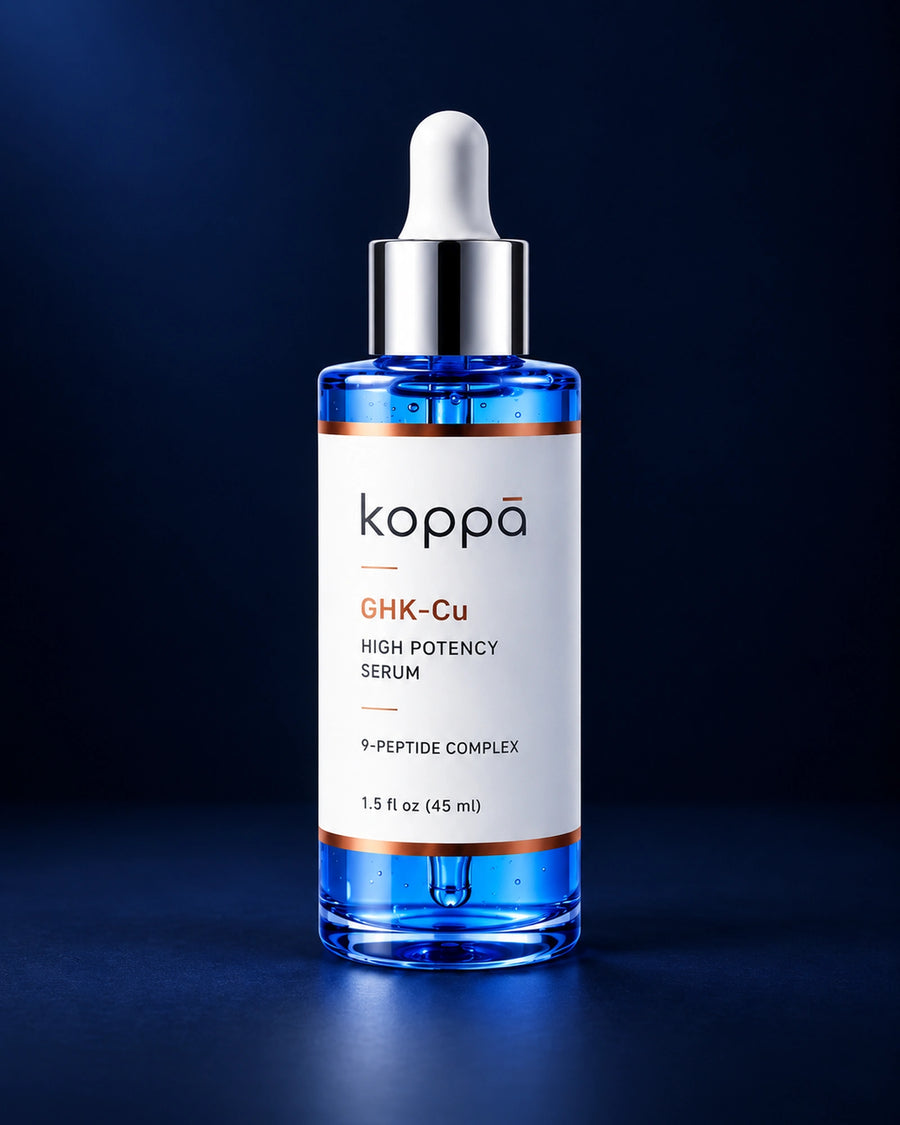
koppāGHK-Cu 2% High Potency Serum
- GHK-Cu, as stated
- 2% GHK-Cu, stated
- Size
- 45 ml
- Your current price
- $75
- Best for
- The most GHK-Cu per bottle, with two ceramides and six named peptides, pH 5.5 to 6.0, full list published
Copper Tripeptide-1 is fourth on the list, after water, trehalose and glycerin. Around it: six named supporting peptides, Ceramide EOP and Ceramide NP, five humectants (glycerin, trehalose, betaine, polyglutamic acid, sodium hyaluronate), panthenol, allantoin and carnosine, at pH 5.5 to 6.0. No fragrance, silicones, parabens or added colour. Full ingredient list.
What stands out
- 2% GHK-Cu in 45 ml: about 0.9 g of GHK-Cu per bottle at that percentage by weight
- Two ceramides and six named peptides in the same step
- pH 5.5 to 6.0, inside the range in which GHK-Cu stayed intact3
- Fragrance-free and silicone-free, full list published
Worth knowing
- US$75, US$1.67 per ml, live on the product page
- Ships to the US from US$3, free over US$100, free US returns
-
02Stated 1.4%
CopperTheory1.4% GHK-Cu Copper Peptide Face Serum
- GHK-Cu, as stated
- 1.4% Copper Tripeptide-1, stated
- Size
- 30 ml
- US list price
- US$35
- Best for
- A stated 1.4% at a lower entry price, in a short 17-ingredient formula
A 17-ingredient water-based serum. Copper Tripeptide-1 is sixth, after water, butylene glycol, glycerin, 1,2-hexanediol and p-hydroxyacetophenone. The brand states 4% niacinamide, 1% panthenol, 0.08% sodium hyaluronate and 0.04% hydrolysed sodium hyaluronate, 0.2% allantoin, and a 10% Argireline solution, which it counts with the GHK-Cu as an 11.4% peptide complex. A supplier solution percentage is not the peptide percentage; the page does not say how much Acetyl Hexapeptide-8 that is. No fragrance or silicones appear in the list.
shopcoppertheory.comWhat stands out
- A stated 1.4% GHK-Cu
- Full ingredient list published, with percentages for most actives
- US$35 for 30 ml
Worth knowing
- US$35 on shopcoppertheory.com, 29 October 2026, with US$49 also shown
- About 0.42 g of GHK-Cu per bottle at 1.4% by weight
- Australian-owned; international standard shipping A$10, free over A$89, 5 to 8 business days, per its shipping policy
-
03Encapsulated, with 5% niacinamide
koppāGHK-Cu Moisturizing Cream
- GHK-Cu, as stated
- 0.5% GHK-Cu, encapsulated, stated
- Size
- 80 g
- Your current price
- $70
- Best for
- A daily moisturiser that protects its GHK-Cu in capsules, with niacinamide at the trialled 5%, in 80 g
0.5% GHK-Cu held in visible blue capsules designed to protect the peptide until the cream is massaged in, with 5% niacinamide, 4% squalane and 3% jojoba oil, adenosine, three supporting peptides and two weights of hyaluronic acid. Supplier accelerated-stability and temperature-cycling documentation covers the cream. No fragrance, silicones or PEGs. Full ingredient list.
What stands out
- GHK-Cu protected in capsules until use, with stability documentation on file
- 5% niacinamide, the level tested in a 12-week double-blind study4
- 80 g, about US$0.88 per gram
- Fragrance-free, silicone-free, PEG-free, full list published
Worth knowing
- US$70, live on the product page
- Ships to the US from US$3, free over US$100, free US returns
-
04Stated 1.4%
CopperTheory1.4% GHK-Cu Copper Peptide Face Cream
- GHK-Cu, as stated
- 1.4% Copper Tripeptide-1, stated
- Size
- 30 g
- US list price
- US$35
- Best for
- A higher stated percentage in a small tube, with a barrier-lipid trio and two silicones
A 28-ingredient cream. Copper Tripeptide-1 is 21st, after the emollients, both silicones, argan oil, squalane, a 2.5% barrier-lipid complex (Ceramide NP, cholesterol, phytosphingosine), sodium hyaluronate, panthenol and 4% niacinamide. Also lists PEG-100 stearate. The page does not describe how the GHK-Cu is protected in the formula, and states no pH. No fragrance appears in the list.
shopcoppertheory.comWhat stands out
- A stated 1.4% GHK-Cu
- Ceramide NP, cholesterol and phytosphingosine, 2.5% together
- Full ingredient list published
Worth knowing
- US$35 on shopcoppertheory.com, 29 October 2026, with US$49 also shown
- Contains cyclopentasiloxane, dimethicone and PEG-100 stearate
- The brand's separate beef-tallow face cream states no percentage and was out of stock when checked
koppā 2% serum vs CopperTheory 1.4% serum, ingredient by ingredient
| On the label | koppā GHK-Cu 2% Serum | CopperTheory 1.4% Serum |
|---|---|---|
| Stated GHK-Cu | 2% Copper Tripeptide-1, fourth of 26 ingredients. |
1.4% Copper Tripeptide-1, sixth of 17 ingredients. |
| GHK-Cu per bottle | About 0.9 g (2% of 45 ml, taken by weight). |
About 0.42 g (1.4% of 30 ml, taken by weight). The koppā bottle holds roughly twice the peptide. |
| Supporting peptides | Six, each named: Acetyl Hexapeptide-8, Palmitoyl Tetrapeptide-7, Palmitoyl Tripeptide-5, Acetyl Octapeptide-3, Dipeptide Diaminobutyroyl Benzylamide Diacetate, Hydrolyzed Collagen. |
One: Acetyl Hexapeptide-8, as a 10% Argireline solution. A solution percentage is not the peptide percentage, and the page does not give one. |
| Barrier lipids | Ceramide EOP and Ceramide NP. A moisturiser built from ceramides, humectants and emollients raised skin hydration in a clinical study6. |
None listed. |
| Hydration system | Five humectants: glycerin, trehalose, betaine, polyglutamic acid, sodium hyaluronate; plus panthenol and allantoin. |
Glycerin, butylene glycol, 0.08% sodium hyaluronate, 0.04% hydrolysed sodium hyaluronate, 1% panthenol, 0.2% allantoin. |
| Niacinamide | None in the serum; 5% in the koppā cream, the next step. |
4%. |
| pH | 5.5 to 6.0, inside the 4.5 to 7.4 range in which GHK-Cu stayed intact in a preformulation study3. |
Not stated. Arginine is listed for pH control. |
| Fragrance, silicones, parabens | None, and labelled fragrance-free and silicone-free. |
None in the list; the page makes no fragrance-free or silicone-free statement. |
| Size and price | 45 ml, US$75, US$1.67 per ml. |
30 ml, US$35, US$1.17 per ml. |
Stated GHK-Cu
- koppā GHK-Cu 2% Serum
2% Copper Tripeptide-1, fourth of 26 ingredients.
- CopperTheory 1.4% Serum
1.4% Copper Tripeptide-1, sixth of 17 ingredients.
GHK-Cu per bottle
- koppā GHK-Cu 2% Serum
About 0.9 g (2% of 45 ml, taken by weight).
- CopperTheory 1.4% Serum
About 0.42 g (1.4% of 30 ml, taken by weight). The koppā bottle holds roughly twice the peptide.
Supporting peptides
- koppā GHK-Cu 2% Serum
Six, each named: Acetyl Hexapeptide-8, Palmitoyl Tetrapeptide-7, Palmitoyl Tripeptide-5, Acetyl Octapeptide-3, Dipeptide Diaminobutyroyl Benzylamide Diacetate, Hydrolyzed Collagen.
- CopperTheory 1.4% Serum
One: Acetyl Hexapeptide-8, as a 10% Argireline solution. A solution percentage is not the peptide percentage, and the page does not give one.
Barrier lipids
- koppā GHK-Cu 2% Serum
Ceramide EOP and Ceramide NP. A moisturiser built from ceramides, humectants and emollients raised skin hydration in a clinical study6.
- CopperTheory 1.4% Serum
None listed.
Hydration system
- koppā GHK-Cu 2% Serum
Five humectants: glycerin, trehalose, betaine, polyglutamic acid, sodium hyaluronate; plus panthenol and allantoin.
- CopperTheory 1.4% Serum
Glycerin, butylene glycol, 0.08% sodium hyaluronate, 0.04% hydrolysed sodium hyaluronate, 1% panthenol, 0.2% allantoin.
Niacinamide
- koppā GHK-Cu 2% Serum
None in the serum; 5% in the koppā cream, the next step.
- CopperTheory 1.4% Serum
4%.
pH
- koppā GHK-Cu 2% Serum
5.5 to 6.0, inside the 4.5 to 7.4 range in which GHK-Cu stayed intact in a preformulation study3.
- CopperTheory 1.4% Serum
Not stated. Arginine is listed for pH control.
Fragrance, silicones, parabens
- koppā GHK-Cu 2% Serum
None, and labelled fragrance-free and silicone-free.
- CopperTheory 1.4% Serum
None in the list; the page makes no fragrance-free or silicone-free statement.
Size and price
- koppā GHK-Cu 2% Serum
45 ml, US$75, US$1.67 per ml.
- CopperTheory 1.4% Serum
30 ml, US$35, US$1.17 per ml.
koppā 0.5% moisturizing cream vs CopperTheory 1.4% cream, ingredient by ingredient
| On the label | koppā Moisturizing Cream | CopperTheory 1.4% Face Cream |
|---|---|---|
| Stated GHK-Cu | 0.5%, encapsulated; 16th of 38 ingredients. |
1.4%; 21st of 28 ingredients. |
| How the GHK-Cu is protected | Held in visible capsules designed to protect the peptide until the cream is massaged in; accelerated-stability and temperature-cycling documentation on file. |
Not described on the page. No pH stated. |
| Niacinamide | 5%, the level tested in the 12-week double-blind study of 50 women4. |
4%. |
| Emollients and barrier | 4% squalane, 3% jojoba seed oil, caprylic/capric triglyceride, olivate esters. Niacinamide itself raised ceramide synthesis in keratinocytes and reduced water loss on dry skin5. |
Squalane, argan oil, caprylic/capric triglyceride, cetearyl and behenyl alcohols, and a 2.5% complex of Ceramide NP, cholesterol and phytosphingosine. |
| Silicones and PEGs | None. |
Cyclopentasiloxane, dimethicone, PEG-100 stearate. |
| Supporting peptides | Three: Acetyl Hexapeptide-8, Pentapeptide-3, Tripeptide-1; plus adenosine and two weights of hyaluronic acid. |
None besides the GHK-Cu. |
| Fragrance | None, labelled fragrance-free. |
None in the list; not labelled fragrance-free. |
| Size and price | 80 g, US$70, about US$0.88 per gram. |
30 g, US$35, about US$1.17 per gram. |
Stated GHK-Cu
- koppā Moisturizing Cream
0.5%, encapsulated; 16th of 38 ingredients.
- CopperTheory 1.4% Face Cream
1.4%; 21st of 28 ingredients.
How the GHK-Cu is protected
- koppā Moisturizing Cream
Held in visible capsules designed to protect the peptide until the cream is massaged in; accelerated-stability and temperature-cycling documentation on file.
- CopperTheory 1.4% Face Cream
Not described on the page. No pH stated.
Niacinamide
- koppā Moisturizing Cream
5%, the level tested in the 12-week double-blind study of 50 women4.
- CopperTheory 1.4% Face Cream
4%.
Emollients and barrier
- koppā Moisturizing Cream
4% squalane, 3% jojoba seed oil, caprylic/capric triglyceride, olivate esters. Niacinamide itself raised ceramide synthesis in keratinocytes and reduced water loss on dry skin5.
- CopperTheory 1.4% Face Cream
Squalane, argan oil, caprylic/capric triglyceride, cetearyl and behenyl alcohols, and a 2.5% complex of Ceramide NP, cholesterol and phytosphingosine.
Silicones and PEGs
- koppā Moisturizing Cream
None.
- CopperTheory 1.4% Face Cream
Cyclopentasiloxane, dimethicone, PEG-100 stearate.
Supporting peptides
- koppā Moisturizing Cream
Three: Acetyl Hexapeptide-8, Pentapeptide-3, Tripeptide-1; plus adenosine and two weights of hyaluronic acid.
- CopperTheory 1.4% Face Cream
None besides the GHK-Cu.
Fragrance
- koppā Moisturizing Cream
None, labelled fragrance-free.
- CopperTheory 1.4% Face Cream
None in the list; not labelled fragrance-free.
Size and price
- koppā Moisturizing Cream
80 g, US$70, about US$0.88 per gram.
- CopperTheory 1.4% Face Cream
30 g, US$35, about US$1.17 per gram.
What the research says about where the two ranges differ
The percentage on a cream is not the result
CopperTheory's cream states 1.4% to koppā's 0.5%. No published human study has compared two retail percentages head to head. The randomised, double-blind trial most often quoted for GHK-Cu tested a serum that delivered the peptide in a lipid nanocarrier and did not state a percentage2, and the laboratory study that first showed collagen stimulation found it at very low concentrations1. What the number cannot tell you is whether the peptide is intact when it reaches your skin.
GHK-Cu has to survive the formula
GHK-Cu stayed intact between pH 4.5 and 7.4 and broke down under alkaline and oxidising stress3. koppā's serum states its pH, 5.5 to 6.0, inside that range; its cream holds the peptide in capsules designed to protect it until use, and carries accelerated-stability and temperature-cycling documentation. CopperTheory's pages state no pH and do not describe how the GHK-Cu is protected in either product.
In a serum, more GHK-Cu and more around it
koppā's serum states 2% to CopperTheory's 1.4%, in 45 ml to 30 ml: roughly twice the GHK-Cu per bottle. It also carries what CopperTheory's serum does not list: two ceramides, whose class raised skin hydration in a clinical study of a ceramide-humectant-emollient moisturiser6, and five further named peptides. Both list Acetyl Hexapeptide-8, which improved eye-area wrinkle roughness in a four-week randomised, placebo-controlled trial of 60 people7.
Niacinamide at the trialled level
koppā's cream states 5% niacinamide; CopperTheory's serum and cream state 4%. The double-blind, split-face study of 50 women that reduced the look of fine lines, dark spots, red blotchiness and yellowing and improved elasticity over 12 weeks used 5%4. In cultured keratinocytes nicotinamide raised ceramide synthesis about 4 to 5.5 times, and on dry skin it raised stratum corneum ceramide levels and reduced water loss5.
Two ways to support the barrier
CopperTheory's cream adds a 2.5% complex of Ceramide NP, cholesterol and phytosphingosine, a recognised barrier-lipid approach. koppā splits the job: two ceramides in the serum step, then 5% niacinamide, 4% squalane and 3% jojoba in the cream, with the niacinamide evidence above5 behind the cream's barrier claim. Both are reasoned choices; koppā's does it without silicones or PEGs, with a published percentage for every active it names.
What each brand publishes about testing
CopperTheory publishes percentage results for both products (for example +58% skin hydration at 8 weeks, described as instrumental) without the number of participants, the instrument or the control. koppā publishes what its documentation covers: a supplier certificate of analysis specifying at least 99% purity for the raw GHK-Cu, accelerated-stability and temperature-cycling testing for the cream, hydration and ingredient-stability testing for the balm, and the published study behind each ingredient it names, with the paper cited on the page.
What each brand makes, and where it ships from
| Compare | koppā | CopperTheory |
|---|---|---|
| Products | 2% serum, 0.5% moisturizing cream, 0.5% balm stick, and the three as the Protocol set. |
1.4% serum, 1.4% cream, a beef-tallow face cream, a cleanser, face masks, an under-eye mask, a clay mask, pimple patches, a hair serum, and routine bundles. |
| GHK-Cu percentage stated on | Every product: three of three. |
The serum and the cream. The tallow cream, cleanser, masks and patches state none. |
| A balm or stick | Yes: the 20 g water-free balm stick, 0.5% GHK-Cu with eight supporting peptides, no tallow. Why no tallow. |
No stick. A beef-tallow face cream, percentage not stated, out of stock when checked. |
| Fragrance-free and silicone-free | Every product, labelled. |
Not labelled; the cream lists two silicones. |
| Based in, ships from | Operated from the UAE; the United States is the primary market, priced in USD. US standard shipping US$3, free over US$100, 6 to 11 business days; free US returns. |
Australian-owned, Melbourne. International standard shipping A$10, free over A$89, 5 to 8 business days, per its shipping policy; US rates confirmed at checkout. |
| Also on Amazon.com | Yes: serum, cream, balm stick and set, under koppā's own listings. |
Yes: the serum. |
Products
- koppā
2% serum, 0.5% moisturizing cream, 0.5% balm stick, and the three as the Protocol set.
- CopperTheory
1.4% serum, 1.4% cream, a beef-tallow face cream, a cleanser, face masks, an under-eye mask, a clay mask, pimple patches, a hair serum, and routine bundles.
GHK-Cu percentage stated on
- koppā
Every product: three of three.
- CopperTheory
The serum and the cream. The tallow cream, cleanser, masks and patches state none.
A balm or stick
- koppā
Yes: the 20 g water-free balm stick, 0.5% GHK-Cu with eight supporting peptides, no tallow. Why no tallow.
- CopperTheory
No stick. A beef-tallow face cream, percentage not stated, out of stock when checked.
Fragrance-free and silicone-free
- koppā
Every product, labelled.
- CopperTheory
Not labelled; the cream lists two silicones.
Based in, ships from
- koppā
Operated from the UAE; the United States is the primary market, priced in USD. US standard shipping US$3, free over US$100, 6 to 11 business days; free US returns.
- CopperTheory
Australian-owned, Melbourne. International standard shipping A$10, free over A$89, 5 to 8 business days, per its shipping policy; US rates confirmed at checkout.
Also on Amazon.com
- koppā
Yes: serum, cream, balm stick and set, under koppā's own listings.
- CopperTheory
Yes: the serum.

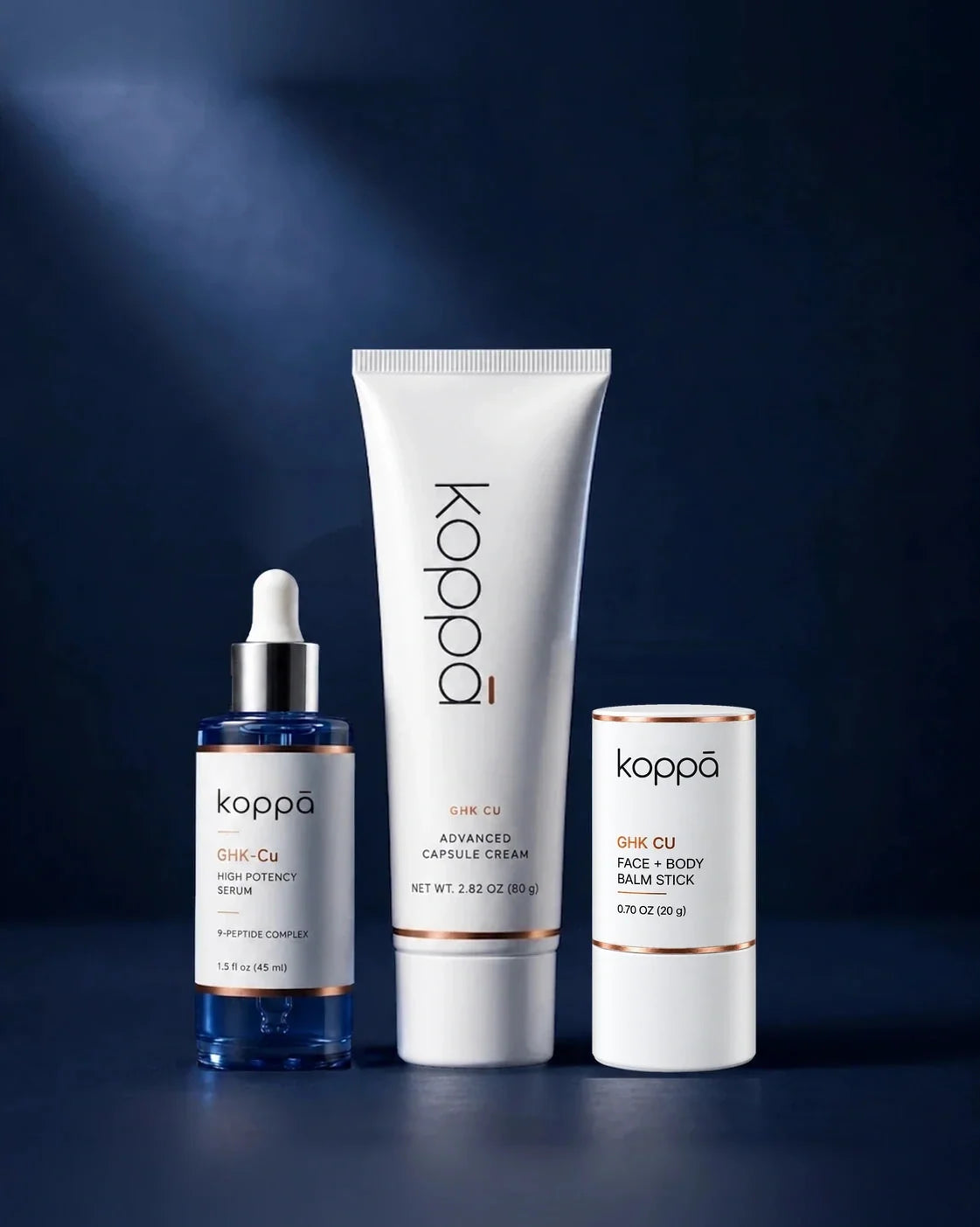
The most GHK-Cu, in a formula built to keep it intact.
2% GHK-Cu in 45 ml, with two ceramides and six named peptides at pH 5.5 to 6.0; then a moisturizing cream that protects its GHK-Cu until use, with niacinamide at the trialled 5%. Fragrance-free, silicone-free, every ingredient list published, US price, free US returns. We make koppā, and the tables above show the labels side by side.
- 2% GHK-Cu, stated · 45 ml
- Fragrance-free, silicone-free, PEG-free
- Full ingredient lists published
- Free US shipping over US$100, free US returns
Free US shipping over US$100. See all four products
Questions about koppā and CopperTheory
Is CopperTheory's 1.4% stronger than koppā's?
For the serums, no: koppā states 2% to CopperTheory's 1.4%, in a 45 ml bottle to 30 ml, so roughly twice the GHK-Cu per bottle. For the creams, CopperTheory prints the higher number, 1.4% to koppā's 0.5%. No published study has compared two retail percentages head to head2, and GHK-Cu breaks down under oxidising stress3, so how the peptide is kept intact matters as much as the figure: koppā's is encapsulated and backed by stability documentation; CopperTheory's page does not say how its GHK-Cu is protected.
Which brand gives you more GHK-Cu for the money?
In serums, koppā: about 0.9 g of GHK-Cu per US$75 bottle against about 0.42 g per US$35 bottle, taking each percentage by weight. That is roughly US$83 per gram of GHK-Cu for both, with koppā's bottle also carrying two ceramides and six named peptides. In creams, CopperTheory's 1.4% in 30 g is about 0.42 g per US$35 tube; koppā's 0.5% in 80 g is about 0.4 g per US$70 tube, protected in capsules and with 5% niacinamide. Per gram of cream, koppā is US$0.88 and CopperTheory US$1.17.
Which is better for sensitive or reactive skin?
Both serums list no fragrance. koppā labels every product fragrance-free and silicone-free and lists no PEGs; CopperTheory's cream lists cyclopentasiloxane, dimethicone and PEG-100 stearate, and its pages make no fragrance-free statement. Copper Tripeptide-1 was assessed safe as used in cosmetics by the Cosmetic Ingredient Review panel8. Patch-test any new product.
Can I use koppā and CopperTheory together?
You can, but there is little reason to: both serums are GHK-Cu steps for the same place in a routine. If you own both, use one copper peptide serum, then one moisturiser. Keep low-pH vitamin C and exfoliating acids at the other end of the day from either.
Does CopperTheory ship to the United States?
Its site shows US-dollar prices for the United States and its shipping policy lists international standard shipping at A$10, free over A$89, with a 5 to 8 business day estimate; US rates are confirmed at checkout. koppā ships to the US from US$3, free over US$100, in about 6 to 11 business days, with free US returns, and is on Amazon.com under its own listings.
Is this comparison fair?
We make koppā. Every CopperTheory figure here is from its own product and policy pages, read on 29 October 2026 and linked above, and we have written what its labels state, including where they state more than ours. If something has changed, email hello@koppabeauty.com with the page and we will correct it.
References
Published research on GHK-Cu and the supporting ingredients named above. Where a study was run in cells or on skin samples rather than on people, the text says so. CopperTheory product facts are from its own pages, linked in each card.
- 1.Maquart FX, Pickart L, Laurent M, Gillery P, Monboisse JC, Borel JP. Stimulation of collagen synthesis in fibroblast cultures by the tripeptide-copper complex glycyl-L-histidyl-L-lysine-Cu2+. FEBS Letters. 1988;238(2):343-346. Read the paper
- 2.Badenhorst T, Svirskis D, Merrilees M, Bolke L, Wu Z. Effects of GHK-Cu on MMP and TIMP Expression, Collagen and Elastin Production, and Facial Wrinkle Parameters. Journal of Aging Science. 2016;4(3):166. Read the paper
- 3.Badenhorst T, Svirskis D, Wu Z. Physicochemical characterization of native glycyl-l-histidyl-l-lysine tripeptide for wound healing and anti-aging: a preformulation study for dermal delivery. Pharmaceutical Development and Technology. 2016;21(2):152-160. doi:10.3109/10837450.2014.979944. Read the paper
- 4.Bissett DL, Oblong JE, Berge CA. Niacinamide: a B vitamin that improves aging facial skin appearance. Dermatologic Surgery. 2005;31(7 Pt 2):860-865. doi:10.1111/j.1524-4725.2005.31732. Read the paper
- 5.Tanno O, Ota Y, Kitamura N, Katsube T, Inoue S. Nicotinamide increases biosynthesis of ceramides as well as other stratum corneum lipids to improve the epidermal permeability barrier. British Journal of Dermatology. 2000;143(3):524-531. Read the paper
- 6.Spada F, Barnes TM, Greive KA. Skin hydration is significantly increased by a cream formulated to mimic the skin's own natural moisturizing systems. Clinical, Cosmetic and Investigational Dermatology. 2018;11:491-497. Read the paper
- 7.Wang Y, Wang M, Xiao S, Pan P, Li P, Huo J. The anti-wrinkle efficacy of argireline, a synthetic hexapeptide, in Chinese subjects: a randomized, placebo-controlled study. American Journal of Clinical Dermatology. 2013;14(2):147-153. doi:10.1007/s40257-013-0009-9. Read the paper
- 8.Johnson W, Bergfeld WF, Belsito DV, et al. Safety Assessment of Tripeptide-1, Hexapeptide-12, Their Metal Salts and Fatty Acyl Derivatives, and Palmitoyl Tetrapeptide-7 as Used in Cosmetics. International Journal of Toxicology. 2018;37(3 suppl):90S-102S. Read the paper
Start with the serum, or take the full Protocol.
Every koppā formula is fragrance-free and silicone-free, with the GHK-Cu concentration on the pack and the full ingredient list published.
 Step 1, treat · For this question
koppā 2% GHK-Cu High-Concentration Copper Peptide SerumConcentrated peptides for firmer, smoother-looking skin.$75Shop
 Step 2, nourish
koppā GHK-Cu Moisturizing CreamCapsule-released peptides for deep, lasting hydration.$70Shop
 Step 3, seal
koppā GHK-Cu Balm StickCollagen support and hydration, from face to body.$45Shop
 All three, for less
koppā GHK-Cu Protocol TrioYour complete peptide routine, for less.$175
Keep reading
Still not sure?
Ask us about an ingredient, a concentration or how to fit GHK-Cu into your routine.