


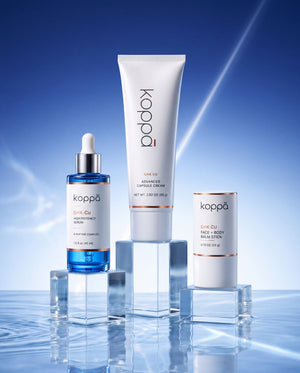
Scientists added a copper peptide to cells. The cells made more collagen.
That finding started in a lab. Years later, researchers measured what happened to a smile line when women used a copper peptide serum at home.

Some mornings I’m perfectly happy with my 54-year-old skin. Then I pick up my magnifying mirror and suddenly I have questions. One of them is what a beauty headline actually means when it says “more collagen.” Who saw more? Where did they look? And could anyone see a difference on a face?
1. Why scientists took a closer look at copper
In 1988, researchers added a copper peptide called GHK-Cu to cells growing in a lab. A peptide is a short chain of amino acids. This one has just three, and it can bind copper. The cells they chose were fibroblasts. One of their jobs is to make collagen, a protein that gives skin some of its structure.
When the researchers added GHK-Cu, the cells made more collagen. That’s the finding behind the headline. It’s quite a journey from that dish to the little lines at the corners of my eyes, though. A serum has to work as a whole formula, on skin, in an ordinary bathroom. Those are different questions, and they need a different kind of test.
What I wanted to know next was whether anyone had picked an actual line on an actual face and followed it for long enough to see what changed. Someone had.
2. Why use a serum on just one side?
Forty women aged 40 to 65 joined an eight-week study. Every morning and evening, they put Snowberry New Radiance Face Serum, which contained GHK-Cu, on the right side of their face. On the left they used a different formula. Half the women compared it with a plain serum. The other half compared it with a second peptide formula. The bottles were coded so the women and the people assessing them wouldn’t know which formula was which.
There’s something pleasingly simple about comparing the two sides of a face. They’ve had the same birthdays. Both sides went through the same eight weeks together. That takes some of the guesswork out of comparing one woman’s skin with someone else’s.
Near the outside corner of the eye, the team chose a wrinkle they could find again. They used a device that mapped the skin’s surface in three dimensions. It let them measure the depth of the line. My bathroom mirror definitely doesn’t do that.
3. What changed after eight weeks?
Thirty-nine women finished the study. The clearest comparison to follow is the group of 20 who used Snowberry’s copper peptide serum on one side and the plain serum on the other. After eight weeks, the average depth of the measured wrinkle had fallen on both sides. Here’s how much the lines changed from where they started.
That works out to a gap of five percentage points. It helps to see the smaller number too. If I only heard the first one, I’d miss how much the line changed on the side that got the plain serum.
It was one small study, and the result belongs to the Snowberry formula the women used. The researchers could measure the line, but the numbers can’t tell us whether a woman noticed it when she smiled at herself the next morning. That distinction matters to me as a reader and as someone who makes skincare.
4. Why we chose 2% copper peptides for our serum
I first heard about GHK-Cu through someone close to me who was interested in injectable peptides. That got me reading. The route that made sense to me was topical. I wanted something I could put on the skin I was looking after every day, including the places my face cream rarely reached.
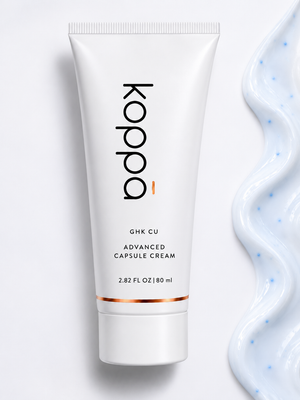
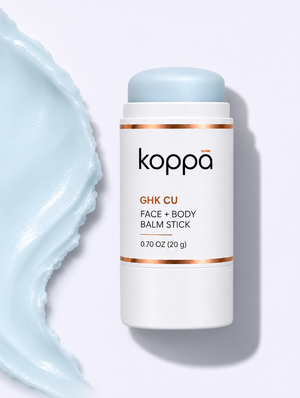
My hands are a good example. I’m fairly sure they keep their own record of my birthdays. On a ski hill, I wanted something I could pull out of a pocket and swipe over dry spots. A balm stick felt like an obvious place to start. That’s the idea my daughter Madelaine and I built on when we founded koppā.
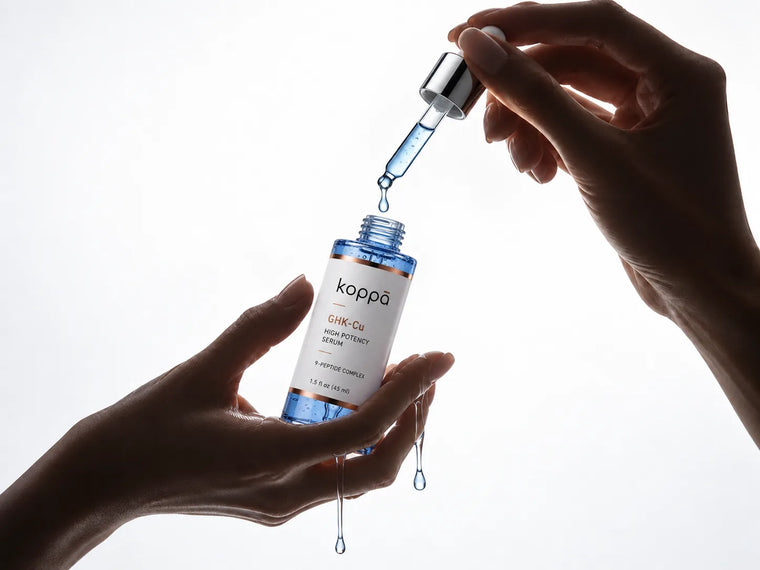
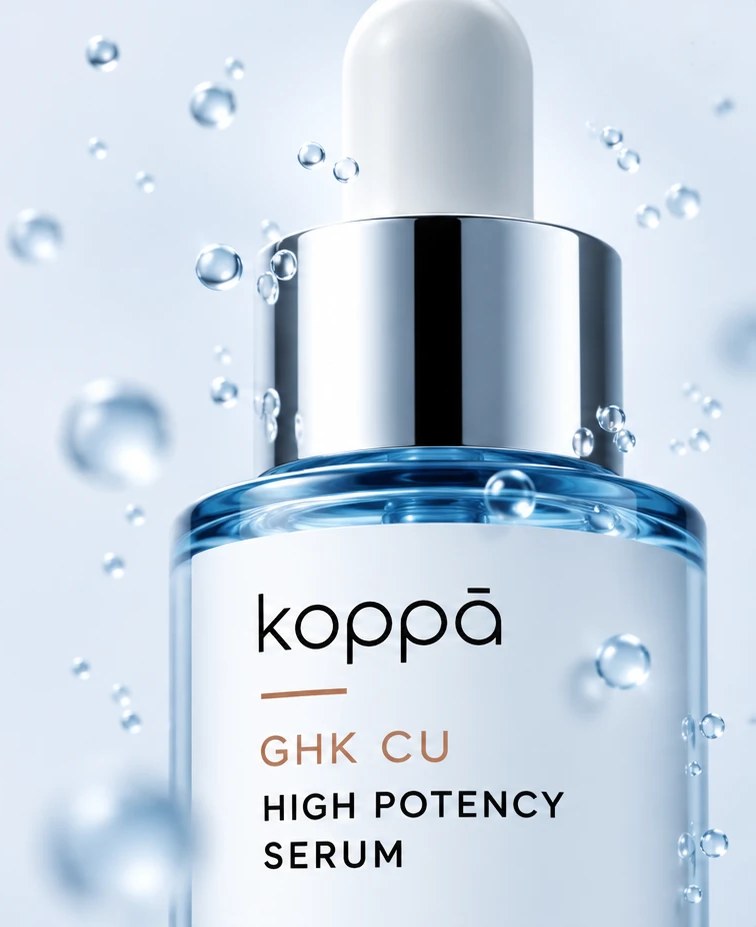
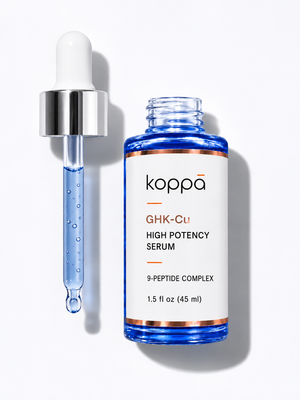
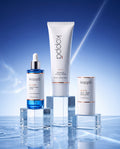
The serum had a different job. It needed to spread easily over my face and neck and feel light enough that I’d still want to use my usual moisturiser. We worked with our formulation team on a water-light serum with 2% GHK-Cu. We paired it with six other peptides for smoother-looking skin. Hyaluronic acid helps skin feel hydrated, and two ceramides help hold that moisture in. If I can get that in a few drops under the cream I already love, that’s a step I’ll keep.
5. Three or four drops before your moisturiser
Draw a little serum into the pipette and you’ll see a deep blue. That colour comes from the copper peptide itself. Once a few drops spread across your face, the layer is much thinner than the one you see through the glass. It slips across skin like water. We left out added fragrance, too.
Can I keep the cream I already use?
After cleansing, smooth three to four drops over your face and neck. Follow with the moisturiser you already like, and finish with sunscreen in the morning. That’s the whole change to your routine. I like a bottle I can use down to my collarbone, so we made ours 45 mL. That’s 50% more than a 30 mL bottle.
What does it feel like under cream?
When the Italian publication Shifts! reviewed our three-step routine, its reviewers described the serum as quick to sink in. They also said it layered with cream or sunscreen without rolling up into little bits. That’s a detail I’d want to know before buying a bottle, especially if I were putting makeup on next.
I still have the mirror. Some days I even use it. But most mornings I’m happy to spend those few minutes taking care of my skin, put the lid back on, and get on with my day.
Start with the serum. Keep the rest of your routine.
For smoother-looking skin and light hydration, apply three or four drops after cleansing. Follow with your favourite moisturiser.
2% GHK-Cu · 45 mL · US$75
Shop the 2% serum