



Before and after, honestly
Copper peptides before and after: what actually changes, and when
Published studies of topical GHK-Cu measured changes over 4 to 12 weeks, so that is the timeline to judge by.
4 to 12 weeks
Study timeline
Consistent, daily topical use
Week 4, 8, 12
Photo days
Same window, same time of day
1
Change at a time
So the photo is about one product
3
Full sizes
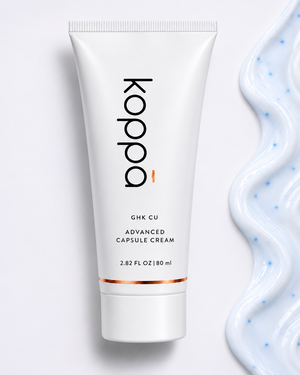
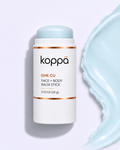
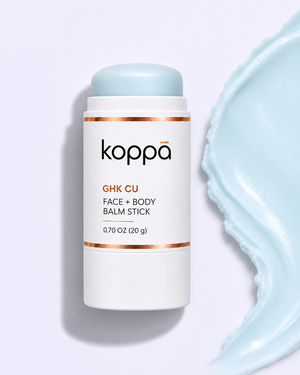
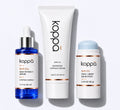
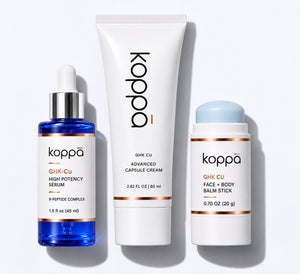
Serum, moisturizing cream and balm stick
The koppā community
koppā, in everyday life.

Sarah MFace + Body Balm Stick
“I tried to to use an acid treatment to get rid of an old eyebrow tattoo and ended up with a chemical burn (oops). Once it had started to heal I began using the stick on it a few times a day. 2 days later it was so much better.”
 Before
 After
Alex SThe koppā Protocol
“I’ve been using the protocol for a few months and my skin looks really good. It looks hydrated and healthy. The stick is my favourite.”

Gurveen HThe koppā Protocol
“I didn’t think much was changing day to day, but the before and after surprised me. My skin looks calmer, smoother and more even. I’ve just been consistent with the routine rather than adding more products.”

Sarah M2% GHK-Cu Serum
“The products have been great for my skin. It’s really sensitive and I can’t handle retinols, but this has been really good for me.”

Brandon GThe koppā Protocol
“I have all 3 but the cream is my favourite. I’m a pilot and long flights, recirculated air and jetlag take a real toll. I use it constantly. Stick for after shaving. Bonus- I can get all three in my flight bag with no issues at security.”

Chris HFace + Body Balm Stick
“Great post shave, i like that I can throw it in my gym bag. It has no smell which of course is important.”
Tap or swipe for more
Customer feedback | koppā GHK-Cu Protocol Trio
“Been using it about 6 weeks now. Didn’t notice much the first couple weeks, but my skin looks noticeably smoother around my cheeks and my makeup sits better. Will repurchase.”
Sarah M., koppā customer
Our results
Real skin. Real experiences.
Two generations, two different skin journeys. Our personal experiences with the skincare we created.
A co-founder's experience
My skin at 54. What actually changed.

I don't feel like I have to hide my skin under makeup anymore. There's a real freedom in putting on a little mascara and just getting on with your day.
Chantelle, 54 | Co-founder of koppā
Menopause-related skin changes. Persistent dehydration. Dull, tired-looking skin.
I've always had reasonably good skin. But after breast cancer treatment and medically induced menopause, I started noticing real changes. My skin was becoming increasingly dehydrated, looked dull, and seemed to show every late night, long flight or glass of wine.
Continue reading
Chantelle’s personal observations — not clinical results or guaranteed outcomes.
What actually changed
The first difference was almost immediate. The koppā GHK-Cu Moisturizing Cream was a whole new level of hydration for me, and that feeling lasted. Around six weeks, my skin texture looked smoother. By eight weeks, my skin looked fresher, a little firmer and more radiant.
One of the biggest differences is how my skin feels when I wake up. After using the full three-step GHK-Cu Protocol the night before, my skin still feels soft and hydrated. It's a significant change. My skin simply feels better.
But perhaps the most meaningful result is that I no longer feel like I have to hide my skin under makeup. There's something genuinely freeing about putting on a little concealer and mascara and getting on with your day. My skin isn't perfect, and I don't expect skincare to erase every line or sign of ageing. But I feel much more confident in it.
The routine I actually use
I'm not someone who wants a complicated ten-step routine. I only wash my face at night with a very basic cleanser, so in the morning I jump straight into the Protocol and always finish with sunscreen.
I start with the GHK-Cu Copper Peptide Serum. A couple of drops on my forehead and each cheek, then I use my fingertips to work it into my skin, down across my jaw and onto my neck until there's nothing left to spread.
About a minute later, I follow with the GHK-Cu Moisturizing Cream. I apply it much the same way, although I'm more generous with the amount. It goes over my face, down my neck and across my chest.
The GHK-Cu Face + Body Balm Stick is my final step. I apply it under my eyes, around my mouth, across my entire neck and finish with a couple of quick swipes across my chest.
It's simple, takes very little time, and I've been able to stick with it consistently, even when travelling or life gets busy.
My faithful companion
The balm stick has become my faithful companion. It's always in my handbag or travel bag, particularly on long-haul flights where the dry cabin air can be brutal on skin. It doesn't leak, isn't greasy, and I can apply it directly without using my fingers.
Whether I've just handled airport security trays or pushed a shopping cart, the last thing I want to do is rub my hands all over my face. A few quick swipes and I'm done.
Keeping it real
Of course, koppā isn't the only thing I do for my skin. I'm religious about sunscreen, microneedle at home whenever I remember it's been a while, and firmly believe that one very hot, prickly CO2 fractional laser session can do more for your skin than a cupboard full of great skincare products combined.
And despite having my own skincare brand, I still dabble in new products and trends, usually riding on the coattails of whatever Madelaine has discovered lately. Some things never change.
I'm not going to pretend a skincare routine is responsible for everything. But using these three products consistently has made a real difference to how my skin looks and feels.
Sometimes I'm envious of my daughter's beautiful young skin. But I've had my twenties. I've had my thirties. I don't want them back.
I just want to look after the skin I have now and keep it as healthy as I can.
And if that means feeling confident enough to walk out the door with almost no makeup, I'm very happy with that.
Chantelle's personal experience using koppā alongside other skincare products and professional treatments. Individual results vary.
A co-founder’s experience
My skin, eight weeks in.

After about eight weeks, my skin looked noticeably glowier and more hydrated. I no longer wear any face makeup day to day.
Maddie, 28 | Co-founder of koppā
Hormonal breakouts. Easily irritated skin. A routine that fits real life.
I’m 28, so my skin concerns are a little different. I’m not really dealing with visible signs of aging yet, but I do want to look after my skin now and be proactive about how it ages. Day to day, it’s hormonal breakouts and sensitivity that I notice most.
Continue reading
I tend to get breakouts around my chin and jaw every month, and I’ve definitely noticed a difference since using koppā. When a spot does appear, I reach for the balm stick. For me, those breakouts seem to settle and heal more quickly.
My skin is also easily irritated. I have eczema and it can be very fussy about what I use. I’ve tried tretinoin, but for now I prefer using GHK-Cu in my routine. It feels like a better fit for my skin at this stage.
After about eight weeks, my skin looked noticeably glowier and more hydrated. I feel comfortable enough in it that I no longer wear any face makeup day to day.
I’m busy, and I’ll admit I can be a little lazy with skincare, so I love how quick and easy the stick is. It makes looking after my skin feel like something I can actually keep up with.
I’ve definitely noticed a difference, and a few people at my gym have even complimented my skin. It looks really good to me, and I feel good in it. That’s what matters most.
Maddie’s personal experience with her koppā routine. Individual experiences vary.

What the science says
Do copper peptides actually work?
Before you look at anyone’s photos, it helps to know what the research counts as a result, and what it doesn’t.
GHK-Cu’s activity in skin was described in the laboratory first: in 1988 the copper complex was shown to stimulate collagen synthesis in cultured fibroblasts, and later cell work found increases in both collagen and elastin production at very low concentrations. The two reviews by Pickart and colleagues gather the human work since, including facial studies of topical creams that measured the appearance of firmness, fine lines, smoothness and hydration over weeks of use. Skin-penetration studies on human skin samples show the peptide reaches and is retained in the layers where those cells live.
Notice what’s on that list and what isn’t. The studies measured appearance and feel, over weeks, with consistent use. The research explored changes over weeks of consistent use.*
What the evidence supports
Collagen and elastin production in cell studies, and changes in the appearance of firmness, smoothness and hydration in facial studies over weeks.
What it doesn’t
Overnight change, wrinkle removal, or a result for any particular brand’s bottle. Ours included.
What that means for a photo
A fair comparison is week 8 to 12, in the same light, with one product changed. Anything faster or more dramatic is a lighting change or a different routine.

The timeline
Week by week: a realistic timeline
Everyone’s skin is different. This is the shape of it, not a promise.
Week 1 to 2
Mostly nothing you’d photograph. Some people notice skin feels softer or better hydrated; some notice mild dryness from starting too fast, which is the cue to slow down. A faint blue tint on the surface means too much product.
Week 3 to 4
The point most people stop. Don’t. Skin renews on a cycle of roughly a month, and the published studies hadn’t finished measuring yet. Texture is often the first thing that reads differently in the mirror.
Week 6 to 8
Where the shorter studies end and where the look of firmness and smoothness starts to be something you could compare in a photo taken in the same light. This is the earliest fair before-and-after.
Week 12
The end of the longer studies and the honest point to judge a product. If you’ve been consistent and see nothing, this isn’t your ingredient, and no amount of pushing on will change that.
Results vary with age, skin type, sun exposure and how consistent you are. Two people using the same product rarely get identical results, and no honest brand promises otherwise.
The photos
What a before-and-after photo can’t tell you
Which is most of what matters.
Light and angle
The same face, photographed by a window in the morning and under a bathroom bulb at night, looks like two different people. Most dramatic before-and-afters are a lighting change.
Hydration
A moisturised face photographed ten minutes after applying looks plumper than a dry one. That’s real, and it’s also the least interesting effect.
Everything else you did
Sunscreen, sleep, a new retinol, a holiday. A photo can’t isolate one product, which is why the studies use controls and the internet doesn’t.
Selection
You see the photos people chose to post. The ones where nothing happened stay in the camera roll.
The method
How to run your own before and after
If you want a comparison you can trust, take it like a study would.
01 · The before photo
Take the before photo on clean, dry skin, in daylight, from the same window, before you start. No filter. Note the date.
02 · Once a night, every night
Use the product once a night, every night. Write down any nights you skip.
03 · Change nothing else
Change nothing else for the first month. No new actives, no new sunscreen.
04 · Week 4, 8 and 12
Repeat the photo at week 4, 8 and 12. Same window, same time of day, same expression, dry skin.
05 · Judge at 12 weeks
Judge at 12 weeks, not 12 days. If nothing changed, stop; if something did, you know it was this.

The Protocol
A routine you can keep up for twelve weeks.
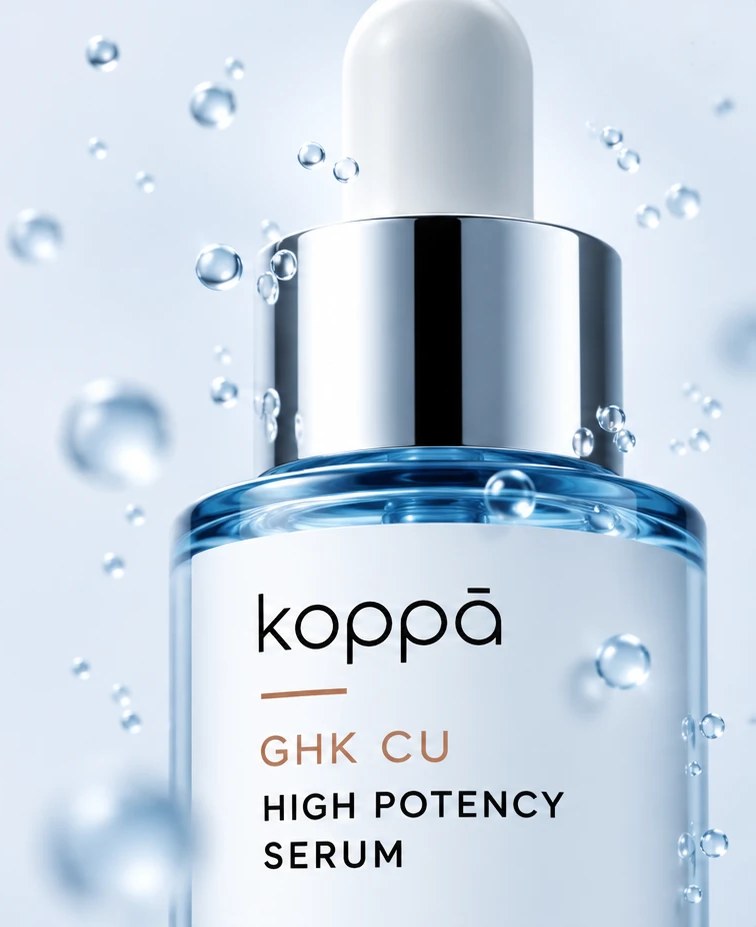
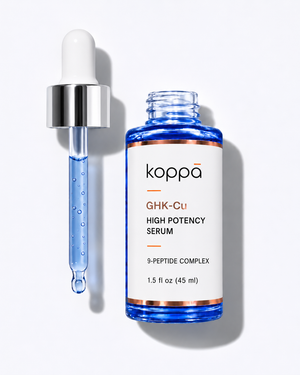
The honest timeframe for GHK-Cu is weeks, so the honest product is a routine you can keep up. The Protocol is the 2% serum, the moisturizing cream and the balm stick together, three full sizes at less than buying them separately, with the concentration and the full ingredient list on every one.
Step 1, treat
2% GHK-Cu serum, three or four drops a night.
Step 2, nourish
0.5% encapsulated GHK-Cu in the moisturizing cream.
Step 3, seal
0.5% GHK-Cu balm stick for jaw, neck and hands.
Why we keep it topical
Real people, real skin, nothing you can’t check. We’re real people too. We feel the pressure to look good and to see it in a photo, and we know how slow twelve honest weeks can feel. But our health is everything, and we’d rather promise the timeline the research supports than the one that sells.
That’s why koppā only makes topical GHK-Cu: on the skin, where the human research was done, in formulas with the concentration and the full ingredient list on the label. Nothing you can’t check, and nothing you can’t stop.
Study references
Studies behind the figures in our product galleries
The published studies behind koppā’s product pages and product galleries, with the formulation, concentration and method of each.
GHK-Cu serum study (Badenhorst, 2016)
At eight weeks, average wrinkle-volume changes were −24.1% with GHK-Cu and its nano-carrier, versus −15.0% with the control. The relevant split-face comparison included 20 women aged 40 to 65. Figures on the image are rounded. Read the study
Copper-peptide cream study (Abdulghani, 1998)
Seven of the ten participants receiving the copper-peptide cream showed increased procollagen synthesis after one month, measured using thigh-skin biopsies. This is the proportion of participants showing an increase, not a 70% increase in collagen. Study record
4% niacinamide study (Kawada, 2008)
In an eight-week split-face study with 30 women enrolled, 64% showed marked or moderate improvement in eye-area wrinkles. This is the share of participants with that assessment, not a 64% reduction in wrinkles. The tested cosmetic contained 4% niacinamide; koppā Capsule Cream contains 5%. Read the abstract
5% niacinamide study (Bissett, 2004)
A separate twelve-week study involving 50 women compared a 5% niacinamide formulation with its control. The authors reported improvements in fine lines, pigmentation and redness. Read the abstract
Further studies cited on our product pages (14)
GHK-Cu (Copper Tripeptide-1)
Maquart FX et al., 1988. Stimulation of collagen synthesis in fibroblast cultures by the tripeptide-copper complex GHK-Cu. FEBS Letters. Cell study. PubMed
Leyden JJ et al., 2002. GHK-Cu facial cream and skin density, thickness and firmness in 71 women over 12 weeks. Human study, presented at the American Academy of Dermatology.
Pickart L, Margolina A, 2018. Regenerative and protective actions of the GHK-Cu peptide in the light of the new gene data. International Journal of Molecular Sciences. Review. Read the paper
Expression-line peptides
Blanes-Mira C et al., 2002. A synthetic hexapeptide (Argireline) with antiwrinkle activity. International Journal of Cosmetic Science. Record
Wang Y et al., 2013. The anti-wrinkle efficacy of Argireline, a synthetic hexapeptide, in Chinese subjects: a randomized, placebo-controlled study of 60 people. American Journal of Clinical Dermatology. Record
Nguyen TQ et al., 2021. A randomized, double-blind, placebo-controlled study of a peptide serum targeting expression lines, 12 weeks, 55 women. Journal of Clinical and Aesthetic Dermatology. Funded by Revision Skincare; peptides not individually named. PubMed
Zhu M et al., 2026. A serum with Acetyl Hexapeptide-8, Dipeptide Diaminobutyroyl Benzylamide Diacetate and other actives: ex vivo and two clinical studies, 92 participants. L’Oréal researchers. International Journal of Cosmetic Science. Journal
Niacinamide
Bissett DL et al., 2005. Niacinamide: a B vitamin that improves aging facial skin appearance. Dermatologic Surgery. The authors’ summary of the 12-week, 50-woman study above. PubMed
Hydration and barrier
Fluhr JW et al., 2008. Glycerol and the skin: holistic approach to its origin and functions. British Journal of Dermatology. Review. PubMed
Nicander I et al., 2003. Betaine and skin hydration and irritation. Human study.
Pavicic T et al., 2011. Efficacy of cream-based novel formulations of hyaluronic acid of different molecular weights in anti-wrinkle treatment, 76 women, 60 days. Journal of Drugs in Dermatology. PubMed
Imokawa G et al., 1991. Ceramide levels and barrier function in skin. Journal of Investigative Dermatology.
Spada F et al., 2018. Skin hydration is significantly increased by a cream formulated to mimic the skin’s own natural moisturizing systems. Clinical, Cosmetic and Investigational Dermatology. Full text
Ebner F et al., 2002. Topical use of dexpanthenol in skin disorders. American Journal of Clinical Dermatology. Review. PubMed
Independent review
Reviewed by Shifts! Magazine
Shifts! Magazine, an Italian lifestyle publication, used the full three-product koppā routine for four consecutive weeks and scored the routine 9.2/10 (published 6 November 2026; an editorial in-use review, not a clinical study).
FAQ
Questions about copper peptide results
How long do copper peptides take to work?
Published topical studies measure changes over 4 to 12 weeks of consistent use. Some people notice softer or better hydrated skin in the first weeks; the look of firmness and smoothness is a 6 to 12 week question.
Do copper peptides really work?
The research on GHK-Cu is broad, spanning decades of cell, animal and human work, and it consistently associates the peptide with collagen, elastin and how skin looks and feels. Whether a given product works on your face is something only 12 consistent weeks will tell you.
Will copper peptides get rid of my wrinkles?
No cosmetic removes wrinkles, and we won’t say GHK-Cu does. The studies describe improvements in the appearance of fine lines and firmness over weeks. That’s the claim, and it’s the whole claim.
Why don’t you show before-and-after photos?
Because we don’t have ones we could stand behind: same light, same camera, no other changes, and a customer’s permission. When we do, they’ll be unedited and dated. Until then, the research and your own 12-week test are the honest evidence.
What’s the fastest way to see a difference?
Consistency, not more product. Once a night, every night, with sunscreen every morning, for 12 weeks. Doubling up in week one mostly produces dryness.

Still deciding
Still not sure?
Ask us about an ingredient, a concentration or how to fit GHK-Cu into your routine. We’re real people on the other end, and we’d rather you asked than guessed.
Keep reading
Sources and references (5)
- Pickart L, Vasquez-Soltero JM, Margolina A. GHK Peptide as a Natural Modulator of Multiple Cellular Pathways in Skin Regeneration. BioMed Research International. 2015;2015:648108. Read the paper
- Pickart L, Margolina A. Regenerative and Protective Actions of the GHK-Cu Peptide in the Light of the New Gene Data. International Journal of Molecular Sciences. 2018;19(7):1987. Read the paper
- Maquart FX, Pickart L, Laurent M, Gillery P, Monboisse JC, Borel JP. Stimulation of collagen synthesis in fibroblast cultures by the tripeptide-copper complex glycyl-L-histidyl-L-lysine-Cu2+. FEBS Letters. 1988;238(2):343-346. Read the paper
- Badenhorst T, Svirskis D, Merrilees M, Bolke L, Wu Z. Effects of GHK-Cu on MMP and TIMP Expression, Collagen and Elastin Production, and Facial Wrinkle Parameters. Journal of Aging Science. 2016;4:166. Read the paper
- Hostynek JJ, Dreher F, Maibach HI. Human skin penetration of a copper tripeptide in vitro as a function of skin layer. Inflammation Research. 2011;60(1):79-86. Read the paper