


copper peptides
Copper Peptides, Collagen and Skin Elasticity: What GHK-Cu Can Do After 30

In lab studies, GHK-Cu (copper tripeptide-1), the main copper peptide in skincare, increased collagen and elastin production in human skin cells[1]; in people, it has been studied for wrinkles and laxity, not measured collagen in the face. In small human studies of 40 to 71 women over 8 to 12 weeks, reviewed in 2018[2], GHK-Cu creams and serums reduced the look of wrinkles and laxity.
That is a summary of research findings, not a product promise. The cell results come from a dish, not a face. The human studies were small, mostly in women with sun-aged skin, and they used GHK-Cu creams and serums made for the research, not any one brand's product. The most detailed numbers come from a single 40-woman trial, and it measured wrinkles, not collagen or elasticity directly.
What is skin elasticity?
Skin elasticity is skin's ability to stretch and snap back, and it depends on three things in the dermis, the thick layer under the surface: collagen, elastin and water-holding molecules, as a 2019 review in the International Journal of Molecular Sciences[3] by Shin and colleagues describes. Pinch the back of your hand and let go: the speed it flattens out is elasticity at work.
- Collagen gives strength. It makes up about 75% of skin's dry weight. Type I collagen does the heavy structural work and accounts for 80 to 90% of skin collagen, and type III, a finer form, accounts for 8 to 12%, according to the 2019 review. It's the rope that stops skin stretching too far.
- Elastin gives recoil. Elastic fibers return skin to its normal shape after it is stretched (Shin and colleagues, 2019). It's the spring.
- Glycosaminoglycans, water-holding molecules such as hyaluronic acid, fill the space between the fibers. They make up only 0.2% of the dermis by dry weight but absorb up to 1,000 times their volume in water, which keeps the dermis cushioned (Shin and colleagues, 2019).
When researchers measure elasticity, they usually use a small suction probe called a Cutometer. It pulls the skin up gently, lets go, and records how far it stretched and how completely and quickly it returned. That's worth knowing, because "firmer-looking" on a product label and "more elastic" on a probe are not the same measurement. For what else GHK-Cu does beyond elasticity, see copper peptides for skin.
How does skin elasticity change after 30?
Skin elasticity drifts down steadily with age rather than dropping at 30, and the face changes more than the body. In a 2008 study in Skin Research and Technology[4], dermatology researchers Ryu, Joo, Kim, Park and Youn measured 96 healthy women aged 20 to 75 with a Cutometer on the face, upper arm and back. Three measures of how well skin springs back fell as age rose, the face changed more than the arm or back, and the clearest age-related fall was on the face. The study reports the trend, not the size of each change.
Why the face? It gets the most sun. The 2019 review by Shin and colleagues describes sun-driven aging as the kind that brings laxity, deep wrinkles and uneven pigment, with disorganized elastic fibers building up through the dermis, while aging from time alone brings finer lines and a thinner top layer of skin.
The body's own supply of the peptide changes too. In blood plasma, GHK falls from about 200 ng/mL at age 20 to 80 ng/mL by age 60, according to a 2015 review in BioMed Research International[5] by Pickart, Vasquez-Soltero and Margolina. That is a blood measurement, not a skin one.
By your 30s, many people notice the change in small ways: a pillow crease that lasts past breakfast, skin under the eyes that takes longer to smooth out. For the collagen side of the story in depth, read skin aging and collagen. If you are already past 35, skin after 35 covers what shifts next.
What the evidence says about GHK-Cu, collagen and elasticity
In lab studies, GHK-Cu raised collagen and elastin in human skin cells, and in animal and cell studies it raised water-holding molecules; in small human studies, GHK-Cu creams and serums reduced the look of wrinkles and laxity, and two reports described denser, thicker skin. Here is each piece, labelled by where it was done. Laxity is the nearest measure to elasticity the human studies report.
In the lab and in animals
A 2016 study in the Journal of Aging Science by Travis Badenhorst, Darren Svirskis, Mervyn Merrilees, Liane Bolke and Zimei Wu treated adult human dermal fibroblasts, the cells that make collagen, with GHK-Cu (copper tripeptide-1) at 0.01, 1 and 100 nanomolar. All three concentrations increased both collagen and elastin production. GHK-Cu also shifted the genes for the enzymes that break collagen down and for the inhibitors that hold those enzymes back, and collagen and elastin output was highest where the inhibitors outweighed the enzymes. These are tiny concentrations in a dish; how much of a product's GHK-Cu reaches those cells in living skin is a separate question.
The cushioning side comes from animal work. In rat wound and cell studies (Siméon and colleagues, Journal of Investigative Dermatology, 2000[6], cited in the 2015 review), GHK-Cu stimulated collagen, dermatan sulfate, chondroitin sulfate and decorin, a small molecule that helps collagen fibers line up. There's a copper angle too. Lysyl oxidase, the enzyme that starts the cross-linking of collagen and elastin into stable fibers, is a copper enzyme, according to a 2019 review in Essays in Biochemistry[7] by Vallet and Ricard-Blum. No study has shown that copper from a skincare product changes that cross-linking in facial skin.
On people: the human studies, with their numbers
Five human studies of GHK-Cu skincare are regularly cited, and only one has published its numbers in a journal abstract.
| Study | Who and how long | Design | What it reported | Where the numbers come from |
|---|---|---|---|---|
| Badenhorst and colleagues, Journal of Aging Science, 2016 | 40 women aged 40 to 65; face, twice a day for 8 weeks | Randomized, double-blind; GHK-Cu in a nano-lipid carrier against the same serum without GHK-Cu and against a commercial Matrixyl 3000 product | Wrinkle volume 55.8% lower than the plain serum (p below 0.001) and wrinkle depth 32.8% lower (p = 0.012); wrinkle volume 31.6% lower than the Matrixyl 3000 product (p = 0.004) | The published abstract |
| Leyden and colleagues, American Academy of Dermatology annual meeting, 2002 | 71 women with mild to advanced sun aging; face, 12 weeks | GHK-Cu facial cream; no comparison group is described in the reviews that report it | Reduced laxity, improved clarity, fewer fine lines, shallower wrinkles, increased skin density and thickness | A conference abstract, reported second-hand in the 2015 and 2018 Pickart reviews; no percentages given |
| Leyden and colleagues, same meeting, 2002 | 41 women with mild to advanced sun damage; around the eyes, 12 weeks | GHK-Cu eye cream against a placebo and a vitamin K cream | Did better than both on lines and wrinkles; increased skin density and thickness | A conference abstract, reported second-hand; no percentages given |
| Finkley, Appa and Bhandarkar, book chapter, 2005 | 67 women aged 50 to 59 with mild to advanced sun damage; face, 12 weeks | GHK-Cu facial cream; design not described in the review | Improved laxity, clarity, firmness and appearance | Reported second-hand in the 2015 review; no percentages given |
| Abdulghani and colleagues, Disease Management and Clinical Outcomes, 1998 | Women, thigh skin; a small pilot | GHK-Cu cream against a vitamin C cream and retinoic acid | Increased collagen production in 70% of the GHK-Cu group, against 50% with vitamin C and 40% with retinoic acid | Reported second-hand; group sizes not given in the reviews |
The 71-woman study is the source of the line you will see everywhere, that GHK-Cu creams left skin measuring denser and thicker. It was presented by Leyden and colleagues at the American Academy of Dermatology's 60th annual meeting in 2002. The two reviews that report it, Pickart and colleagues in 2015 and Pickart and Margolina in the International Journal of Molecular Sciences in 2018, list what improved but give no percentages, do not say how density was measured, and describe no placebo group for it. No full paper is cited in either review. Treat it as an early, encouraging report, not a controlled trial.
What the evidence does not show
- No human study in these reviews measured collagen in facial skin after GHK-Cu. The one collagen measurement in people was a small pilot on thigh skin.
- The best-designed trial measured wrinkles, not elasticity or collagen, and it used a nano-lipid carrier built to help GHK-Cu into skin. A different formula may behave differently.
- The studies were small and enrolled women, and most ran 8 to 12 weeks. There is no long-term human data on GHK-Cu and elasticity.
How do other firming ingredients compare?
"Firming" on a label can mean very different things: hyaluronic acid works on surface water within hours, while retinoids and GHK-Cu are studied over months. Here's where each common option sits.
| Ingredient | What it does for bounce | How long it takes |
|---|---|---|
| Hyaluronic acid | Holds water in the surface layers, so skin looks plumper | Hours. Good for comfort, not a structural change |
| Retinoids | The American Academy of Dermatology[8] reports that tretinoin, a prescription retinoid used since the 1970s, speeds skin cell turnover, increases collagen, evens tone and reduces fine lines and wrinkles | A dermatologist quoted by the AAD advises starting every other night, building up, and using it at night only; can irritate |
| GHK-Cu | In lab and animal studies, raises collagen, elastin and water-holding molecules (Badenhorst, 2016; Siméon, 2000); in people, reduced the look of wrinkles and laxity | Most human studies ran 8 to 12 weeks |
| Daily sunscreen | Protects collagen and elastin from UV; in a 2013 trial in the Annals of Internal Medicine[9], the group assigned to daily sunscreen showed 24% less skin aging than the group using it at their discretion | Measured over 4.5 years |
They work well together: hyaluronic acid for comfort today, retinoids and GHK-Cu for the long game, and sunscreen to protect what you have.
How do you use copper peptides every day?
Apply a copper peptide serum to clean face and neck, follow with a moisturizer, add a richer balm only where skin feels dry, and finish every morning with broad-spectrum SPF 30 or higher. That order, thinnest to thickest, is the whole routine.
- Cleanse. A gentle cleanser, then pat skin dry or leave it slightly damp.
- A copper peptide serum on face and neck. Usually three to four drops, morning, evening or both, as the label directs. Serums are water-light and absorb quickly, so they sit under everything else.
- A moisturizer on top. A serum is a light, water-based layer, not a moisturizing one. Any good moisturizer does the job; a copper peptide moisturizer adds GHK-Cu in a second layer. For hydration, look for humectants such as glycerin and hyaluronic acid, which pull water into skin, and emollients such as squalane, which soften it and help hold moisture in. More on pairing them in copper peptides and hyaluronic acid.
- A balm where skin is driest. Optional. A richer balm or stick on dry patches, along the jaw or on the neck, after the moisturizer.
- Sunscreen every morning. Broad-spectrum, SPF 30 or higher, taken down to the neck.
Keep low-pH vitamin C and exfoliating acids to the other end of the day from your copper peptide, and bring in a retinoid on alternate nights at first. The neck gets the same products as the face, not a separate routine. New to copper peptides? Patch test first, as the American Academy of Dermatology advises[10]: a quarter-sized spot on the underside of your arm or the bend of your elbow, twice a day for seven to 10 days. The full step-by-step is in our guide to using GHK-Cu morning and night.
What should you check in a copper peptide serum or moisturizer?
Check that the ingredient list names copper tripeptide-1, that the label states a GHK-Cu percentage, that the formula has no fragrance if your skin reacts easily, and that the price per ml or gram lets you use it daily for the 8 to 12 weeks most human studies ran.
For a daily serum
- Copper tripeptide-1 on the ingredient list. "Copper peptides" on the front of a bottle can mean other copper ingredients. The INCI name is the check.
- A stated percentage. Not every brand gives one. A number lets you compare like with like. No published human study has compared GHK-Cu percentages, so read the rest of the formula too.
- Blue color. GHK-Cu is blue because of the copper bound to it, so a GHK-Cu serum is usually tinted blue.
- Acids kept out. Low-pH vitamin C and exfoliating acids belong in a separate step, so a serum that combines them with GHK-Cu is worth a second look.
- Texture and price. A light texture that sits under sunscreen, and a price per ml you can keep paying for two to three months.
For a daily moisturizer
- A stated GHK-Cu percentage. Creams vary, so compare the number, not the word "copper" on the front.
- A base you would use anyway. Humectants such as glycerin and hyaluronic acid, and emollients such as squalane or plant oils. If you would not use it as a plain moisturizer, the peptide will not save it.
- No fragrance, and a finish that sits under sunscreen and makeup.
- Size and price per gram. A moisturizer goes on in a larger amount than a serum, over the whole face and neck, so size matters more.
Simple copper peptide options by format
| Format | Where it fits | What to check |
|---|---|---|
| Serum | First step after cleansing, face and neck | Copper tripeptide-1 listed, stated percentage, light texture |
| Cream or moisturizer | After serum, or alone as a one-step routine | Stated percentage, moisturizing base, no fragrance |
| Eye cream | Around the eyes; the 41-woman study tested this area | No fragrance, a texture you can pat on thin skin |
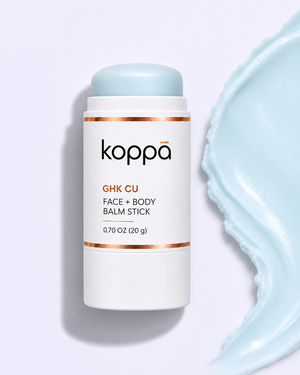
| Balm or stick | Last step, on dry spots, neck, hands | Stated percentage, a base rich enough for dry skin |
How long before you can judge a copper peptide product?
Most human studies measured results at 8 and 12 weeks, so give a copper peptide product two to three months of daily use before you decide, and keep wearing sunscreen throughout.
Make it measurable. Before you start, take a photo in the same light and try the pinch test on the back of your hand, noting how quickly it flattens. Repeat both when you finish the bottle. It's crude, but it's yours, and it beats guessing.
Frequently asked questions
Do copper peptides improve skin elasticity?
In the lab, GHK-Cu increased elastin and collagen production in human skin cells (Badenhorst and colleagues, 2016). In people, small 12-week studies of GHK-Cu creams reported less laxity and denser skin, though those reports give no percentages. Those studies used GHK-Cu creams and serums made for the research, not any one brand's product, and none ran longer than 12 weeks.
What do copper peptides do to collagen?
In cell studies, GHK-Cu raised collagen production at every concentration tested and shifted the balance between the enzymes that break collagen down and the inhibitors that hold them back (Badenhorst and colleagues, 2016). In people, the only direct collagen measurement was a small thigh-skin pilot, where 70% of the GHK-Cu group showed increased collagen production, against 50% with vitamin C and 40% with retinoic acid (Abdulghani, 1998, reported in Pickart and Margolina, 2018). No human study in the main reviews measured collagen in facial skin after GHK-Cu.
What are simple skincare options containing copper peptides?
The simplest options are a copper peptide serum, a copper peptide moisturizer, or both: serum first on face and neck, then moisturizer, then sunscreen in the morning. A copper peptide eye cream or balm stick is an optional extra for dry spots. Whichever you pick, check for copper tripeptide-1 on the ingredient list and a stated percentage.
What are the best copper peptide serums for daily use?
The best daily copper peptide serum is one that passes the serum checklist above: copper tripeptide-1 on the ingredient list, a stated GHK-Cu percentage, no fragrance, a texture that sits under sunscreen and a price you can keep paying for two to three months.
What is a simple copper peptide moisturizer for daily use?
A simple daily copper peptide moisturizer is one that passes the moisturizer checklist above: a stated GHK-Cu percentage, a moisturizing base you would use anyway, no fragrance and a finish that sits under sunscreen.
What is the fastest way to improve skin elasticity?
Nothing topical is fast. Hyaluronic acid makes skin look plumper within minutes, but that's water, not structure, and it fades. Structural change from retinoids or copper peptides is studied over months. The most useful habit is daily sunscreen: in a 2013 trial of 903 adults, the group assigned to daily sunscreen showed 24% less skin aging over 4.5 years than the group using it at their discretion.
Can you get lost skin elasticity back?
Partly. Skin keeps making collagen and some elastin through life, and studies of retinoids and GHK-Cu have measured fewer visible lines and less laxity over weeks to months. No cream returns skin to where it was at 25, and protecting what you have with daily sunscreen matters as much as anything you add.
Why does the face lose elasticity faster than the body?
Mostly sun. The 2008 Skin Research and Technology study of 96 women found the face changed more than the upper arm or back, with the clearest age-related fall on the face, and a 2019 review links sun-driven aging with laxity and deep wrinkles. That is why sunscreen comes first in any routine for bounce.
The short version
Skin elasticity depends on collagen, elastin and water-holding molecules, and all three decline with age and sun, the face most of all. In the lab, GHK-Cu raised collagen and elastin production. In people, small 8- to 12-week studies found fewer visible wrinkles and less laxity, with full numbers published for only one 40-woman trial. For more on collagen itself, read copper peptides and collagen. Then wear sunscreen first, add 3 to 4 drops of a GHK-Cu serum to face and neck morning and night, follow with moisturizer, and judge it over a bottle.
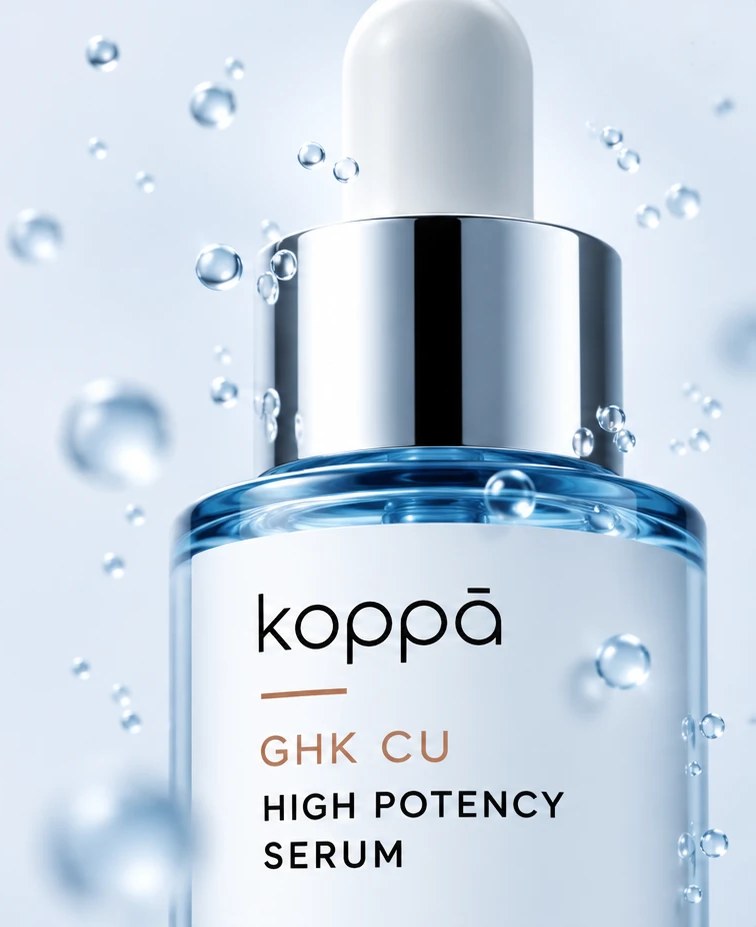
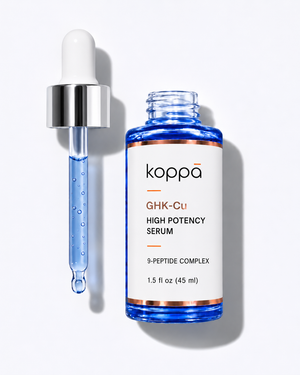
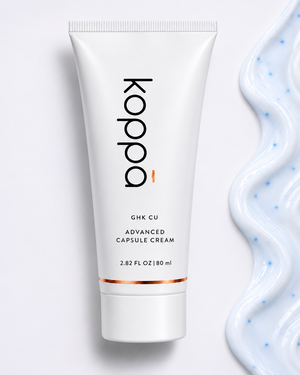
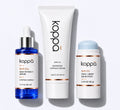
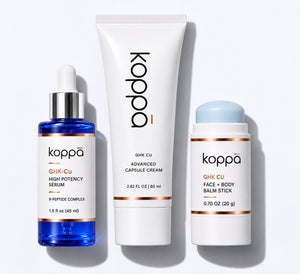
koppā, who publish this journal, make the koppā 2% GHK-Cu High-Concentration Copper Peptide Serum, a fragrance-free serum with 2% GHK-Cu on the label, used before moisturizer on face and neck.
Sources and further reading
- T Badenhorst et al. (2016). Effects of GHK-Cu on MMP and TIMP Expression, Collagen and Elastin Production, and Facial Wrinkle Parameters. Journal of Aging Science. walshmedicalmedia.com
- Loren Pickart et al. (2018). Regenerative and Protective Actions of the GHK-Cu Peptide in the Light of the New Gene Data. International Journal of Molecular Sciences. DOI: 10.3390/ijms19071987 mdpi.com
- a 2019 review in the International Journal of Molecular Sciences mdpi.com
- a 2008 study in Skin Research and Technology pubmed.ncbi.nlm.nih.gov
- Loren Pickart et al. (2015). GHK Peptide as a Natural Modulator of Multiple Cellular Pathways in Skin Regeneration. BioMed Research International. DOI: 10.1155/2015/648108 pubmed.ncbi.nlm.nih.gov
- Siméon and colleagues, Journal of Investigative Dermatology, 2000 pubmed.ncbi.nlm.nih.gov
- a 2019 review in Essays in Biochemistry pubmed.ncbi.nlm.nih.gov
- American Academy of Dermatology aad.org
- Hughes et al. (2013). Sunscreen and prevention of skin aging: a randomized trial. Annals of Internal Medicine. DOI: 10.7326/0003-4819-158-11-201306040-00002 pubmed.ncbi.nlm.nih.gov
- the American Academy of Dermatology advises aad.org