


Study references
The published studies behind koppā's product pages and product galleries, with the formulation, concentration and method of each.
Studies behind the figures in our product galleries
GHK-Cu and copper-peptide studies
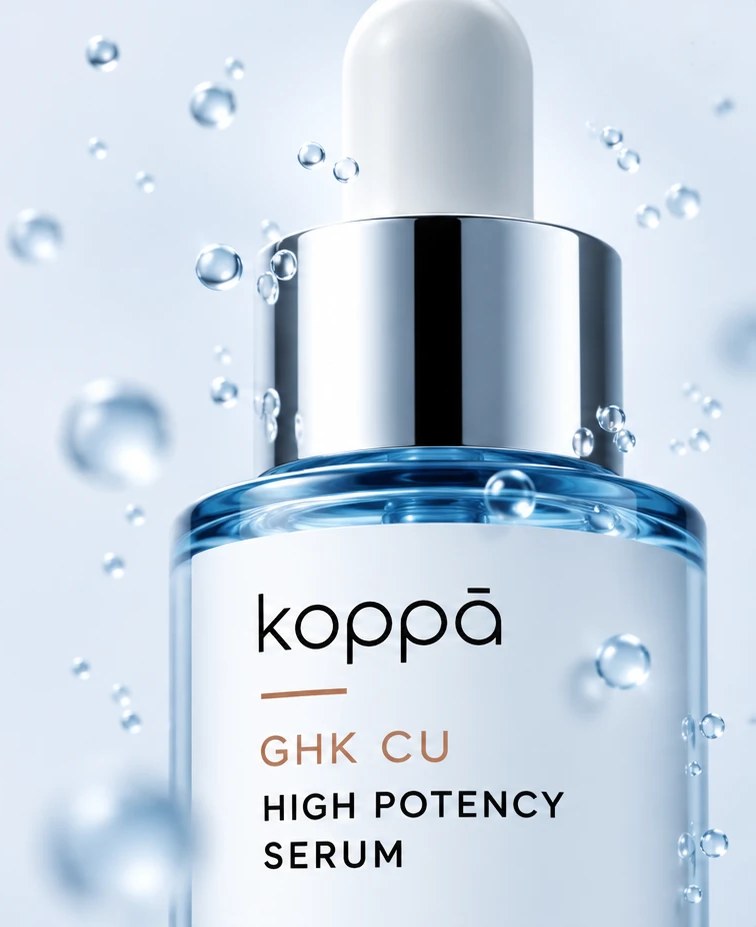
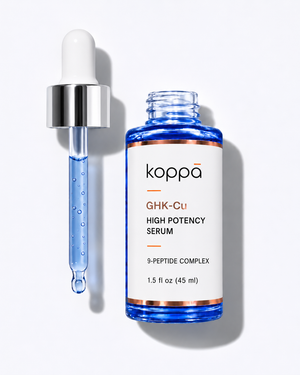
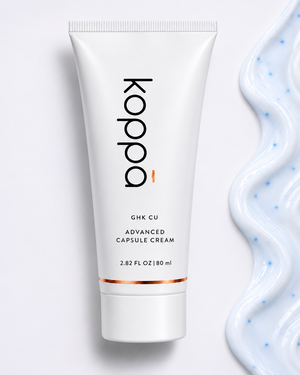
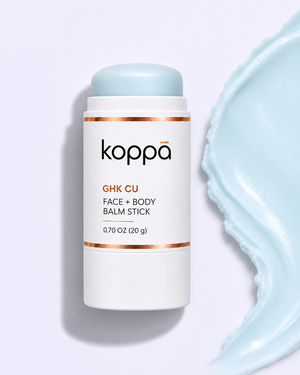
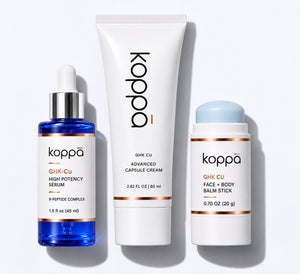
GHK-Cu serum study (Badenhorst, 2016). At eight weeks, average wrinkle-volume changes were −24.1% with GHK-Cu and its nano-carrier, versus −15.0% with the control. The relevant split-face comparison included 20 women aged 40 to 65. Figures on the image are rounded. Read the study.
Copper-peptide cream study (Abdulghani, 1998). Seven of the ten participants receiving the copper-peptide cream showed increased procollagen synthesis after one month, measured using thigh-skin biopsies. This is the proportion of participants showing an increase, not a 70% increase in collagen. Study record.
Niacinamide studies
4% niacinamide study (Kawada, 2008). In an eight-week split-face study with 30 women enrolled, 64% showed marked or moderate improvement in eye-area wrinkles. This is the share of participants with that assessment, not a 64% reduction in wrinkles. The tested cosmetic contained 4% niacinamide; koppā Capsule Cream contains 5%. Read the abstract.
5% niacinamide study (Bissett, 2004). A separate twelve-week study involving 50 women compared a 5% niacinamide formulation with its control. The authors reported improvements in fine lines, pigmentation and redness. Read the abstract.
Further studies cited on our product pages
GHK-Cu (Copper Tripeptide-1)
- Maquart FX et al., 1988. Stimulation of collagen synthesis in fibroblast cultures by the tripeptide-copper complex GHK-Cu. FEBS Letters. Cell study. PubMed
- Leyden JJ et al., 2002. GHK-Cu facial cream and skin density, thickness and firmness in 71 women over 12 weeks. Human study, presented at the American Academy of Dermatology.
- Pickart L, Margolina A, 2018. Regenerative and protective actions of the GHK-Cu peptide in the light of the new gene data. International Journal of Molecular Sciences. Review. PubMed
Expression-line peptides
- Blanes-Mira C et al., 2002. A synthetic hexapeptide (Argireline) with antiwrinkle activity. International Journal of Cosmetic Science. Record
- Wang Y et al., 2013. The anti-wrinkle efficacy of Argireline, a synthetic hexapeptide, in Chinese subjects: a randomized, placebo-controlled study of 60 people. American Journal of Clinical Dermatology. Record
- Nguyen TQ et al., 2021. A randomized, double-blind, placebo-controlled study of a peptide serum targeting expression lines, 12 weeks, 55 women. Journal of Clinical and Aesthetic Dermatology. Funded by Revision Skincare; peptides not individually named. PubMed
- Zhu M et al., 2026. A serum with Acetyl Hexapeptide-8, Dipeptide Diaminobutyroyl Benzylamide Diacetate and other actives: ex vivo and two clinical studies, 92 participants. L'Oréal researchers. International Journal of Cosmetic Science. Journal
Niacinamide
- Bissett DL et al., 2005. Niacinamide: a B vitamin that improves aging facial skin appearance. Dermatologic Surgery. The authors' summary of the 12-week, 50-woman study above. PubMed
Hydration and barrier
- Fluhr JW et al., 2008. Glycerol and the skin: holistic approach to its origin and functions. British Journal of Dermatology. Review. PubMed
- Nicander I et al., 2003. Betaine and skin hydration and irritation. Human study.
- Pavicic T et al., 2011. Efficacy of cream-based novel formulations of hyaluronic acid of different molecular weights in anti-wrinkle treatment, 76 women, 60 days. Journal of Drugs in Dermatology. PubMed
- Imokawa G et al., 1991. Ceramide levels and barrier function in skin. Journal of Investigative Dermatology.
- Spada F et al., 2018. Skin hydration is significantly increased by a cream formulated to mimic the skin's own natural moisturizing systems. Clinical, Cosmetic and Investigational Dermatology. Full text
- Ebner F et al., 2002. Topical use of dexpanthenol in skin disorders. American Journal of Clinical Dermatology. Review. PubMed